

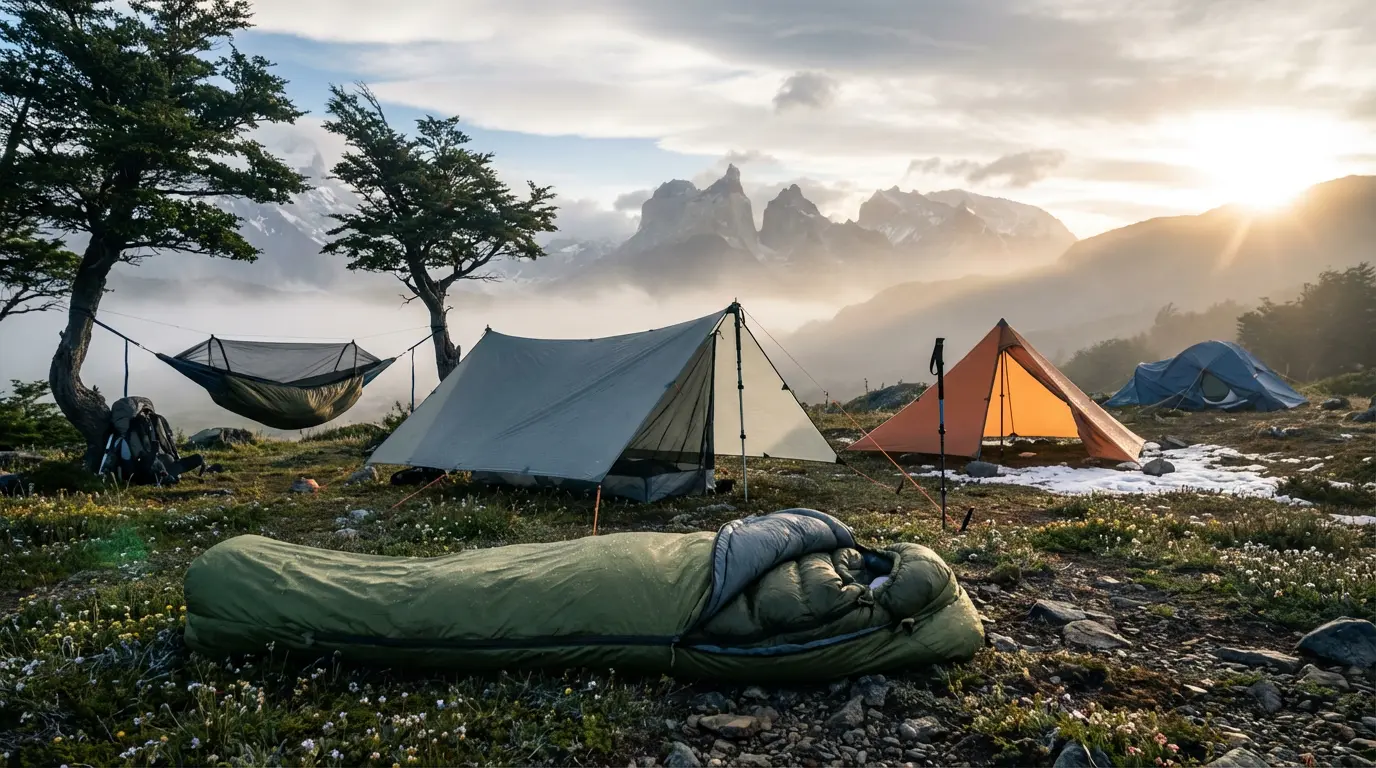
I’ve woken up in a puddle more times than I care to admit, and I can tell you it’s rarely the shelter’s fault—it’s usually user error. But a few years ago, deep in the wind-scoured backcountry of Patagonia, I watched my hiking partner sleep soundly in a glorified plastic bag while my “bombproof” four-season tent sounded like it was being attacked by a helicopter.
That “plastic bag” was a high-end bivy sack, and that night changed my perspective on what a shelter actually needs to be.
We get conditioned to think camping requires a freestanding nylon dome with mesh doors and a vestibule. But after 18 years of sleeping on the ground across six continents, I’ve learned that sometimes the best tent isn’t a tent at all. Let’s talk about the alternatives—tarps, bivies, and hammocks—and why you might want to ditch the poles on your next trip.
The Bivy Sack: For the Fast and Dirty
Let’s start with the most claustrophobic option: the bivy (bivouac) sack. Essentially, it’s a waterproof jacket for your sleeping bag.
I used to hate these things. My first experience with a bivy was a cheap surplus bag that trapped so much condensation I woke up wetter than if I’d slept in the rain. But modern fabrics have changed the game.
Why consider it?
If you are pushing big miles or climbing, a bivy is unbeatable. You don’t need a flat campsite. I’ve slept on narrow ledges in the Rockies where a tent footprint would hang off the edge. You unroll it, crawl in, and you’re done. No poles to snap, no stakes to hammer. It adds serious warmth to your sleep system, too—sometimes 5 to 10 degrees.
The trade-off:
Here’s what the marketing doesn’t tell you: waiting out a storm in a bivy is psychological torture. You can’t sit up. You can’t read a book easily. You are essentially a burrito. If you’re the type of camper who likes to hang out in the tent and play cards, run far away from this option.
The Tarp: The Skill-Based Palace
Tarps are my personal obsession. When I was designing gear, we spent months engineering complex pole geometries to withstand wind. A simple square of Silnylon, properly pitched, can often do the same job for a fraction of the weight.
A flat tarp is the ultimate minimalist tool. It’s just fabric and guy lines. You use your trekking poles or trees for support.
The Freedom of Airflow
The biggest advantage isn’t just the weight savings (though carrying a 10-ounce shelter is incredible); it’s the connection to the outdoors. In a tent, you’re in a nylon room. Under a tarp, you feel the breeze and see the sunrise without unzipping a door. Ventilation is unbeatable—condensation is rarely an issue because the airflow is constant.
The Learning Curve
However, don’t buy a tarp and head straight for a rainy weekend in the Olympics. I learned this the hard way. A sloppy pitch in a thunderstorm means you get wet spray from the sides, or worse, the whole thing collapses. You need to know your knots (bowline and trucker’s hitch are mandatory) and understand wind direction. It requires practice, but once you master it, you feel like a wizard.
Hammocks: The Comfort King (With Caveats)
I have friends who swear they will never sleep on the ground again. And honestly, after a week of sleeping on roots and rocks, their swinging cocoons look pretty inviting.
Hammock camping explodes the concept of “campsite selection.” You don’t need flat ground; you just need two trees. Rocky slopes, muddy swamps, dense underbrush—it doesn’t matter.
The “Cold Butt” Syndrome
Here is the thing new hammock campers always miss: convection. Air circulates underneath you, stealing heat from your backside faster than you can imagine. Even in 60-degree weather, you will freeze without under-insulation.
You can’t just use a sleeping bag, because you compress the insulation when you lie on it. You need an underquilt (a blanket that hangs under the hammock) or a sleeping pad. Suddenly, that “simple” hammock setup involves a suspension system, a bug net, a rain tarp, and an underquilt. It can get heavy and expensive fast.
But for comfort? If you have a bad back, this is the answer.
Floorless Pyramids: The Middle Ground
If you aren’t ready to give up walls but want to shed weight, look at floorless pyramid shelters (often called “mids”).
These are basically rain flies that pitch with a single trekking pole in the center. I use these for winter camping constantly. Without a floor, you can dig out a “cold well” in the snow or walk in with your boots on without worrying about tearing a delicate tent floor.
They shed wind incredibly well because of the steep walls. The downside is creepy-crawlies. If the idea of a spider walking across your sleeping bag keeps you up at night, stick to a fully enclosed tent or get a mesh inner insert (which, ironically, brings the weight back up to that of a normal tent).
So, Should You Ditch the Tent?
Look, traditional double-wall tents are popular for a reason. They are foolproof. You can set them up half-asleep, they keep bugs out, and they offer a clean, dry floor.
But they isolate you.
Switching to an alternative shelter forces you to engage with the environment. You have to read the wind, look at the slope of the ground for drainage, and pick your site with intention.
My advice? Start with a cheap blue hardware store tarp. Set it up in your backyard or a local park. Try an A-frame pitch, a lean-to pitch. See how it feels to sleep with the breeze on your face. You might hate it. Or, like me, you might realize that for 15 years, you’ve been carrying three pounds of poles and zippers you didn’t actually need.
Just, please, don’t try a bivy sack for the first time if you have claustrophobia. Trust me on that one.