

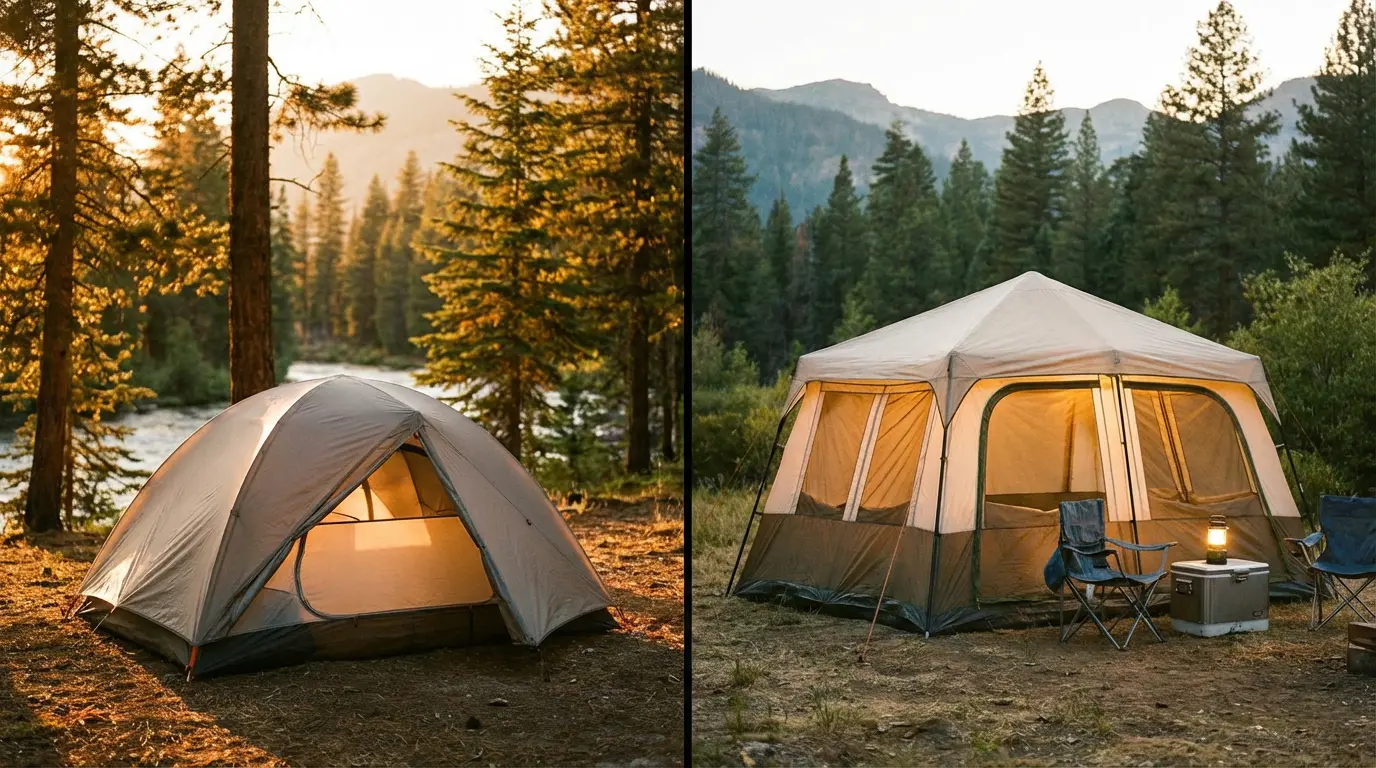
Picture two campers at the same campground. One is crouched inside a tight dome tent, wrestling a sleeping bag into the corner like he’s stuffing laundry into a hamper. Fifteen feet away, the other is standing upright inside a cabin tent, changing clothes with room to spare, kids playing cards at a small folding table. Neither is doing anything wrong. They just made different decisions before they got there.
Dome versus cabin. It’s one of the most common debates in family and recreational camping and surprisingly, most people choose wrong the first time. Not because the gear is bad, but because they bought for the tent they imagined camping would be, instead of the camping they actually do.
I’ve slept in both styles across six continents. I’ve designed tent structures professionally. And I can tell you with complete confidence: neither tent “wins.” The right answer lives entirely in your circumstances. Let me break down the differences so you can make the call before you’re standing in a parking lot at 10 PM, wondering why your shelter doesn’t fit your trip.
The Shape Changes Everything
The most fundamental difference isn’t price or brand it’s geometry.
A dome tent uses two or more flexible poles that cross over the center, creating that classic hemispherical arch. The curved walls slope inward as they rise, which means the maximum headroom sits dead-center, and it drops off sharply toward the edges. Most dome tents will let you crouch or sit upright in the middle but standing fully upright is rare unless you’re buying a large extended-dome model.
A cabin tent flips this logic entirely. Cabin tents use multiple vertical poles to create straight walls, much like a small room. The ceiling stretches flat across the top, and the walls don’t start curving until they meet the roof. That geometry gives you usable standing space across nearly the entire floor not just the center.
This single structural difference cascades into almost every other performance characteristic you care about: wind resistance, livable space, setup complexity, and pack weight.
Weather Resistance: Dome Wins, No Contest
Here’s what the marketing doesn’t tell you about cabin tents with their beautiful large windows and room dividers: those vertical walls act like a sail in a windstorm.
Dome tents shed wind beautifully. The curved surface lets air flow smoothly around and over the structure, dispersing force rather than collecting it. Rain runs straight off the sloped walls onto the ground. Snow loads distribute evenly across the arch, preventing dangerous accumulation in any single spot.
Cabin tents, by contrast, present flat walls directly to the wind. In a strong gust, the fabric strains against the poles and the stakes. I’ve seen cabin tents visibly flex and ripple in weather that a dome tent would handle without drama. The flatter roofs of many cabin tents also allow rainwater to pool and sag rather than shed cleanly a problem you absolutely don’t want at 2 AM.
If you’re camping in exposed locations, mountainous terrain, or anywhere with unpredictable weather, a dome tent is the safer structural choice every single time.
Space and Livability: Cabin Tent is in a Different League
That said, if you’ve ever tried to change clothes in a dome tent, you know the humbling experience of elbowing your tent wall repeatedly while hopping on one foot.
Cabin tents are a fundamentally different living experience. Standing room across the entire floor changes how you interact with your shelter. You can set up a small camping table, hang a lantern from a central hook, organize gear in corners, and move around without performing yoga. For families with kids, the difference between a dome tent and a cabin tent is essentially the difference between a studio apartment and a house.
Many cabin tents also include room dividers removable fabric partitions that split the interior into separate sleeping zones. For a family with young kids who go to bed at 8 PM while the adults want to stay up, this feature alone is worth serious consideration.
Dome tents do offer vestibules small covered extensions at the entrance that provide excellent gear storage. This partially compensates for the tighter interior, but it doesn’t solve the headroom problem.
Setup: A Clear Edge for Dome Tents
After a long drive or a hard day of hiking, the last thing you want is a complicated setup process.
Dome tents are typically faster and simpler to pitch. Two or three flexible poles, a few clips or sleeves, and the structure essentially pops into shape. Many experienced campers can solo-pitch a dome tent in under five minutes. The freestanding design means the tent holds its shape without stakes, so you can orient it before committing.
Cabin tents require significantly more pole work. More poles mean more assembly steps, more potential for confusion with unfamiliar gear, and more physical effort. Pitching a large cabin tent solo is genuinely awkward they’re designed for two people working together. For group or family camping where you have extra hands, this isn’t a dealbreaker. But if you’re frequently setting up and breaking down camp alone, the additional complexity gets old fast.
Portability and Who Each Tent Is Really For
This is the simplest filter: How far are you carrying your shelter?
If the answer is “from the car to the campsite,” a cabin tent is a completely reasonable choice. The extra weight and packed size don’t matter when the trunk is 30 feet away.
If you’re carrying your shelter on your back even for moderate distances dome tents dominate. They’re lighter, pack smaller, and their simple pole systems are less prone to breakage on the trail. When thinking about your complete camp sleep system, a dome tent pairs naturally with a lightweight sleeping pad and bag in a way that a cabin tent simply cannot.
For backpacking trips, dome tents aren’t just the better option they’re often the only practical option. If you’re also considering alternatives like tarps or bivy sacks, dome tents sit comfortably in the middle ground between ultralight systems and full shelter comfort.
Side-by-Side Breakdown
Choosing Based on Your Trip Type
Choose a dome tent if you:
- Backpack or hike to your campsite
- Camp in exposed, windy, or wet conditions
- Camp solo or with one partner
- Want faster setup and simpler logistics
- Prioritize durability and weather protection over living space
Choose a cabin tent if you:
- Car camp exclusively
- Camp with family, including young children
- Want standing room and interior comfort
- Plan multi-night stays where living space matters
- Need room dividers for privacy between sleeping areas
Whatever shelter you choose, remember that a good camping layering system ensures you stay warm inside it, and solid camping lighting and power gear keeps your shelter functional after dark. The tent just needs to keep the weather out everything else is about the system around it.
The best tent isn’t the one with the highest rating or the biggest price tag. It’s the one that fits your trip so perfectly, you stop thinking about it and start thinking about the view outside the door instead.