

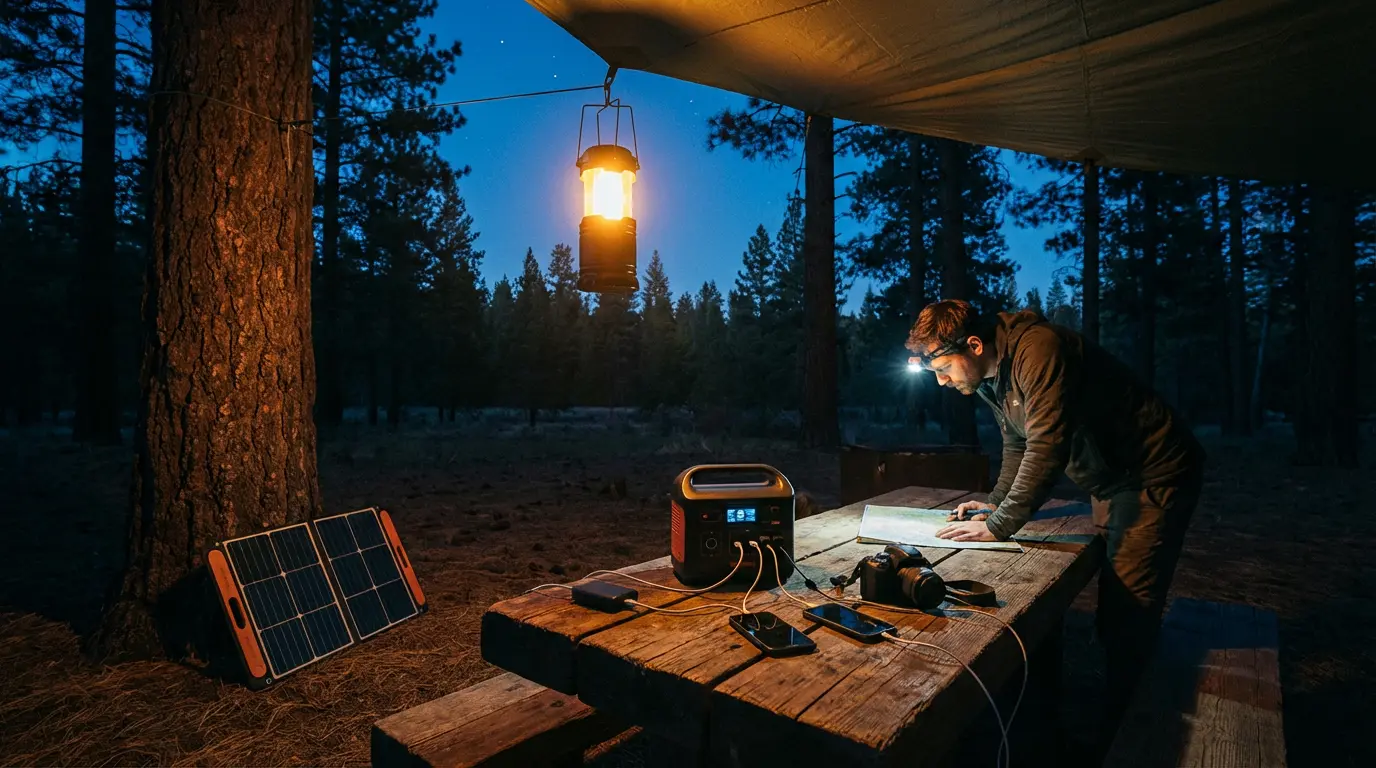
Nine years into my rangering career, I worked a night rescue in the Tetons with a volunteer who showed up carrying a gas-station flashlight and a phone at 14% battery. He became the second problem of the evening.
Darkness doesn’t announce itself politely. It arrives the moment the sun drops behind a ridge, and suddenly every task you were doing comfortably five minutes ago reading a map, filtering water, treating a blister requires light. Out here, light isn’t ambience. It’s safety infrastructure.
What’s changed dramatically in the last decade is power. It used to be simple: bring batteries, bring spares, go home when they died. Today’s camper is managing a small electronics ecosystem headlamps, GPS units, satellite communicators, phone cameras, and sometimes laptops all of which need energy in places that don’t have wall sockets. That ecosystem needs a strategy, not just a bag of AA batteries.
This guide covers everything from lumens and beam angles to watt-hours and solar panel efficiency practically, honestly, and without the marketing hype.
Headlamps: Your Non-Negotiable Primary Light
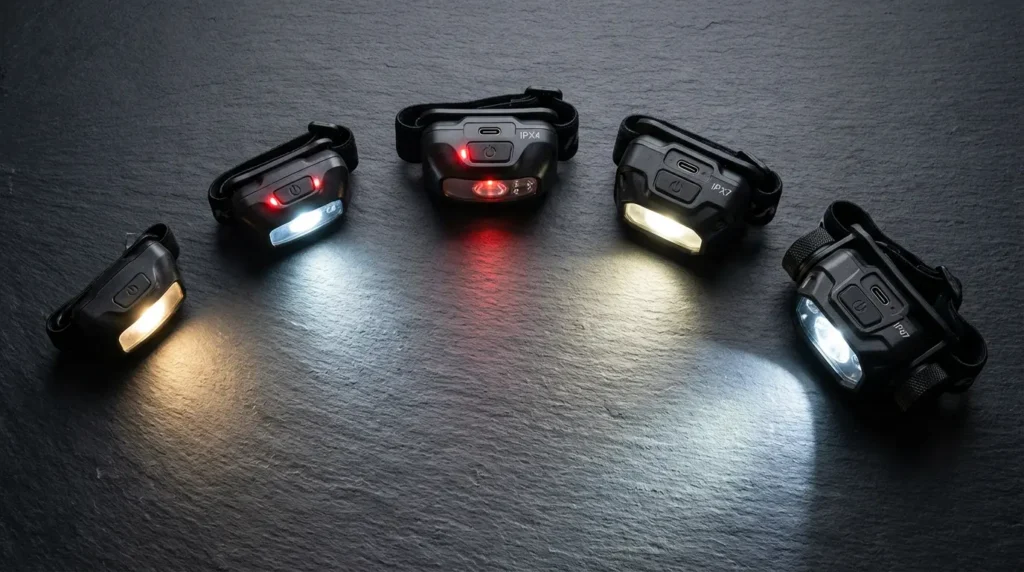
Skip the gimmicks. If you buy only one lighting item for any camping trip, it must be a headlamp. Not a flashlight. Not a lantern. A headlamp.
Hands-free lighting is the difference between performing a task and struggling through it. Setting up camp, cooking dinner, treating an injury, reading a map in the rain every one of these activities requires both hands, and a headlamp provides the light without requiring one of them to hold anything.
Lumens: How Much is Actually Enough?
The lumen wars in headlamp marketing have produced some genuinely absurd products. I once tested a headlamp rated at 1,200 lumens that ran at full power for roughly 90 minutes before dying. For most camping activities, you need far less than manufacturers push.
Here’s the honest breakdown:
- 30–80 lumens: Reading in a tent, camp chores, close-range tasks completely sufficient
- 150–300 lumens: Trail navigation, setting up camp in the dark, general campsite movement the real working range
- 300–600 lumens: Technical scrambling, search tasks, long-distance trail identification genuinely useful
- 600+ lumens: Specific professional or technical applications; battery drain at this level is significant
The Petzl ACTIK CORE at 600 lumens and the Black Diamond Spot 400 represent the sweet spot for serious recreational use enough power for real darkness without burning through battery capacity in a single night. For most campers, 300 to 400 lumens covers every realistic scenario.
Red Light Mode: Non-Negotiable
I won’t buy a headlamp without a dedicated red light mode, and I mean that completely. White light destroys your night vision in seconds. It takes up to 30 minutes for your eyes to fully readapt to darkness after white light exposure. Red light preserves your night vision, doesn’t blind your campmates, and is significantly less visible from a distance which matters in bear country where you don’t want to announce your position.
Rechargeable vs. Replaceable Batteries
This debate has largely been settled by lithium-ion technology, but context still matters.
Rechargeable headlamps (USB-C charging) are the right choice for most campers. Lower long-term cost, consistent output until the battery depletes, and no scrambling for spare batteries mid-trip. The Petzl ACTIK CORE runs dual-source it accepts both its rechargeable battery and standard AAA batteries which is the smartest design on the market for extended trips.
Alkaline batteries have one real advantage remaining: they’re available at every gas station on the planet. For international travel or expeditions into remote regions where charging isn’t possible for weeks, alkaline backup capability is genuine insurance. Just know that alkaline batteries lose significant capacity in cold temperatures they can read full and deliver almost nothing below freezing.
The practical answer: own a rechargeable headlamp with alkaline backup capability. Charge it before every trip. Carry a spare set of alkalines for trips exceeding three nights.
IP Ratings: What Waterproof Actually Means
IPX4 means splash-resistant. IPX7 means submersible to one meter for 30 minutes. The difference between these two ratings is the difference between surviving a rain storm and surviving a river crossing. For serious outdoor use in unpredictable conditions, IPX6 or IPX7 is the minimum worth considering.
Lanterns: Ambient Light Done Right
Lanterns serve a fundamentally different function than headlamps. They’re not task lights they’re environmental lights, filling a space rather than directing a beam.
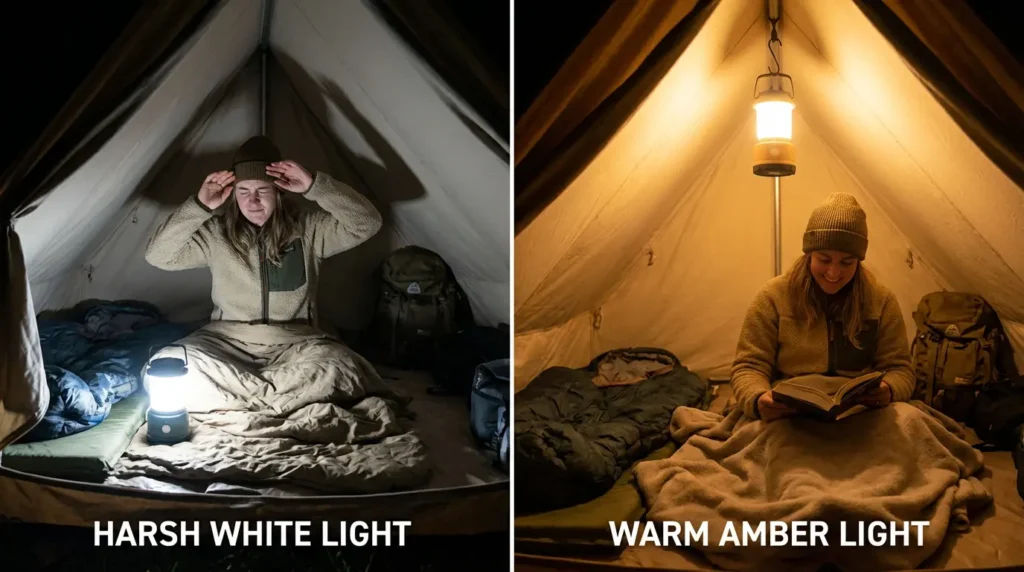
The most common mistake I see at campgrounds: someone buys the brightest lantern available, cranks it to maximum on the picnic table, and turns the entire campsite into an interrogation room. Your campmates will hate you. Nearby wildlife will avoid the area entirely. And ironically, the harsh glare actually makes it harder to see peripheral details around camp.
The goal is diffused, warm light. Not maximum output.
LED Lanterns: The Modern Standard
Modern LED lanterns have completely replaced propane and fuel-burning models for most applications. They’re safer (no carbon monoxide risk in enclosed spaces), more efficient, and infinitely dimmable.
The BioLite AlpenGlow 500 produces 500 lumens with a beautifully diffused output through its translucent globe the warm amber glow setting genuinely creates a different atmosphere than stark white LED. The Goal Zero Lighthouse 600 at the same price point outputs 600 lumens with a split-bulb design allowing half or full illumination. Both are rechargeable via USB-C and pack small enough for backpacking.
For car camping, the UST 60-Day DURO hits 1,200 lumens on 4 D-cell batteries and genuinely lasts 60 days on its lowest setting the kind of battery life that makes it a legitimate emergency preparedness item, not just a camping toy.
Hanging vs. Freestanding
Lighting from above eliminates the harsh shadows that tabletop lanterns create. Look for lanterns with integrated hooks or magnetic bases that allow overhead hanging inside a tent or from a tarp ridgeline. A lantern hung from a tent ceiling at two feet above your head lights the entire interior evenly. The same lantern on the tent floor creates an unflattering, cave-like atmosphere with deep shadows in every corner.
The translucent Nalgene trick still works: strap a headlamp around a water-filled bottle with the light facing inward, hang it from a loop. Free, effective, and surprisingly pleasant ambient light practical ingenuity that no amount of gear spending replaces.
Solar Lanterns: Backup, Not Primary
The Goal Zero Crush Light and LuminAid series are genuine ultralight options they weigh almost nothing and pack completely flat. But manage expectations clearly: solar charging on a backpacking lantern with a postage-stamp-sized panel requires direct, unobstructed sunlight for 6 to 8 hours to deliver a meaningful charge. In a forest canopy, under cloud cover, or during a multi-day storm, they’re essentially decorative.
Use solar lanterns as backup or supplemental lighting. Build your primary system around rechargeable LED units.
Power Banks: The Off-Grid Fuel Tank
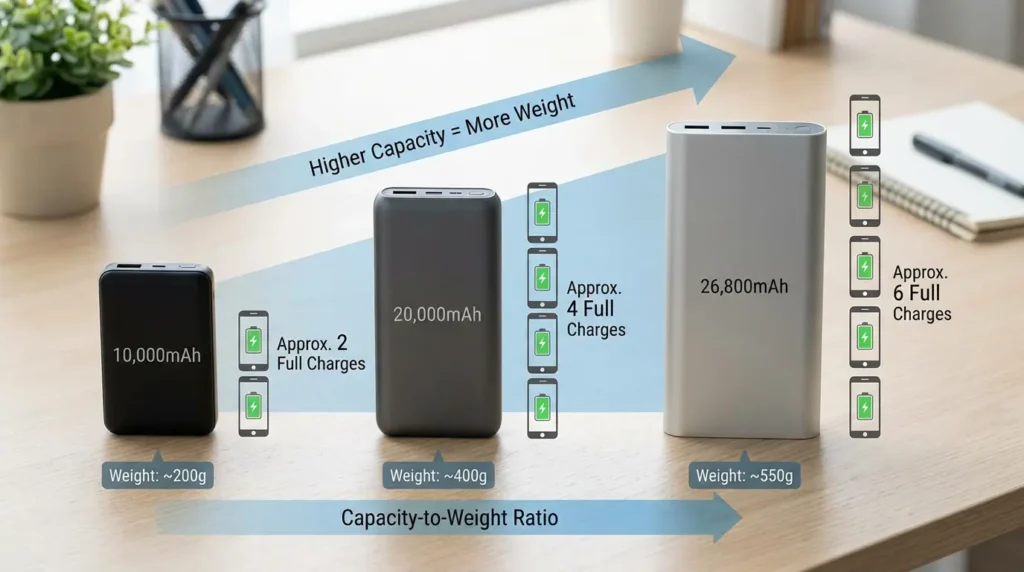
Ten years ago, running out of power meant your headlamp died. Today it means your GPS, satellite communicator, phone camera, and emergency contact device all die simultaneously. Power management is now a safety system, not a convenience feature.
Capacity: Reading mAh Correctly
Milliamp-hours (mAh) measure stored charge. The math is straightforward:
A typical smartphone carries a 3,000 to 5,000mAh battery. A 10,000mAh power bank charges it roughly 2 times fully (accounting for conversion losses of approximately 15 to 20%). A 20,000mAh bank delivers 4 to 5 full charges.
For a three-night trip running GPS navigation, photography, and an emergency communicator, a 20,000mAh bank is the minimum I’d carry. Budget roughly 5,000mAh per device per day in active use, less in standby mode.
Cold Weather: The Silent Killer of Battery Performance
Lithium-ion batteries lose 20 to 40 percent of their rated capacity at temperatures below 32°F. A bank that reliably charges your phone twice at room temperature may deliver a single partial charge in near-freezing conditions. The fix is simple and free: sleep with your power bank inside your sleeping bag, and keep it in an inner jacket pocket during the day. Body heat maintains operational temperature and preserves full capacity.
Cable Quality Matters More Than People Realize
The fastest, most capable power bank in the world throttles down to trickle-charge speeds through a cheap, thin cable. USB-C to USB-C cables with appropriate wattage ratings (look for 60W or 100W rated cables for fast charging) make a real-world difference in how quickly your devices recover. Buy quality cables, protect them, and replace them when the insulation shows wear.
Portable Power Stations: The Car Camping Game Changer
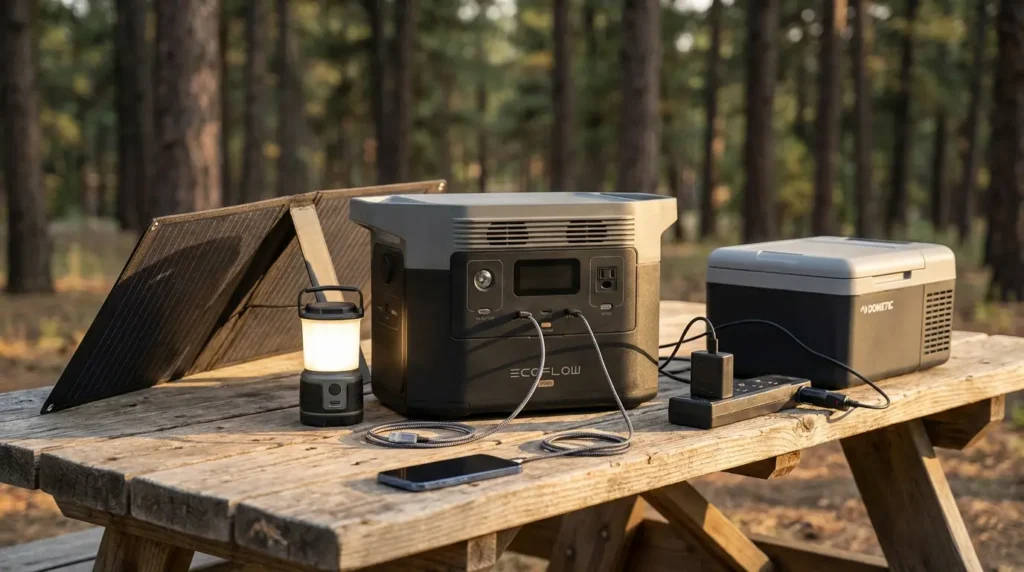
Portable power stations are large-capacity lithium battery packs with integrated inverters essentially, a wall outlet that you carry to your campsite.
These are car camping tools. Don’t confuse them with lightweight backpacking power banks. A quality 500 to 1,000Wh power station weighs 12 to 25 pounds. The trunk carries that weight. You benefit from it.
Understanding Watt-Hours
Watt-hours (Wh) not mAh is the relevant metric for power stations. The formula is simple:
Runtime (hours) = Capacity (Wh) ÷ Device Power Draw (W) × efficiency factor (~0.85)
A 500Wh station running a 50W camping fridge delivers roughly 8.5 hours of runtime. Running a 10W LED lighting system, the same station lasts 40-plus hours. Know your devices’ wattage before buying a station and do this math it prevents expensive disappointments.
Standout Models Worth Knowing
The Jackery Explorer 1000 Plus is consistently the most practical all-round option for weekend car camping compact enough to carry one-handed, enough capacity (1,002Wh) for a full weekend of lighting, phone charging, camera batteries, and a small electric cooler. The EcoFlow DELTA 2 charges faster than almost anything in its class (0 to 80% in 50 minutes via AC) transformative if you’re moving between campsites and need rapid replenishment. The Anker Solix C800 Plus distinguishes itself with a genuinely useful built-in collapsible LED camp lantern integrated directly into the unit lighting and power in one package.
For serious extended use or overlanding, the Bluetti AC200P at 2,000Wh provides enough capacity to run a 12V refrigerator for three days continuously.
Solar Panels: Setting Realistic Expectations
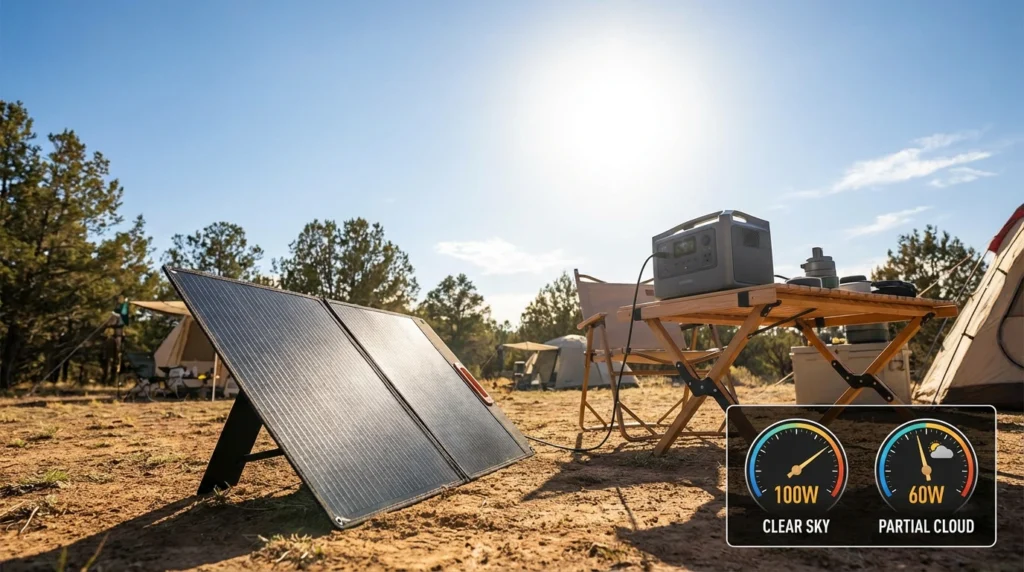
This is the area where marketing and reality diverge most dramatically, and I want to be direct about it.
A quality 100W foldable solar panel (like the Jackery SolarSaga 100 or Renogy 100W) under ideal conditions direct perpendicular sunlight, clear sky, 77°F ambient temperature produces approximately 100W. In realistic camping conditions angled sun, partial cloud cover, afternoon haze expect 50 to 70W actual output.
To meaningfully recharge a 500Wh power station from 20% to 80% under realistic conditions requires approximately 6 to 10 hours of good sun exposure. In the Pacific Northwest during spring, that may never happen on a three-day trip. In the Utah desert in July, it happens before noon.
Solar makes sense when:
- You’re base camping in open, sunny terrain for multiple days
- You need to extend a power station’s usefulness beyond its single-charge capacity
- You’re overlanding or traveling to remote locations where resupply isn’t possible
Solar doesn’t make sense when:
- You’re backpacking through dense forest or cloudy mountain terrain
- Your trip is three nights or fewer with a properly sized power bank
- You’re adding weight in exchange for charging capacity you won’t use
Those tiny solar panels sewn into backpacks or built into small power banks produce 1 to 5W in ideal conditions. At that output, they’ll charge a headlamp battery over a full sunny day. They won’t charge a phone. Manage expectations accordingly.
Building Your Complete Lighting and Power System
Here’s what actually works, built in layers exactly the way I teach in wilderness skills courses:
Layer 1 — Primary Task Light
One quality rechargeable headlamp, IPX6 or better, 300 to 600 lumens, with red light mode. This is your most critical and most personal item.
Layer 2 — Ambient Camp Light
One rechargeable LED lantern with warm white output, dimmable, hanging-capable. This transforms your campsite from a dark field into a functional living space.
Layer 3 — Emergency Backup
A coin-cell emergency light (like the Princeton Tec Byte or Petzl e+LITE) lives permanently in your first aid kit or emergency pouch. It weighs under an ounce and has saved more than one backcountry situation I’ve witnessed personally.
Layer 4 — Power Infrastructure
Scale to your trip: 10,000 to 20,000mAh power bank for backpacking; 500 to 1,000Wh portable station for car camping. Add a quality 100W solar panel for base camp trips exceeding three nights in sunny environments.
This layered approach mirrors how I think about every gear system the same logic that applies to your camping layering system for clothing or your complete camp sleep system for shelter. Redundancy where it matters, weight reduction where it doesn’t.
Whatever power system you run, remember it serves every other system in your kit. Your camp kitchen essentials may include an electric kettle or induction plate. Your backpack carrying system needs to accommodate the weight of your power infrastructure. Your tent and shelter choice determines whether you need internal lighting from a lantern or whether ambient outdoor light suffices. Think in systems, not individual items.
The light that fails at the worst moment is the one you didn’t take seriously at the gear planning stage. Don’t let that be yours.