
Somewhere around mile 23 of a five-day Sierra traverse three years ago, I watched a hiking partner strip off a heavy synthetic puffy, stuff it unsuccessfully into an already overpacked bag, and eventually tie it to the outside of his pack in frustrated defeat. His jacket weighed 22 ounces. Mine weighed 8.4.
We were both warm at camp. The difference was that my jacket disappeared into a fist-sized stuff sack and took up no mental or physical real estate whatsoever. That invisible quality, the ability to have genuine warmth on demand without paying for it in pack space or shoulder fatigue, is what makes the best ultralight down jackets worth understanding deeply.
This guide covers how ultralight down insulation actually works, what separates real performance from marketing language, and which jackets are worth carrying in 2026.
How Fill Power Actually Works (And Why It Matters)
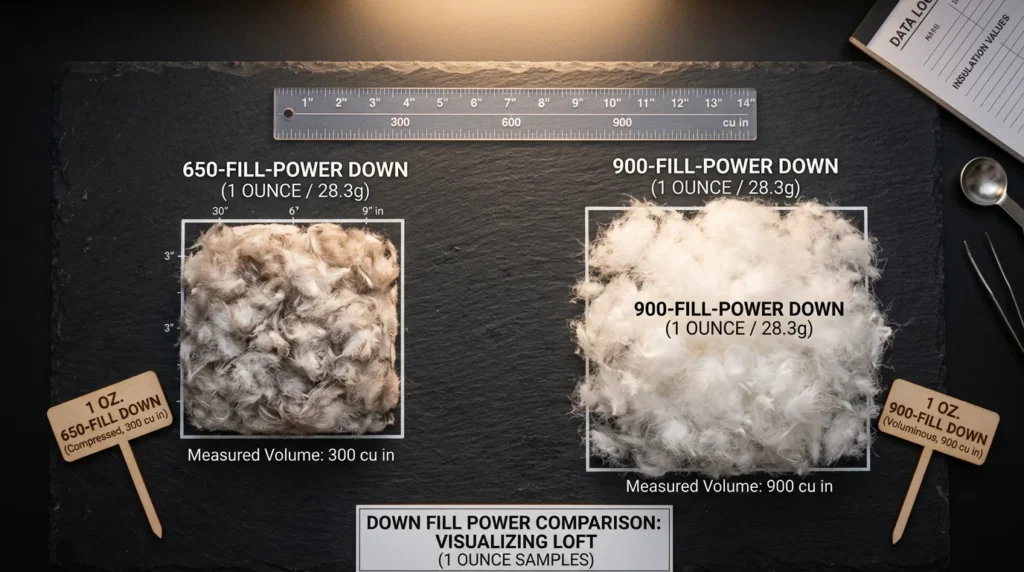
Fill power is the most misunderstood specification in down jacket marketing, and getting it right changes every buying decision you make.
Fill power measures the loft of down, specifically how many cubic inches one ounce of down occupies when allowed to expand freely. An 800-fill-power down cluster expands to fill 800 cubic inches per ounce. A 600-fill-power cluster fills only 600 cubic inches per ounce. Higher fill power means more air trapped per ounce of down, and trapped air is what insulation actually is.
The practical implication is straightforward: higher fill power down delivers the same warmth with less material weight. An 850-fill-power jacket rated to 20°F will weigh significantly less than a 650-fill-power jacket with an identical temperature rating, because less down is needed to achieve the same loft. For backpackers obsessing over base weight, this is not a marginal difference.
Fill power above 900 exists (some brands market 1000-fill Kakapo down) but faces diminishing returns in real-world performance. The fragile structure of ultra-high fill power down clusters degrades faster under compression and washing cycles. The 800 to 900 fill power range represents the practical sweet spot for the best ultralight down jackets: meaningful weight savings with durability that holds across a realistic jacket lifespan.
Fill weight, separate from fill power, is the total ounces of down inside the jacket. A jacket can use 850-fill-power down but contain very little of it, producing a lightweight but cold result. Both numbers together tell the complete insulation story: high fill power plus adequate fill weight produces the best ultralight down jacket performance.
Hydrophobic Down: No Longer Optional
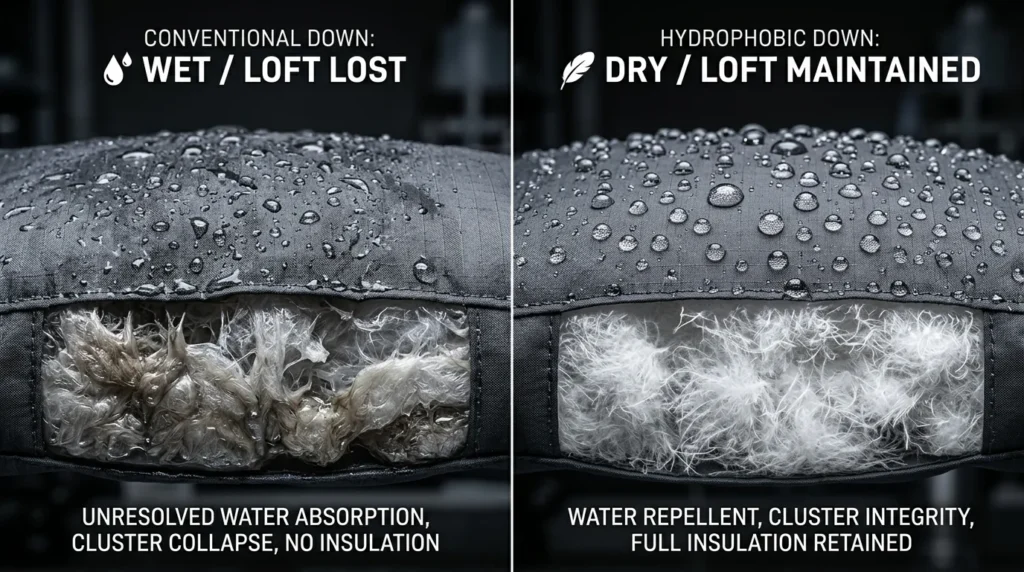
The conventional weakness of down insulation, its collapse when wet, has been substantially addressed by hydrophobic down treatments. This development has changed the calculus on down versus synthetic for three-season backpacking significantly.
Standard down absorbs moisture into its fiber structure, and wet down clusters collapse, losing loft and therefore losing virtually all insulating value. In a wet environment, a traditional down jacket can go from warm to dangerously ineffective in minutes.
Hydrophobic down treats each fiber with a DWR-style polymer coating before the jacket is assembled. The coated fibers resist moisture absorption, allowing the down to maintain 70 to 90% of its dry loft even after sustained exposure to humidity, light rain, or pack sweat. Major implementations include PFC-free treatments from brands like Nikwax Hydrophobic Down and Allied Feather’s HyperDRY, both of which maintain performance through multiple washing cycles without retreatment.
For the best ultralight down jackets used in three-season backpacking, hydrophobic down is now the baseline expectation. Any premium ultralight down jacket without hydrophobic treatment is an outdated design regardless of its fill power rating.
Hydrophobic down significantly closes the gap between down and synthetic in wet conditions. It doesn’t fully close it. In sustained heavy rain or full submersion, a synthetic insulation jacket still outperforms hydrophobic down. For genuinely wet environments like the Pacific Northwest or Southeast Alaska, a synthetic mid-layer remains the safer choice. For the vast majority of backpacking environments and conditions, hydrophobic down is the right call.
Baffle Construction: Where Warmth Actually Escapes
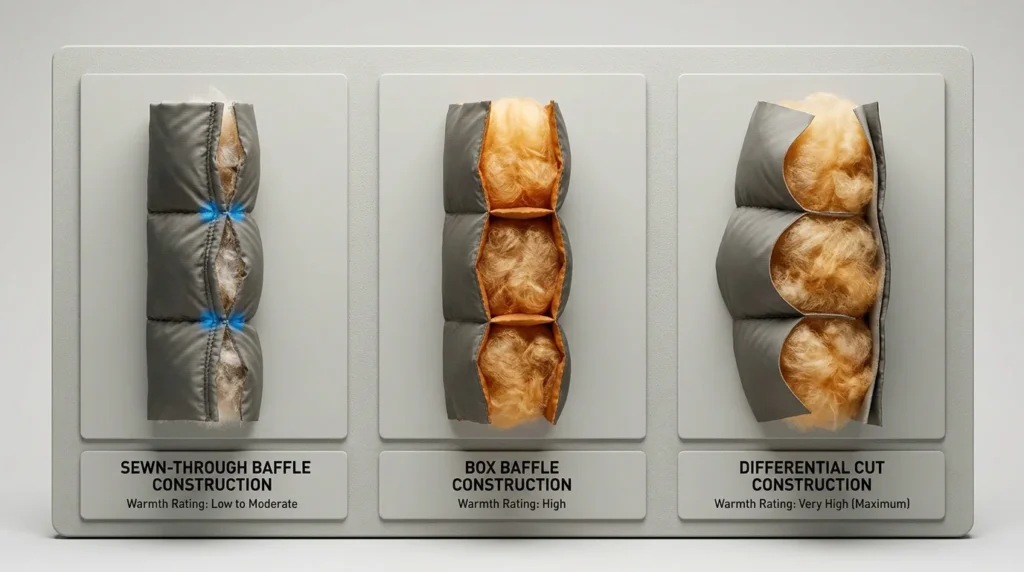
Baffles are the quilted channels that contain down clusters inside a jacket. Their design determines where cold air infiltrates and how evenly warmth is distributed. For the best ultralight down jackets, baffle design is as important as fill power.
Sewn-through baffles stitch directly through both the outer shell and lining fabric to create channels. This is the lightest construction method and works well for lightweight jackets in mild conditions. The limitation is cold spots at every stitch line where the two fabric layers are compressed together with no insulation between them. On a 40°F shoulder-season evening, sewn-through cold spots are imperceptible. At 15°F with wind, they become heat loss pathways.
Box baffles use a separate fabric wall between outer and inner layers, creating three-dimensional chambers that allow down to expand fully in all directions. No cold spots at stitch lines. Box baffle construction is warmer per ounce of down than sewn-through but adds fabric weight and manufacturing complexity. Found primarily in the highest-performance expedition and sleeping bag designs rather than ultralight packable jackets.
Differential cut construction addresses the compression problem differently, cutting the outer shell larger than the inner lining so the down chambers bow outward under loft rather than being compressed when the wearer moves. This improves warmth consistency without the full weight penalty of box baffles.
For the best ultralight down jackets in the 6 to 10 ounce category, sewn-through construction is standard and appropriate. For expedition-weight ultralight down jackets targeting sub-zero performance, differential cut or box baffles justify their added weight.
The Best Ultralight Down Jackets Tested in 2026
Montbell Plasma 1000 Down Jacket, 3.2 oz, $270
Nothing else in production competes with the Montbell Plasma 1000 on pure warmth-to-weight ratio. At 3.2 ounces for a men’s medium, using Montbell’s proprietary 1000-fill-power down in an ultralight 7-denier ripstop nylon shell, it represents the absolute ceiling of ultralight down jacket engineering currently available.
The trade-offs are real and worth knowing. The 7-denier shell fabric is so thin it feels almost weightless in your hand and tears on rough contact with pack buckles or thorny brush. It’s a jacket designed to live inside a pack until needed, not to be worn while scrambling through vegetation. The warmth for its weight is genuinely extraordinary, performing comparably to jackets twice its weight in calm, dry conditions.
For fastpackers, ultralight thru-hikers, and anyone whose primary concern is grams per degree of warmth, the Montbell Plasma 1000 is the benchmark for best ultralight down jacket performance.
Arc’teryx Cerium SL Hoody, 8.1 oz, $350
Arc’teryx’s Cerium SL occupies the sweet spot between ultralight performance and practical durability. The 850-fill-power Coreloft Compact Hydrophobic Down provides genuine cold-weather warmth, the 10-denier Arato shell offers meaningfully better abrasion resistance than Montbell’s 7-denier alternative, and the mapped construction places synthetic insulation at the shoulders and underarms where moisture from pack straps and movement is greatest.
That mapped construction detail is what separates the Cerium SL from competing designs at similar weight. Down at the shoulder areas under a loaded pack absorbs sweat and loses loft progressively over a multi-day trip. Synthetic panels at these contact zones maintain consistent warmth regardless of moisture exposure while adding negligible weight. At 8.1 ounces, it’s not the lightest option, but it is the most intelligently engineered best ultralight down jacket for practical multi-day backpacking use.
Patagonia Down Sweater Hoody, 12.7 oz, $299
The Patagonia Down Sweater Hoody is the practical workhorse of the ultralight down jacket category, and its continued dominance in actual field use reflects real performance advantages rather than brand hype.
800-fill-power recycled down (Traceable Down certified) in a 20-denier recycled nylon shell. More durable than either of the previous options. Heavier at 12.7 ounces, which disqualifies it from strict ultralight category by most definitions (ultralight typically means under 10 oz for a jacket). But the durability difference at this shell weight is substantial: this jacket handles pack abrasion, camp chores, and repeated stuffing with a resilience the lighter alternatives can’t match.
For backpackers who want the best ultralight down jacket that will also function as a daily driver rather than a fragile backup layer, the Down Sweater Hoody is the recommendation. At $299, it also represents better value per ounce of warmth than most competitors above it.
Feathered Friends Eos Down Jacket, 7.0 oz, $290
Feathered Friends is the quietly excellent option that outdoor insiders know and the general camping market underestimates. The Eos uses 900-fill-power Hutterite white goose down, one of the cleanest and highest-performing down sources available, in a 10-denier Pertex Quantum shell.
At 7.0 ounces with 900-fill power, it sits between the Montbell’s extreme minimalism and the Arc’teryx’s practical engineering. No mapped synthetic panels, simpler sewn-through construction, but the down quality is exceptional and the Pertex Quantum shell is more durable than it feels. For the hiker who wants near-ultralight weight with premium down performance and doesn’t need the mapped construction of the Cerium, the Eos is the best ultralight down jacket value in the 7 to 9 ounce category.
REI Co-op 650 Down Jacket 2.0, 9.0 oz, $149
The honest budget recommendation for best ultralight down jackets. 650-fill-power hydrophobic down in a 30-denier recycled nylon shell. Heavier and bulkier than everything above it at this weight, because 650-fill-power down requires more material to achieve equivalent warmth. But at $149, it costs less than half the Arc’teryx and performs at approximately 75% of its capability.
For campers and backpackers who want a capable, packable down jacket without the premium price, the REI Co-op 650 delivers genuine warmth, decent packability (compresses to about 1.2 liters), and durability that exceeds the more delicate ultralight options. The weight penalty is real: 9 ounces compared to the Cerium’s 8.1 ounces sounds similar but the bulk difference is more significant due to the lower fill power requiring more total down volume.
Weight and Warmth: The Number Comparison
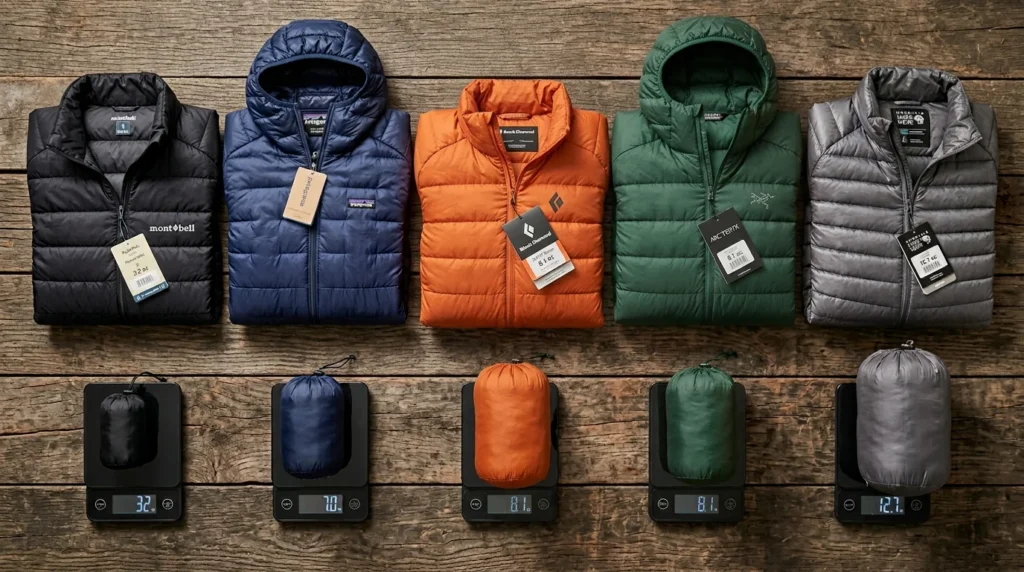
| Jacket | Weight | Fill Power | Shell Weight | Price | Best For |
|---|---|---|---|---|---|
| Montbell Plasma 1000 | 3.2 oz | 1000 fill | 7-denier | $270 | Extreme ultralight, dry conditions |
| Feathered Friends Eos | 7.0 oz | 900 fill | 10-denier Pertex | $290 | Near-ultralight, premium down |
| Arc’teryx Cerium SL | 8.1 oz | 850 fill | 10-denier Arato | $350 | Practical multi-day backpacking |
| REI Co-op 650 | 9.0 oz | 650 fill | 30-denier | $149 | Budget-conscious backpacking |
| Patagonia Down Sweater | 12.7 oz | 800 fill | 20-denier | $299 | Durability-first, daily driver |
Shell Fabric: The Protection Layer Nobody Talks About Enough
The outer shell of an ultralight down jacket does three things simultaneously: it contains the down, protects it from wind and light moisture, and determines how long the jacket survives real-world use. For the best ultralight down jackets, shell fabric choice represents the most significant engineering trade-off after fill power.
Denier (d) is the weight measure of individual fabric threads. Lower denier means lighter, more packable fabric that tears more easily. Higher denier means heavier, more durable fabric that packs larger.
7-denier fabric (Montbell Plasma) is exceptionally fragile. Single contact with a Velcro strap or rough tree bark can cause a snag or tear. Treat it like a fragile instrument, not an outdoor workhorse.
10-denier fabric (Arc’teryx, Feathered Friends) is still very light but survives normal backpacking contact with gear, brush, and rough surfaces with much greater resilience. The weight penalty over 7-denier is under half an ounce for a full jacket, a trade-off nearly all experienced backpackers make after their first fragile shell catastrophe.
20 to 30-denier fabrics (Patagonia, REI) approach the durability of normal outdoor garments while remaining packable. They’ll handle years of hard use without the careful handling that lower-denier shells demand.
Shell fabric choice should align with how you use the jacket. If it lives in your pack and comes out only for belay ledges and camp hours, 7 to 10-denier is appropriate. If you wear it while hiking, scrambling, or doing camp chores, 20-denier minimum is the practical call.
Understanding shell fabric performance is part of the complete clothing system knowledge covered in the camping layering system guide, where each layer’s outer fabric determines how the complete system manages wind, moisture, and temperature.
Packability: Understanding Compression and Stuff Sacks
The best ultralight down jackets pack into their own internal chest pockets or included stuff sacks. Compression volume varies significantly between options at similar weights and matters more for tight pack organization than most buyers anticipate.
The Montbell Plasma 1000 compresses to approximately 0.4 liters, genuinely smaller than a softball, making it essentially invisible in a pack. The Arc’teryx Cerium SL compresses to approximately 0.6 liters. The Patagonia Down Sweater compresses to approximately 0.8 liters. The REI Co-op 650 to approximately 1.2 liters.
For backpackers using a 35 to 40-liter pack, the difference between 0.4 and 1.2 liters of jacket space is a meaningful organizational constraint. For car campers with unlimited space, it’s irrelevant.
The habit that extends any ultralight down jacket’s life significantly: never store it compressed for extended periods. The compression that makes these jackets pack so impressively also slowly degrades down cluster structure over time if maintained permanently. Store hanging or loosely in a large breathable bag between trips, exactly the same principle that applies to sleeping bag care in the 4-season sleep system guide.
Layering Your Down Jacket Correctly
A best ultralight down jacket performs its maximum function when placed correctly in a layering system, not just thrown on at random.
Down insulation is a mid-layer, not a shell. It traps body heat in still air. Wind collapses the surface down clusters and dramatically reduces warmth. Wearing an ultralight down jacket as the outermost layer in moving or windy conditions wastes most of its thermal potential.
The correct sequence for cold conditions: moisture-wicking base layer against skin, down jacket over that, wind-resistant or waterproof shell over the down. The shell protects the down’s loft from wind and moisture, allowing it to perform at its rated warmth. This layering architecture is what makes the best ultralight down jackets genuinely warm at their stated ratings. Without the shell protection, performance degrades significantly.
For high-output hiking, the down jacket typically lives in the pack during movement and comes out immediately at rest stops, lunch breaks, and camp. The transition from hiking warmth to resting cold happens faster than most beginners expect, and having the jacket accessible in a top pocket or hip belt pocket rather than buried in the main compartment makes that transition seamless.
The full system interaction between base layer, down mid-layer, and shell is covered comprehensively in the camping layering system guide. Understanding that interaction makes the best ultralight down jacket significantly more effective than treating it as an isolated piece of gear.
Your best base layers for camping choice also affects how the down jacket above it performs. A moisture-saturated synthetic base layer transfers humidity into the down fill directly. A merino or wicking synthetic base layer keeps the moisture moving outward before it reaches the down, preserving loft and warmth at the mid-layer.
Frequently Asked Questions About Ultralight Down Jackets
Q: What fill power is best for an ultralight down jacket for backpacking?
For the best ultralight down jackets, 800 to 900 fill power is the practical sweet spot. It delivers significant weight savings over 600 to 700 fill power alternatives without the fragility and diminishing returns of 1000-fill ultra-premium down. The Feathered Friends Eos at 900-fill and Arc’teryx Cerium at 850-fill represent the sweet spot of performance and real-world durability.
Q: Are ultralight down jackets warm enough for winter camping?
Most ultralight down jackets in the 6 to 10 ounce category are designed for three-season use and are best suited to temperatures above 15 to 20°F when used as a mid-layer with a shell over them. For genuine winter camping below 0°F, a heavier down jacket or a synthetic insulation jacket with higher fill weight is more appropriate. Pairing any down jacket with a proper 4-season sleep system and quality base layers dramatically extends its effective temperature range.
Q: How do I store an ultralight down jacket to make it last?
Always store loosely in a large breathable storage bag or hanging in a closet. Never compress in a stuff sack for months between seasons. Compression permanently degrades down cluster structure over time, reducing loft and warmth. Wash annually or after heavy use with Nikwax Down Wash Direct in a front-loading machine on a gentle cold cycle, then tumble dry on low with clean tennis balls to restore loft. Avoid top-loading machines as the agitator can tear baffles.
Q: What is the difference between an ultralight down jacket and a regular down jacket?
Primarily fill power and shell fabric weight. Ultralight down jackets use 800-fill-power or higher down to maximize warmth per ounce and pair it with 7 to 15-denier shell fabrics to minimize total weight. Regular down jackets typically use 550 to 700-fill-power down and 30 to 50-denier shells, making them heavier, more durable, and significantly less packable. The best ultralight down jackets compress to under 1 liter, regular down jackets rarely compress below 1.5 to 2 liters.
Q: Is hydrophobic down worth the extra cost?
Yes, unconditionally for backpacking use. Standard down becomes a liability in any moisture, and backpacking environments generate consistent moisture through body sweat, pack humidity, and weather variability. The modest price premium for hydrophobic treatment is recovered many times over in maintained performance across real conditions. Any best ultralight down jacket recommendation in 2026 that omits hydrophobic down is outdated advice.
Q: What should I wear over an ultralight down jacket in rain?
A waterproof or highly wind-resistant shell jacket worn over the down mid-layer. Down jackets are not waterproof and should never be the outermost layer in rain or high wind. The shell protects the down’s loft from both moisture penetration and wind-induced loft collapse. Your footwear system paired with the right shell reflects the same principle covered in the hiking boots vs trail runners guide, in both cases the outer protective layer determines whether the system beneath it performs as intended.
Q: Can I use an ultralight down jacket as a sleeping bag substitute?
Not as a full substitute, but as a meaningful supplement. Wearing the best ultralight down jackets inside a complete camp sleep system adds approximately 5 to 15°F of effective warmth to your sleeping bag’s rating, depending on jacket weight and down fill. This strategy allows campers to extend a three-season bag into shoulder-season cold snaps without carrying a heavier dedicated winter bag.