

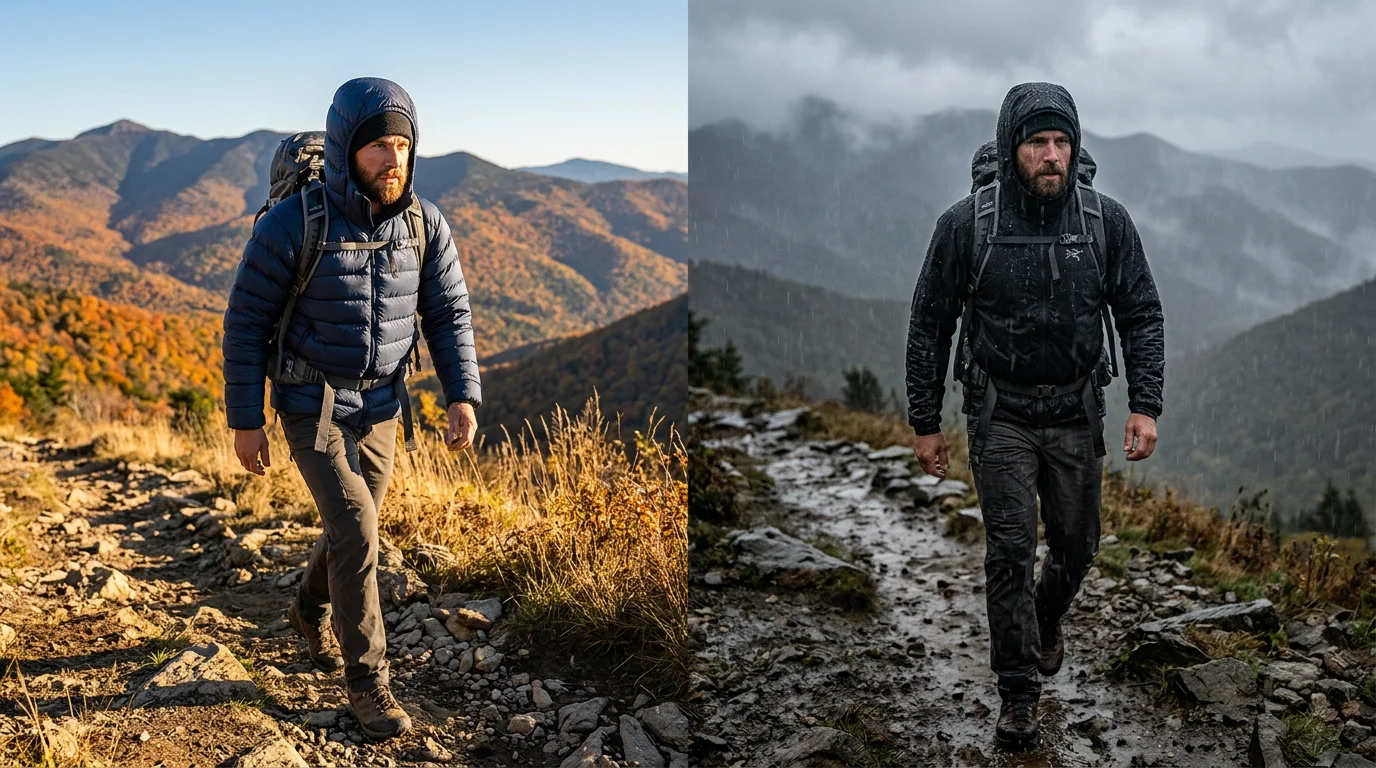
Picture two hikers leaving the same trailhead on the same October morning. One carries a 7-ounce down jacket compressed into a stuff sack the size of an apple. The other carries a 14-ounce synthetic puffy that fills a third of his pack lid. By nightfall, camped at 9,000 feet with temperature dropping fast, both are warm. Two days later, after an unexpected rain squall soaks both packs, one of them is significantly less comfortable than the other.
Which one is better? That question has fueled more heated arguments around campfires than almost any other gear debate, and the honest answer is that it completely depends on conditions, trip length, pack weight priorities, and the environment you’re camping in. The down vs synthetic insulation debate is not a question with one correct answer. It is a question with a correct framework for making the right choice for your specific situation.
The Physics of Warmth: What Insulation Actually Does
Before comparing down vs synthetic insulation directly, understanding what insulation actually does changes the entire conversation.
Insulation does not generate heat. Your body generates heat. Insulation traps the air your body warms and prevents convective heat loss from pulling that warmth away. The more effectively an insulation material traps and holds still air in a lightweight, compressible structure, the better it performs thermally.
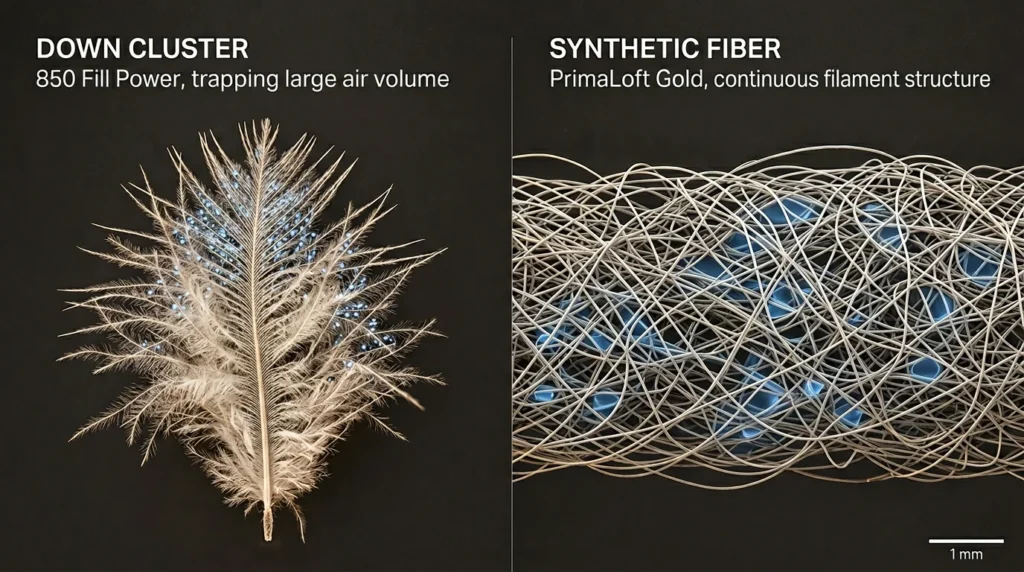
Every performance characteristic of both down and synthetic insulation, including loft, fill power, warmth-to-weight ratio, and wet performance, is a function of how well that material traps and maintains still air under real-world conditions. When down collapses in moisture, it fails because the collapsed fibers can no longer maintain those air pockets. When synthetic insulation feels heavier, it’s because the fiber structure needed to trap equivalent air volume is denser and heavier than down clusters.
This physics foundation makes every product specification meaningful rather than abstract. Loft is a proxy for air volume trapped. Fill power measures the efficiency of trapping per ounce of material. Wet performance measures how much of that loft survives moisture exposure. Once you understand the physics, the down vs synthetic insulation marketing language becomes much easier to evaluate accurately.
Understanding this principle is the foundation of the camping layering system guide, where insulation layer selection sits at the center of the complete warmth management strategy.
Down Insulation: The Benchmark
Down has been the warmth standard in outdoor gear for centuries because nothing naturally occurring or synthetically manufactured matches its warmth-to-weight ratio in dry conditions.
Down is the soft underlayer of waterfowl plumage, consisting of three-dimensional clusters that trap enormous volumes of air relative to their weight. The quality of down is measured in fill power, the number of cubic inches one ounce of down occupies when allowed to expand freely. High-quality goose down ranges from 650 to 1000-plus fill power, with duck down typically ranging 550 to 700 fill power due to smaller cluster size.
The practical consequence of high fill power in the down vs synthetic insulation comparison is direct and significant. An 800-fill-power down jacket rated to 20°F might use 3 ounces of total down fill. A synthetic jacket with an equivalent temperature rating might use 8 to 10 ounces of synthetic fiber to achieve the same warmth. That weight difference, compounded across all insulated items in your kit, including jacket, sleeping bag, and any insulated pants or booties, represents a meaningful base weight reduction for serious backpackers.
Packability follows the same logic. Down at 800-plus fill power compresses to volumes that synthetic insulation simply cannot match. The best ultralight down jackets compress to under 0.5 liters. Equivalent synthetic jackets rarely compress below 1.0 to 1.5 liters. For backpackers running a 35-liter pack, that difference in compression is real organizational space.
Down also has the longest service life of any insulation type when cared for correctly. A quality down sleeping bag maintained with proper washing and storage protocols delivers consistent performance for 10 to 20 years. Synthetic insulation typically shows meaningful loft degradation after 3 to 7 years of regular use, as the fibers break down under repeated compression and washing cycles.
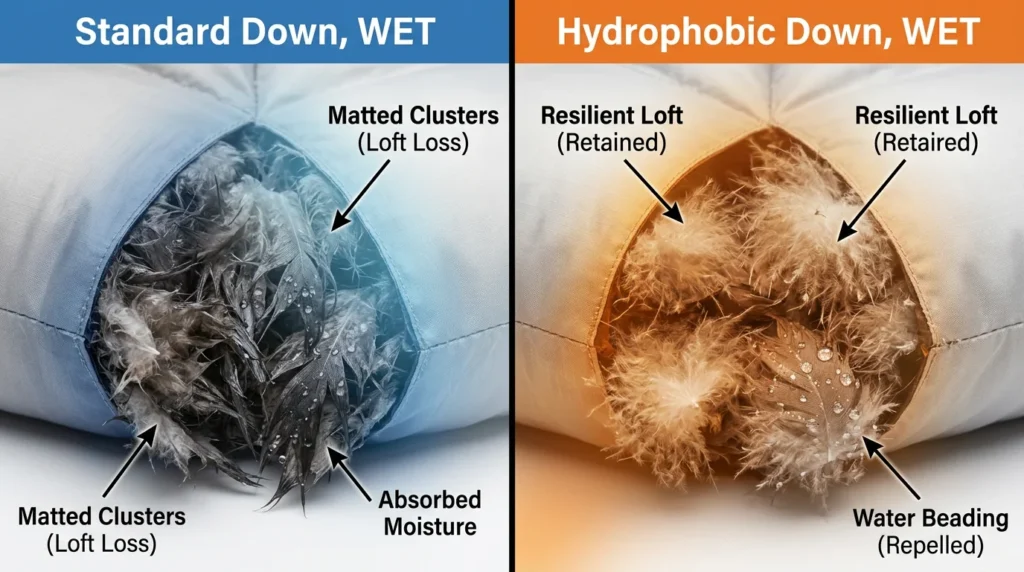
The limitations of down insulation in the down vs synthetic insulation comparison are real and well-documented. Standard down absorbs moisture readily and loses virtually all loft when saturated. A soaking-wet down jacket or sleeping bag in cold temperatures transitions from protective insulation to dangerous cold-conducting weight remarkably quickly. Down also requires more careful care protocols than synthetic alternatives, and quality down carries a significantly higher price per ounce of warmth than equivalent synthetic options.
Hydrophobic Down: Closing the Gap
The most significant development in the down vs synthetic insulation debate over the last decade is hydrophobic down treatment, and it has changed the calculus substantially.
Hydrophobic down treats individual fiber clusters with a DWR-style polymer coating before assembly, causing moisture to bead on fiber surfaces rather than absorbing into the fiber structure. Treated down maintains 70 to 90% of its dry loft in humid conditions and light sustained moisture exposure, compared to near-zero loft retention in conventional untreated down when wet.
Major implementations include Allied Feather’s HyperDRY, Nikwax Hydrophobic Down, and proprietary treatments from brands including Arc’teryx, Patagonia, and Feathered Friends. The treatment adds modest cost and is now standard across premium down products. The treatment degrades over washing cycles, typically over 20 to 30 wash cycles, but is maintained by washing with Nikwax Down Wash rather than conventional detergent.
For the down vs synthetic insulation comparison in three-season environments, hydrophobic down has substantially narrowed synthetic’s primary advantage. It doesn’t fully close the gap. In sustained heavy rain, stream crossings, or multi-day high-humidity environments, synthetic still outperforms hydrophobic down meaningfully. In intermittent moisture, pack humidity, and body sweat scenarios that represent the actual moisture exposure of most backpacking trips, hydrophobic down now performs comparably to synthetic.
Synthetic Insulation: Where It Wins Outright
Synthetic insulation is manufactured from fine polyester fibers engineered to mimic the loft structure of down clusters. The primary implementations include PrimaLoft (used by most major outdoor brands), Climashield Apex, PolyCo, and brand-proprietary constructions including Patagonia’s PlumaFill and Arc’teryx’s Coreloft Compact.
The fundamental advantage of synthetic insulation in the down vs synthetic insulation comparison is moisture performance. Polyester fibers are hydrophobic at the molecular level, meaning they do not absorb moisture at all. Instead, any water present sits between fibers rather than inside them, and the fiber clusters maintain most of their loft structure even when the insulation is thoroughly soaked. A wet synthetic jacket retains approximately 60 to 70% of its dry warmth. A wet conventional down jacket retains approximately 5 to 10%.
This moisture performance advantage is not merely a comfort consideration. In sustained wet conditions at cold temperatures, it is a safety consideration. The Pacific Northwest in November, Southeast Alaska in summer, and any high-humidity coastal mountain environment represents conditions where synthetic insulation provides a genuine safety margin that down cannot match regardless of hydrophobic treatment.
Synthetic insulation performs consistently across repeated moisture exposure without the care protocols down demands. You can machine wash a synthetic jacket in standard cold water with normal detergent, tumble dry on medium heat, and return it to service within a few hours. Down washing requires specific down-safe detergent, front-loading machines only, low heat drying with tennis balls, and significant time investment to ensure full loft restoration.
The trade-offs in the down vs synthetic insulation comparison for synthetic are equally real. Greater weight per unit of warmth. Larger compressed volume for equivalent temperature ratings. Shorter service life as fibers break down under compression cycles. Less comfortable and breathable feel during active use due to denser fiber structure. And for environmentally conscious buyers, synthetic insulation is petroleum-derived, though recycled polyester constructions from brands including Patagonia and Arc’teryx have substantially improved the sustainability picture.
Down vs Synthetic Insulation: The Direct Comparison
The down vs synthetic insulation performance characteristics compared side by side clarify where each material genuinely leads and where the performance is closer than marketing suggests.
| Performance Factor | Down Insulation | Synthetic Insulation | Advantage |
|---|---|---|---|
| Warmth-to-weight ratio | Exceptional (800+ fill) | Good (heavier per warmth unit) | Down, significantly |
| Packability / compression | Excellent (under 0.5L) | Moderate (1.0 to 1.5L) | Down, significantly |
| Wet warmth retention | Poor (standard) / Good (hydrophobic) | Good (60 to 70% retention) | Synthetic in sustained wet |
| Drying speed | Very slow (hours) | Fast (30 to 60 min) | Synthetic |
| Durability / service life | Excellent (10 to 20 years) | Moderate (3 to 7 years) | Down |
| Care requirements | Specific protocols required | Machine wash and dry | Synthetic |
| Odor resistance | Good | Moderate (builds residue) | Down |
| Price per warmth unit | Higher | Lower | Synthetic |
| Performance in sustained rain | Poor to moderate | Good | Synthetic |
| Performance in dry cold | Excellent | Good | Down |
| Sustainability | Natural (traceable sourcing) | Petroleum-based (recycled options exist) | Down (with certified sourcing) |
Choosing the Right Insulation for Your Environment
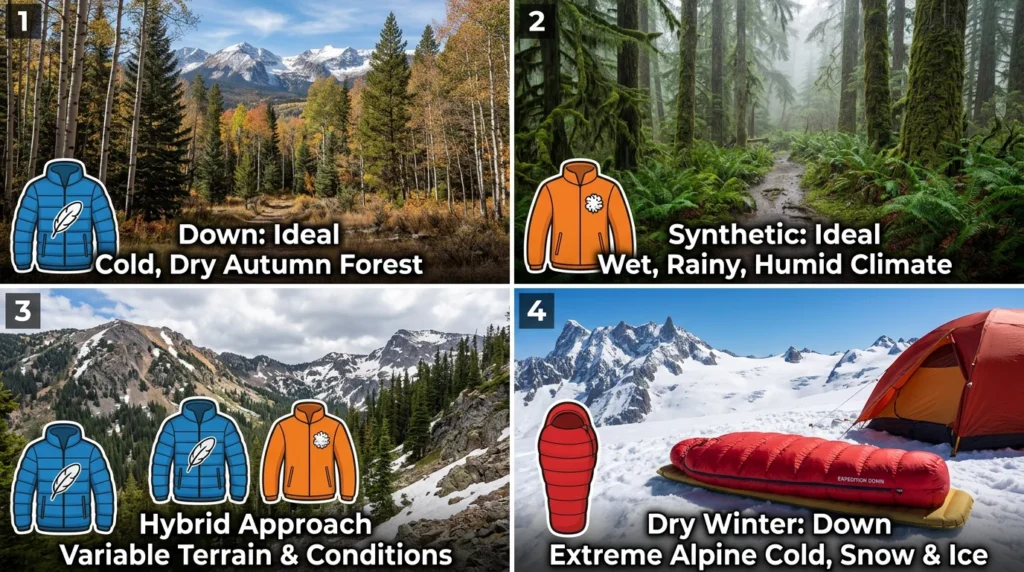
The correct answer in the down vs synthetic insulation debate is environmental. The question is not which insulation is universally better, it is which insulation type is better suited to the specific moisture, temperature, and duration conditions of your intended use.
In consistently dry cold environments, including the Rocky Mountain interior ranges, the Sierra Nevada in summer and fall, the Colorado Plateau, and similar continental climates with low humidity and predictable dry weather, down insulation wins the down vs synthetic insulation comparison clearly. The weight and packability advantage is maximized without the wet performance risk being triggered.
In consistently wet or high-humidity environments, including the Pacific Northwest, the Olympic Peninsula, Southeast Alaska, the Scottish Highlands, and similar maritime climates with frequent precipitation and persistent humidity, synthetic insulation remains the safer choice for primary insulation despite hydrophobic down improvements. The moisture performance margin still matters in these environments.
In variable three-season environments representing most recreational camping, a hybrid approach works best. A hydrophobic down jacket as the primary insulation mid-layer paired with a synthetic or down sleeping bag depending on tent vs hammock camping style and expected precipitation covers the majority of scenarios intelligently. This hybrid approach in the down vs synthetic insulation context is what most experienced backpackers and guides actually run.
Trip duration also shifts the calculation. For weekend trips under three days, synthetic’s ease of care is less relevant because you’re unlikely to need to wash anything mid-trip. For week-long and multi-week expeditions, down’s superior service life and odor resistance become meaningful practical advantages.
The same environmental framework governs sleeping bag selection. Building a 4-season sleep system requires making the identical down vs synthetic insulation decision for your bag as for your jacket, and the same environmental logic applies: dry continental conditions favor down, wet coastal conditions favor synthetic.
Matching Insulation to Each Layer
Down vs synthetic insulation is not a single decision made once for your entire kit. Different items in your layering system have different moisture exposure profiles that make different insulation choices appropriate.
A down jacket worn as a mid-layer under a shell jacket has relatively low direct moisture exposure because the shell above it keeps precipitation out. This is where down performs most safely and where the weight and packability advantages are most valuable. The best ultralight down jackets for backpacking are almost all designed for exactly this protected mid-layer role.
A belay jacket or camp jacket worn as the outermost layer in wet conditions has high direct moisture exposure. Synthetic insulation in an outer jacket is more appropriate for wet environments, or a hydrophobic down jacket used with immediate shell coverage when precipitation begins.
Sleeping bags have the highest moisture exposure from body perspiration over an entire night. The inside of a sleeping bag accumulates more moisture over a multi-day trip than any outer jacket layer does. This is why many experienced winter campers choose synthetic sleeping bags for wet environments even when they prefer down jackets for insulation layers. The complete camp sleep system decision must account for this sleeping bag moisture exposure profile specifically.
Insulated pants and booties see the least moisture exposure of any insulation items and are nearly always appropriate as down, where the warmth and weight savings are most beneficial.
Care and Maintenance for Both Insulation Types
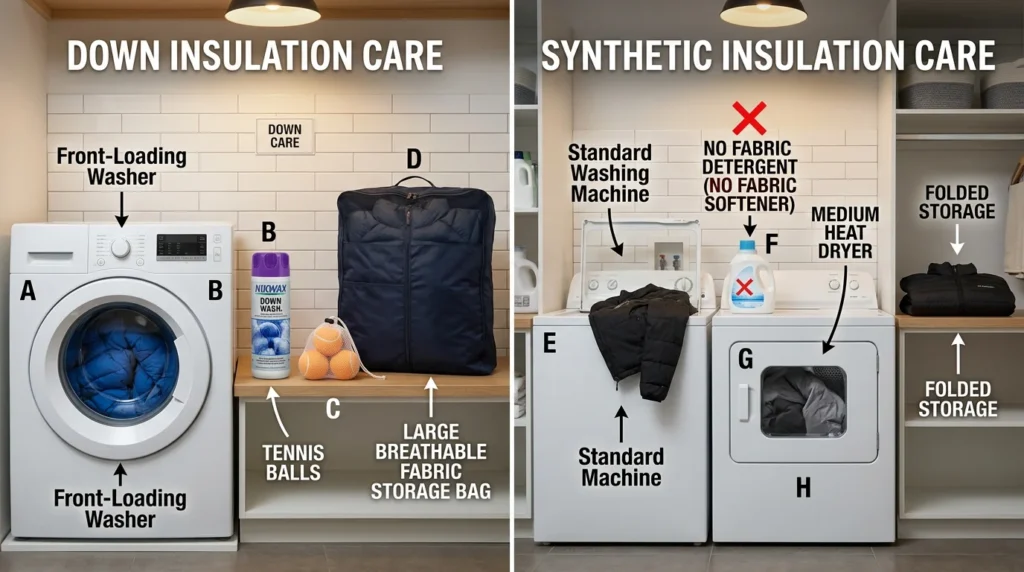
Correct care is what determines whether the down vs synthetic insulation service life gap is 7 years or 20 years for down and 3 years or 7 years for synthetic.
For down insulation: front-loading washer on delicate cycle with cold water and Nikwax Down Wash Direct or Granger’s Down Wash. Never top-loading agitator machines, which tear baffles. Tumble dry on low heat with two clean tennis balls that break up clumping clusters. Check that all clumps are broken up before removing from dryer. Store loosely in a large breathable storage bag, never compressed in a stuff sack for extended periods. Compression permanently degrades cluster structure over time.
For synthetic insulation: machine wash on cold gentle cycle with regular fragrance-free detergent, no fabric softener. Fabric softener coats fiber surfaces and permanently degrades loft. Tumble dry on medium heat. Synthetic dries significantly faster than down and is more forgiving of incomplete drying. Store loosely rather than compressed for extended periods, though synthetic is more resistant to compression degradation than down.
Full fabric care protocols across all gear types, including DWR restoration and seam maintenance, are covered in the tools and maintenance guide. Proper maintenance is what makes the investment in quality down insulation economically rational over the long term.
Your best base layers for camping choice also directly affects how long both down and synthetic insulation types perform. A moisture-saturated base layer that transfers humidity into the insulation layer above it accelerates degradation and loft reduction in both insulation types. A properly wicking merino or synthetic base layer keeps that moisture moving outward, preserving insulation performance across the full trip duration.
Frequently Asked Questions About Down vs Synthetic Insulation
Q: Is down or synthetic insulation warmer?
In dry conditions, down insulation is warmer per ounce than any synthetic alternative. A high-quality 850-fill-power down jacket weighing 8 ounces outperforms a synthetic jacket of the same weight at equivalent temperature ratings. However, in wet conditions, synthetic insulation retains 60 to 70% of its warmth while wet down retains as little as 5 to 10% of dry performance. The warmth comparison in down vs synthetic insulation depends entirely on whether the insulation stays dry.
Q: Is hydrophobic down as good as synthetic in wet conditions?
Not fully. Hydrophobic down maintains 70 to 90% of dry loft in humid conditions and light intermittent moisture exposure, which is a significant improvement over untreated down. In sustained heavy rain, continuous moisture exposure, or submersion, synthetic still outperforms hydrophobic down. For most recreational backpacking environments, hydrophobic down performs adequately. For consistently wet maritime environments, synthetic remains the safer primary insulation choice.
Q: How long does down insulation last compared to synthetic?
With proper care, quality down insulation lasts 10 to 20 years with consistent performance. Synthetic insulation typically shows meaningful loft degradation after 3 to 7 years of regular use and washing cycles. The down vs synthetic insulation durability gap is real and is one of the strongest long-term value arguments for investing in quality down despite higher upfront cost.
Q: Which is better for a sleeping bag: down or synthetic?
For dry continental environments and backpackers who sleep cold: down. For wet environments, hammock camping with moisture exposure from below, and campers who sweat heavily at night: synthetic. Most backpackers in mixed conditions choose down sleeping bags with a hydrophobic treatment. Car campers with no weight constraints often choose synthetic bags for durability and care simplicity.
Q: What fill power should I look for in a down jacket?
800 to 900 fill power represents the practical sweet spot for the down vs synthetic insulation comparison in a packable jacket. It delivers meaningful weight savings over 600 to 700 fill power alternatives without the fragility of 1000-fill ultra-premium constructions. Below 600 fill power, the packability advantage of down over synthetic narrows to the point where the price premium is harder to justify.
Q: Can you use a down jacket in rain?
With a shell jacket over it and hydrophobic down treatment inside it, yes, effectively. Down jackets should never be worn as the outermost layer in rain without a shell over them. The shell protects the down’s loft from moisture penetration while allowing body heat to build up between layers. This same principle applies to the complete layering architecture described in the camping layering system guide.
Q: Which insulation is more sustainable?
Both have environmental trade-offs in the down vs synthetic insulation sustainability comparison. Down is a natural material but raises animal welfare concerns addressed by the Responsible Down Standard (RDS) and similar certifications. Synthetic insulation is petroleum-derived but recycled polyester options from Patagonia, Arc’teryx, and others reduce this impact meaningfully. For environmentally prioritized buying, RDS-certified down or recycled synthetic represents the best available option in each category.