
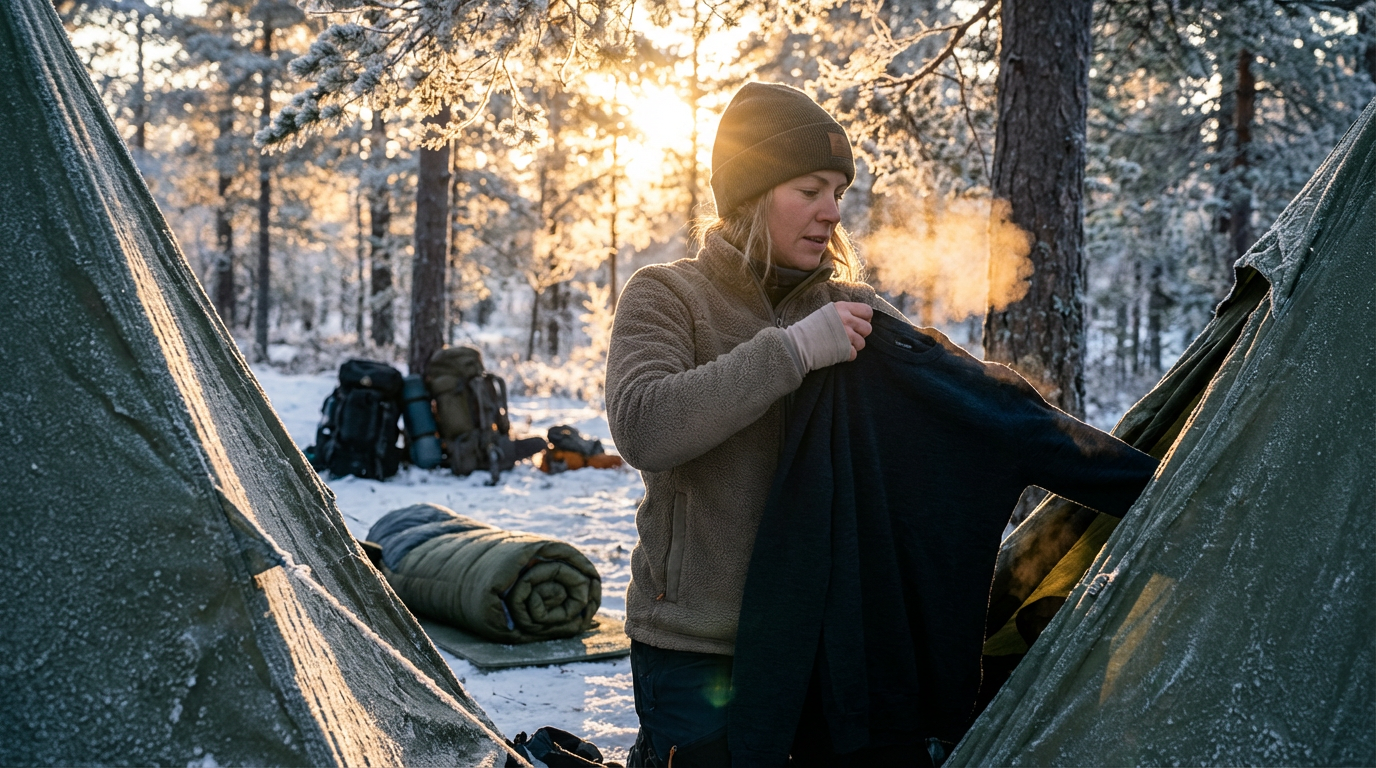
Pull your sleeping bag zipper down at 5 AM on a 20-degree morning, and everything comes down to what’s touching your skin.
Not your jacket. Not your insulation layer. The thin, forgotten first layer that you probably didn’t spend enough time thinking about when you packed. I’ve guided wilderness trips in conditions ranging from -20°F Cascades winters to 100°F desert summers, and I can tell you with complete certainty: the best base layers for camping don’t just manage moisture, they determine whether your entire layering system works or fails.
I’ve sweated through enough base layers to know that fabric choice at this level is not a minor detail. It’s the foundation everything else is built on. This guide covers what actually works across merino wool, synthetic, and silk options, tested in real cold-weather conditions, not climate-controlled labs.
Why Your Base Layer Is the Most Important Layer You Own
Most people spend their clothing budget on insulation jackets and rain shells. I understand the logic, those items are visible, impressive, and easy to justify. But stripping a layering system down to its fundamentals reveals an uncomfortable truth: if your base layer fails at moisture management, every layer stacked on top of it fails too.
Here’s the physics. When you hike with a loaded pack, your core generates significant heat and moisture. That moisture needs to move away from your skin and outward through your layers. A base layer that absorbs and holds moisture, cotton being the catastrophic extreme, keeps that cold, wet film against your skin. Your insulation layer then has to work against both the ambient cold and the chill from your own trapped sweat. You lose warmth far faster than the temperature alone explains.
The right base layer moves moisture away from your skin fast enough that your skin surface stays relatively dry regardless of your exertion level. This is the entire job. Everything else, warmth, odor resistance, durability, matters, but it’s secondary to moisture management.
Understanding this principle is the foundation of building a proper camping layering system that performs across changing conditions throughout the day.
Merino Wool: The Cold-Weather Camping Standard
If you camp in temperatures below 30°F regularly, own at least one heavyweight merino base layer. That’s not a preference, it’s a recommendation I make to every client I guide in the Cascades.
Why merino dominates cold-weather camping specifically:
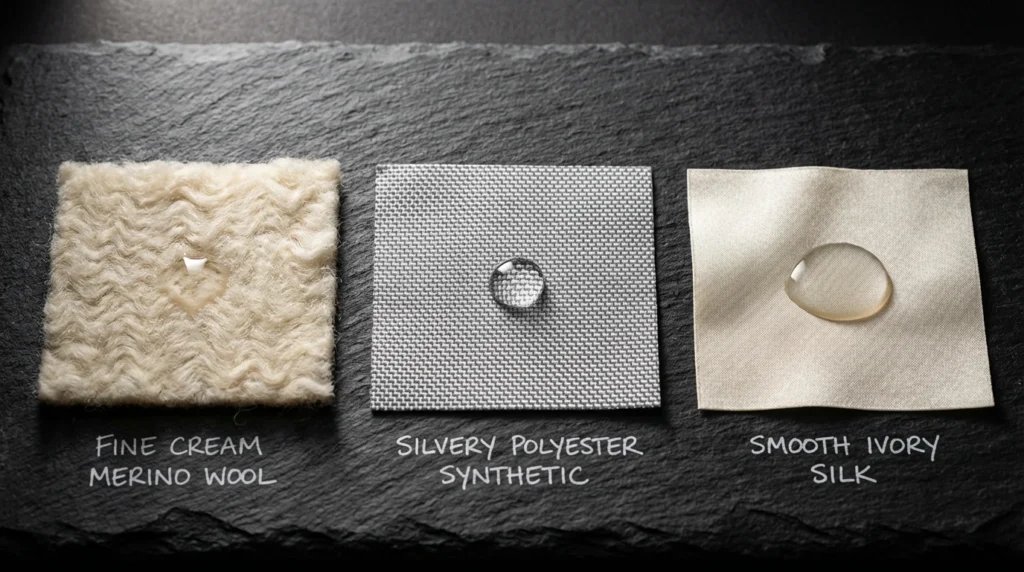
Merino wool fibers absorb up to 30% of their weight in moisture vapor before they feel wet against your skin. That number matters enormously in stop-start camping activities, setting up camp, cooking, sitting still at a viewpoint, because your sweat output changes constantly. Merino absorbs moisture during high-output moments and releases it gradually during low-output moments, creating a thermal buffer that synthetic fabrics simply can’t replicate.
Additionally, merino retains approximately 40% of its insulating value even when saturated. In a genuine emergency, unexpected rain, river crossing, wet snow, that retained warmth is the difference between manageable discomfort and hypothermia risk.
The odor resistance is real and not marketing exaggeration. On a seven-day backcountry trip last winter in the Olympics, I wore the same Smartwool Classic Thermal crewneck for five consecutive days without washing. No one mentioned odor. Try that with any synthetic base layer and you’ll clear your tent by night three.
Weight categories matter, match them to your conditions:
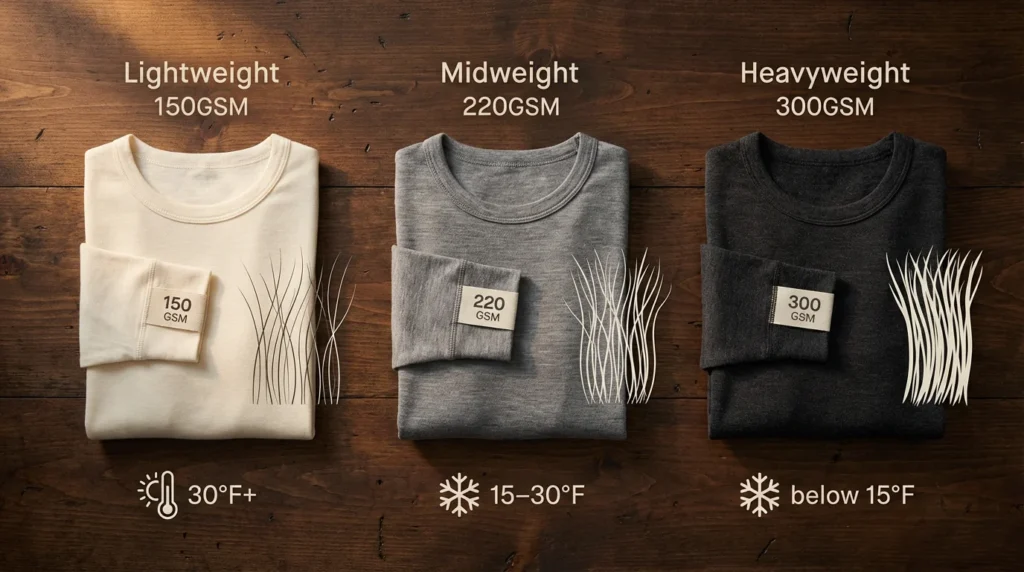
- Lightweight merino (150–200 GSM): Active aerobic use, temperatures above 30°F. The Icebreaker 175 Merino Oasis is the benchmark here, soft against skin, quick-drying for merino, excellent temperature regulation during variable-pace hiking.
- Midweight merino (200–260 GSM): The most versatile category. Camp chores, moderate hiking, temperatures 15°F to 30°F. The Smartwool Classic Thermal Crew is the most-tested recommendation in this range, consistent performers across multiple testing cycles.
- Heavyweight merino (260+ GSM): Static cold-weather activities, ice fishing, sitting at basecamp, winter photography. The Minus33 Ridge Heavyweight crushes this category. Genuinely warm in near-zero conditions when you aren’t generating activity heat.
The honest trade-offs:
Merino costs significantly more than synthetic, quality midweight pieces run $80 to $130. Durability is lower, merino fibers pill and develop thin spots faster than polyester when subjected to pack friction and repeated washing. And merino dries 3 to 5 times slower than quality synthetics. These are real limitations worth knowing before you buy.
Synthetic Base Layers: Speed and Durability Win
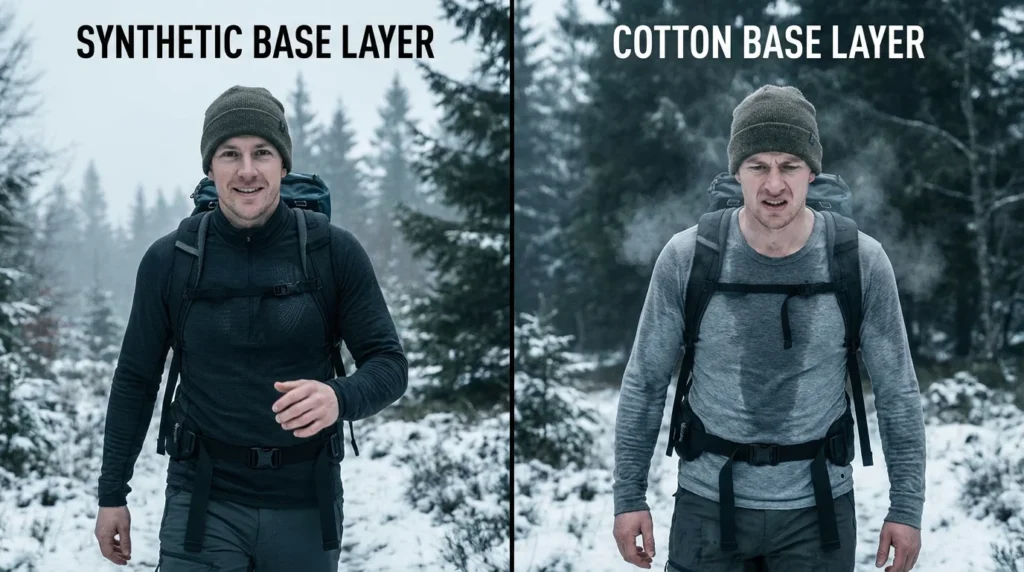
Synthetic base layers, primarily polyester, sometimes nylon, don’t absorb water. Instead of absorbing moisture and releasing it slowly like merino, synthetics move sweat from skin to fabric surface and evaporate it rapidly. At high-output activities, long climbs, fast hiking, trail running, this mechanism keeps you drier moment-to-moment than merino wool.
The drying speed advantage is not marginal. In wet environments or during sustained high-output activities where you’re generating sweat continuously, synthetics manage that moisture 3 to 5 times faster than merino. At near-freezing temperatures, a wet base layer pulls warmth out of your body rapidly, drying speed at that point is a safety variable, not just a comfort preference.
Standout performers tested in cold conditions:
The Patagonia Capilene Thermal Weight represents the benchmark for cold-weather synthetic base layers. Its grid-pattern interior construction creates small air pockets against your skin while the exterior surface wicks moisture outward aggressively. Tested at temperatures down to 10°F on multi-day ski tours, it outperforms every other synthetic in its weight class for active warmth management.
The Arc’teryx Rho LT Zip-Neck is the choice for technical use, climbing, mountaineering, situations where a zipper at the neck allows precise ventilation management. More expensive at around $115, but the fabric quality and cut precision justify the premium for serious use.
For budget-conscious campers, the REI Co-op Midweight Base Layer delivers 85% of the performance of the premium options at 60% of the cost, the most honest budget recommendation I can make.
The honest trade-offs:
Synthetics smell fast. If you’re camping more than two nights without laundry access, synthetic odor accumulation becomes genuinely unpleasant, the antimicrobial treatments applied at the manufacturing stage help but don’t solve the problem. They also feel less comfortable than merino against bare skin, particularly when dry, and provide less thermal buffer during stop-start activity patterns.
Silk Base Layers: The Ultralight Sleeper
Silk gets underestimated constantly, and I understand why, it doesn’t have the marketing machinery of merino or synthetic brands behind it. But for specific applications, a silk base layer is genuinely superior to both alternatives.
Silk weighs almost nothing, a full silk base layer top runs 2 to 4 ounces, roughly half the weight of equivalent merino. For ultralight backpackers or alpinists counting every gram, that weight savings across multiple layers is meaningful.
Silk adds warmth disproportionate to its weight, a lightweight silk base layer adds 5 to 8°F of warmth to your sleep system when worn inside a sleeping bag, which is why silk liners and base layers overlap in function for cold-weather campers.
The limitation: silk’s moisture management is mediocre for high-output activities. It absorbs moisture, dries slowly, and doesn’t maintain performance when repeatedly saturated. Silk works beautifully as a camp layer, a sleep layer, or an aerobic activity layer in dry cold conditions. In wet cold or sustained sweat-generating activity, it underperforms both merino and synthetic.
The Terramar Thermolite Stretch Silk is the most practical silk option in current production, it blends 88% silk with 12% spandex for stretch and durability that pure silk lacks.
Merino vs Synthetic vs Silk: The Honest Head-to-Head
How to Choose by Activity and Condition
This is where most base layer guides fail, they tell you which material is “best” without connecting it to actual use scenarios. Here’s the framework I use with every client:
Winter camping, primarily static (base camp, ice fishing, sitting in a blind):
Heavyweight merino, full stop. You need the absorbed moisture buffer and the warmth retention when your activity level drops. Synthetic base layers at static activity levels chill you as evaporation steals heat faster than your reduced metabolic rate replaces it.
Winter camping with long, hard hiking days:
Midweight synthetic for the hiking, midweight merino for the camp hours. Yes, this means carrying two base layers. On trips with significant elevation gain and extended active periods, the drying speed of synthetic protects you during the hike, and the thermal buffer of merino protects you when you stop and cool rapidly. This is exactly the kind of layering strategy I cover in depth in the camping layering system guide.
Multi-day backpacking in cold, dry conditions:
Midweight merino. The odor resistance earns its premium price the moment you’re in a shelter with five other people at day four.
Multi-day backpacking in cold, wet conditions:
Midweight synthetic with DWR treatment, or a merino/synthetic blend (60% merino, 40% polyester). The blend captures most of merino’s comfort and odor resistance while dramatically improving drying speed. The Smartwool Merino 250 Blend and Icebreaker 260 ZoneKnit both use hybrid construction for exactly this application.
Weight Matters: Match Your Layer to Your Pack
Base layers are part of your complete camp sleep system calculation too, worn inside your sleeping bag, they can add meaningful warmth and extend your bag’s effective temperature range. A heavyweight merino top worn to sleep adds approximately 5 to 8°F to your system, which matters enormously for shoulder-season campers trying to extend a three-season bag.
When building a 4-season sleep system, the base layer you sleep in becomes a direct component of your thermal assembly. Choosing it correctly means you might not need a liner on warmer nights, saving weight and cost elsewhere in the system.
Your base layer weight and bulk also affects your backpack carrying system, a complete three-layer clothing system for winter camping can run 3 to 5 pounds. Knowing your base layer weights precisely lets you make intelligent trade-offs between base layer investment and sleeping bag temperature rating.
Care: Protecting the Investment
Merino wool requires specific washing protocols to maintain performance and prevent shrinkage and fiber damage. Always wash in cold water on a gentle cycle with wool-specific detergent, Nikwax Wool Wash or Eucalan work without stripping the natural lanolin that contributes to odor resistance. Never tumble dry on high heat, air dry flat or tumble on the lowest possible setting. Heat is the primary cause of merino shrinkage and fiber thinning.
Synthetic base layers handle machine washing well but degrade faster if washed with fabric softener, the softener coats the fiber surface and blocks the moisture-wicking channels, progressively destroying the layer’s primary function. Wash synthetics in cold water without softener, and consider a Grangers Performance Wash treatment periodically to restore wicking performance.
For full fabric care protocols and DWR restoration on your outer layers, the tools and maintenance guide covers the complete gear cleaning system that makes every fabric layer perform longer.