

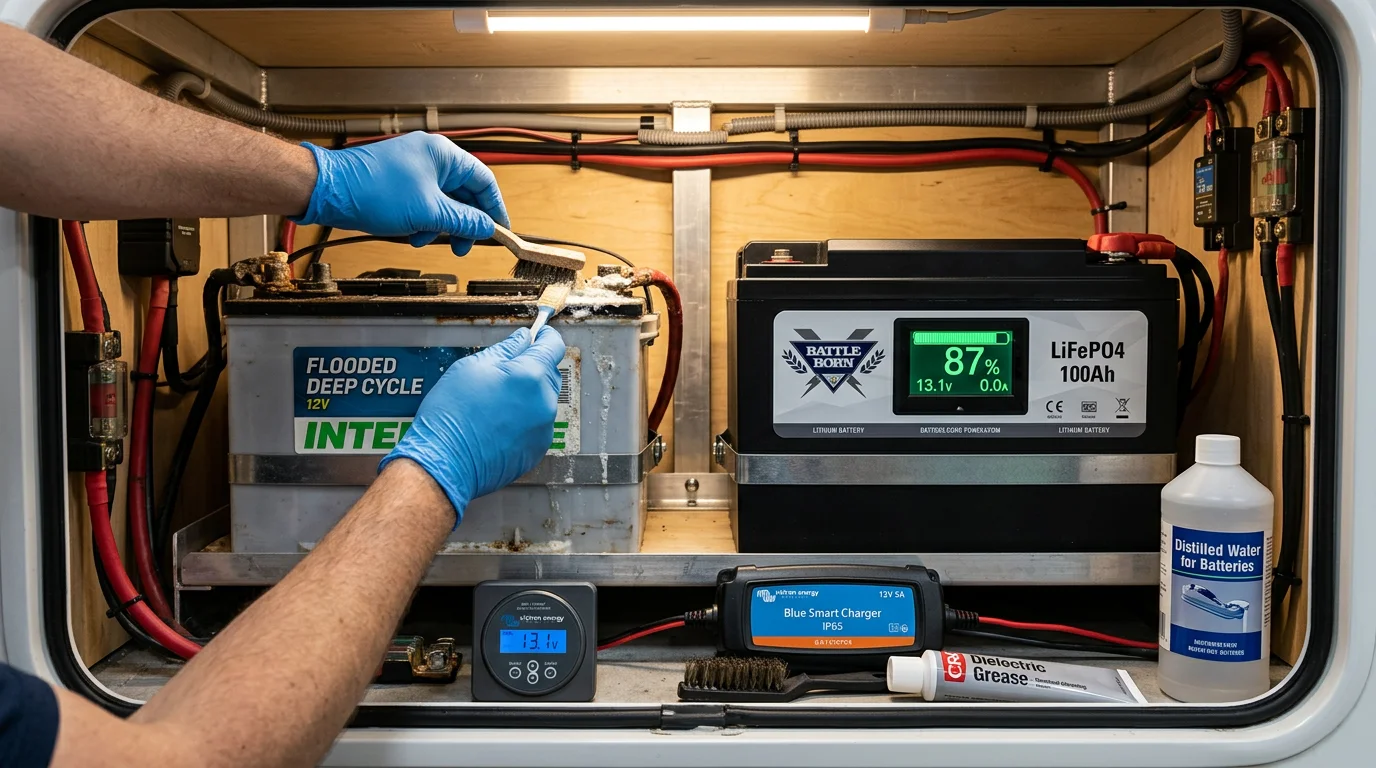
Most campers think about their batteries exactly twice: when they install them and when they fail. Everything in between, the charging habits, the discharge limits, the storage protocols, the terminal care, gets skipped because batteries are invisible. They sit in a compartment, they do their job silently, and nobody thinks about them until a cold morning in November when nothing turns on.
That invisible quality is the reason battery failure is the single most common and most preventable mechanical problem across RV camping, van life, and portable power station use. The battery didn’t fail overnight. It failed over 18 months of habits that nobody noticed were wrong because the damage is cumulative and slow.
Camper battery health maintenance is not complicated. The protocols are short, the tools are inexpensive, and the time investment across a full year is under four hours. What those four hours protect is a battery bank that may represent $300 to $3,000 in hardware investment and that determines whether your camp has power, lighting, refrigeration, and communication at every destination.
This guide covers everything: the chemistry differences between deep cycle lead-acid and lithium iron phosphate (LiFePO4) batteries, correct charging protocols, discharge limits that actually matter, long-term storage procedures, and terminal maintenance. Whether you run a flooded lead-acid battery bank in a classic RV or a lithium power station in a rooftop tent setup, the complete framework for camper battery health maintenance is here.
Understanding Your Battery Chemistry Before Maintaining It
Camper battery health maintenance protocols are not universal. The two dominant battery chemistries used in camping and RV applications, deep cycle lead-acid and lithium iron phosphate, have fundamentally different internal structures, different failure modes, and critically, different maintenance requirements that cannot be interchanged without damaging the battery.
Using lead-acid charging protocols on a lithium battery does not simply reduce efficiency. It actively degrades the lithium cells and, depending on the charger’s float voltage, creates safety risks. Using lithium storage protocols on a lead-acid battery produces sulfation damage that permanently reduces capacity. Understanding which chemistry you’re working with is the starting point for every camper battery health maintenance decision.
Lead-acid deep cycle batteries (including flooded, AGM, and gel variants) use a chemical reaction between lead plates and sulfuric acid electrolyte to store and release energy. They have been the RV and marine battery standard for decades, are widely available, and are relatively inexpensive per amp-hour of capacity. Their maintenance requirements are more demanding than lithium alternatives: they must not be discharged below 50% of capacity without accelerating plate damage, they are sensitive to temperature extremes, and flooded variants require regular electrolyte level monitoring with distilled water.
Lithium iron phosphate batteries (LiFePO4) represent the current premium standard for camper power systems. They tolerate deeper discharge cycles (down to 80 to 90% depth of discharge without degradation), have a dramatically longer cycle life (2,000 to 5,000 cycles versus 300 to 500 for lead-acid), self-discharge at only 1 to 3% per month versus 10 to 15% for flooded lead-acid, and require significantly less active maintenance. They cost 2 to 4 times more per amp-hour upfront but deliver substantially lower cost-per-cycle over their service life.
The maintenance protocols in this guide are separated by chemistry throughout, because applying the wrong protocol is worse than applying no protocol at all.
The Discharge Limits That Actually Determine Battery Lifespan
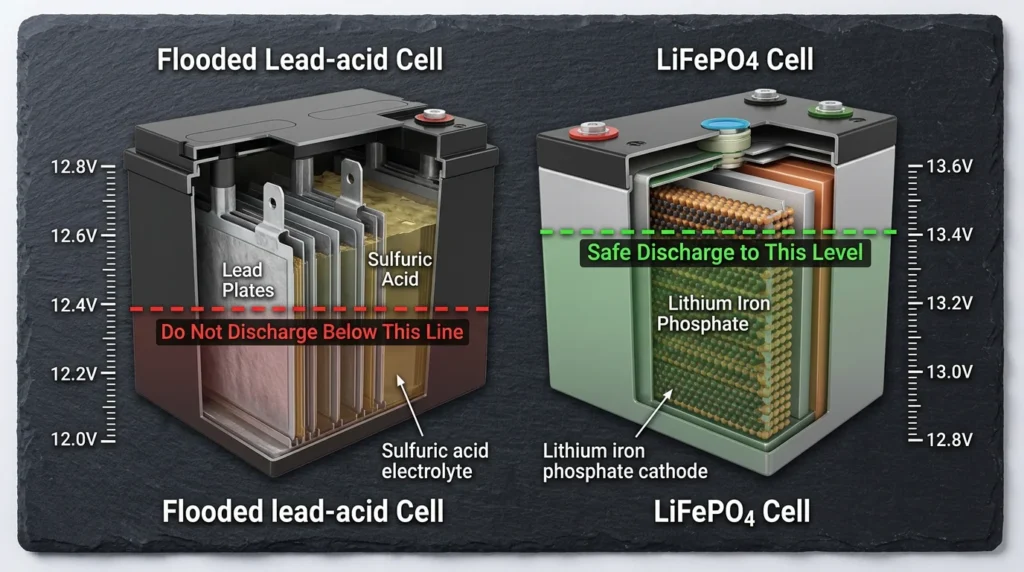
Nothing does more long-term damage to camper battery health than repeated deep discharge below chemistry-specific safe limits. This is the single most important concept in camper battery health maintenance, and it is the one most consistently violated by campers who weren’t given this specific information.
For flooded lead-acid and AGM deep cycle batteries, the maximum safe discharge depth is 50% of rated capacity. Discharging a 100Ah lead-acid battery to 50Ah remaining (12.0 volts resting voltage or below) and then recharging represents a single acceptable cycle. Discharging to 30% or 20% remaining, which feels like “getting your money’s worth” from the battery, actually strips years from its service life through a process called sulfation, where lead sulfate crystals form on the battery plates during deep discharge and do not fully dissolve during subsequent recharging. Each sulfation event reduces the battery’s effective capacity permanently.
A practical voltage reference for lead-acid discharge limits: monitor resting voltage (voltage measured with no load and no charging for at least an hour). At 12.4 volts, you’re at approximately 75% state of charge (SOC). At 12.2 volts, you’re at 50% SOC, which is your limit. At 12.0 volts, you are at approximately 25% SOC and actively causing damage. Never allow resting voltage to drop below 11.8 volts for any sustained period.
For lithium iron phosphate batteries, the manufacturer-rated discharge depth is typically 80 to 90% of capacity, meaning a 100Ah LiFePO4 battery delivers 80 to 90Ah of usable power before requiring recharge. The LiFePO4 cell chemistry tolerates this depth of discharge without the plate damage mechanisms that destroy lead-acid batteries under equivalent conditions. The built-in Battery Management System (BMS) in quality LiFePO4 batteries provides a hard cutoff at the manufacturer’s minimum cell voltage to prevent over-discharge regardless of connected loads.
For portable power stations using LiFePO4 chemistry, including Jackery, EcoFlow, Bluetti, and similar units, the BMS manages discharge limits automatically. For installed LiFePO4 battery banks in RVs, a battery monitor displaying real-time state of charge is an essential companion tool for maintaining camper battery health correctly.
The same disciplined attention to power consumption that preserves battery discharge health connects directly to how you manage your complete camp power system. The camp lighting and power gear guide covers the full framework for managing power consumption across all camp electronics, which directly determines how frequently and how deeply your batteries are cycled.
Charging Protocols: The Most Misunderstood Maintenance Variable
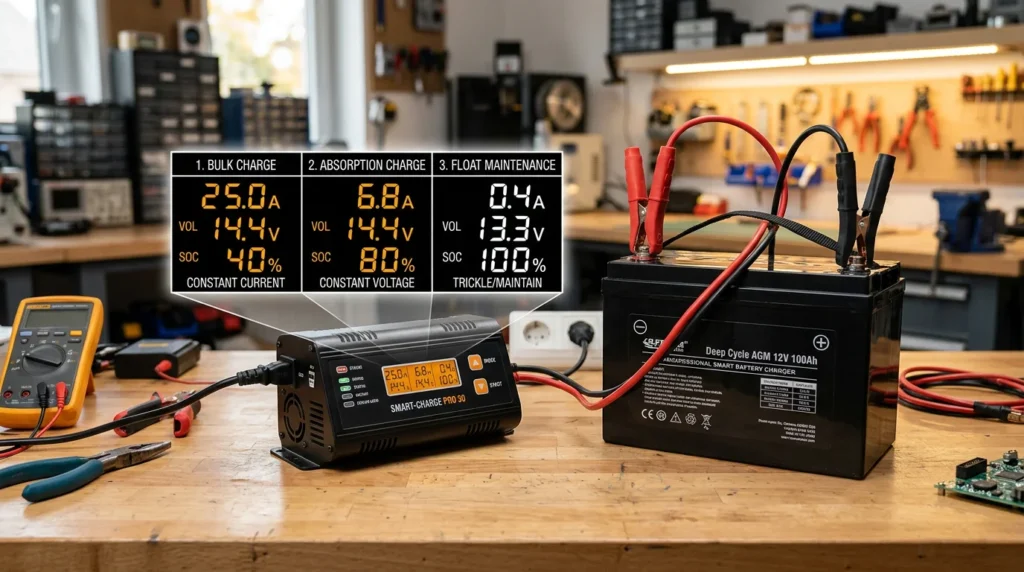
Correct charging does as much work in camper battery health maintenance as correct discharge management. Both overcharging and undercharging cause battery degradation through different mechanisms, and both are easily prevented with the right charger and the right settings.
Three-stage charging for lead-acid batteries is the standard that all quality lead-acid chargers implement: bulk charge (high current to approximately 80% SOC), absorption charge (reduced current at constant voltage to bring cells to 100% SOC evenly), and float charge (maintenance voltage that compensates for self-discharge without overcharging). Using a single-stage charger that applies constant current without transitioning through these stages overcharges the battery during the absorption phase, generating excess heat and driving off electrolyte in flooded types.
The correct float voltage for lead-acid batteries is 13.2 to 13.4 volts. Float voltages above 13.8 volts cause continuous electrolyte loss in flooded batteries and accelerated plate degradation in sealed AGM variants. Many RV converter-chargers ship with factory settings above the correct float voltage, and adjusting this single parameter extends lead-acid battery service life significantly.
Equalization charging for flooded lead-acid batteries is a periodic high-voltage charge (typically 15.5 to 16.0 volts for 2 to 4 hours) that dissolves accumulated sulfation from battery plates and balances cell voltages across the battery bank. Equalization should be performed every 30 to 90 days on flooded batteries that are regularly cycled. AGM and gel batteries must never be equalized: the sealed construction cannot vent the hydrogen gas produced at equalization voltages, creating pressure buildup that ruptures the case.
Lithium iron phosphate charging uses a simpler two-stage protocol: constant current charge to the target voltage (typically 14.2 to 14.6 volts for a 12V LiFePO4 battery) followed by a constant voltage absorption phase at the same voltage until current drops below a threshold. LiFePO4 batteries do not require or benefit from a float charge stage. Applying a continuous float voltage to a fully charged LiFePO4 battery stresses the cells at the top of their charge range and reduces cycle life over time.
Critically, never charge LiFePO4 batteries below 32°F (0°C). Lithium plating occurs when lithium ions are forced into the anode structure at sub-freezing temperatures, permanently reducing capacity and creating internal short-circuit risk. Quality LiFePO4 batteries with integrated BMS systems include a low-temperature charging cutoff that prevents this automatically. Budget LiFePO4 batteries without this protection rely entirely on the user not charging in freezing conditions.
Solar charging systems require a charge controller matched to the battery chemistry. MPPT controllers (Maximum Power Point Tracking) with selectable battery profiles deliver the correct charging protocol for whichever chemistry is installed. A PWM controller on a lithium battery bank applies a charging profile that leaves the battery perpetually at 70 to 80% SOC rather than achieving full charge, representing a significant waste of both solar potential and battery capacity.
Terminal Maintenance: The Overlooked Foundation
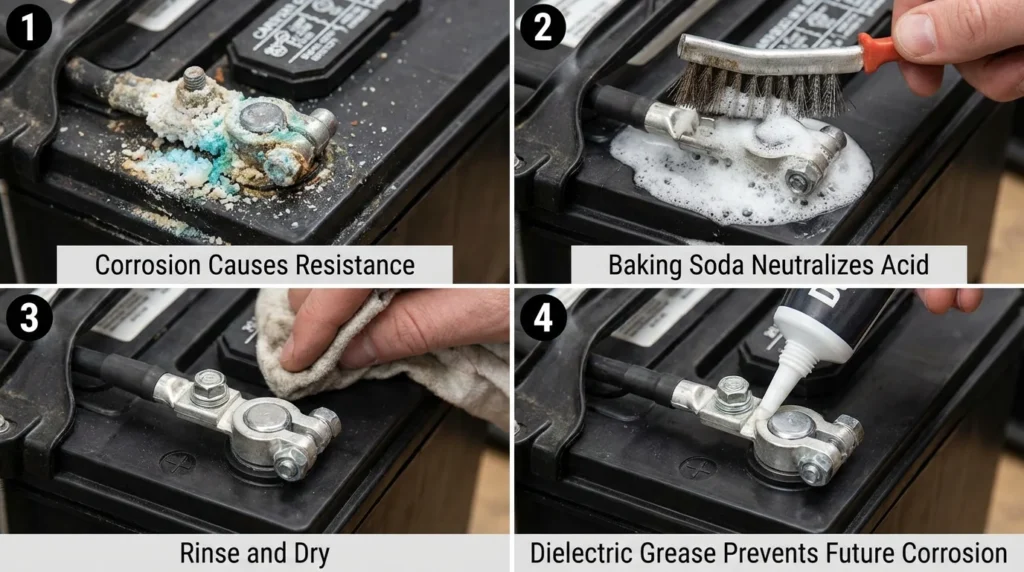
Corroded or loose battery terminals are the most common cause of intermittent power failures, charging inefficiency, and inaccurate voltage readings in RV and camp power systems. They are also the easiest camper battery health maintenance task on this entire list.
For lead-acid batteries, terminal corrosion appears as white, blue, or green crystalline buildup around the terminal posts and cable connections. This corrosion is primarily lead sulfate and copper sulfate from off-gassing during charging, and it is electrically resistive: a heavily corroded terminal connection can add 0.3 to 0.5 volts of resistance drop across what should be a near-zero resistance connection, causing your charger to shut off early and your loads to underperform.
Clean lead-acid terminals with a solution of one tablespoon of baking soda dissolved in one cup of water, applied with a stiff brush. The baking soda neutralizes the acid residue and dissolves the corrosion. Rinse with clean water, dry thoroughly, and apply a thin coat of dielectric grease or dedicated terminal protector spray to both posts and cable ends before reconnecting. Inspect and clean every 1 to 2 months during active use and before every storage period.
For lithium iron phosphate batteries, the sulfuric acid off-gassing that causes heavy corrosion on lead-acid terminals does not occur. Terminal maintenance is simpler: wipe terminals and cable ends with a dry cloth to remove any oxidation, check that all connections are torqued to the manufacturer’s specification (loose lithium terminal connections generate heat under high current loads), and apply a light coat of contact protector. Check every 3 months during active use.
A terminal torque check is a step most campers skip entirely. Battery cables that are hand-tight rather than torqued to specification work loose over road vibration and temperature cycling, creating resistance that builds heat and degrades both the terminal and the cable end over time. Most 12V battery terminals spec a torque of 6 to 11 Nm depending on terminal type. A small torque screwdriver or wrench handles this in under two minutes per battery.
The complete terminal maintenance protocol fits naturally into the broader pre-trip inspection routine covered in the camper maintenance checklist guide, where battery terminal check is one of the 50 pre-trip tasks that prevents field power failures.
Water Level Maintenance for Flooded Lead-Acid Batteries
This section applies exclusively to flooded (wet cell) lead-acid batteries. AGM, gel, and all lithium batteries are sealed and require no electrolyte maintenance.
Flooded lead-acid batteries lose water from their electrolyte during charging as electrolysis splits water molecules into hydrogen and oxygen gas that vents through the cell caps. This water loss is normal and expected, but it must be compensated by adding distilled water at regular intervals to maintain the correct electrolyte level covering the battery plates.
Check electrolyte levels monthly during active use and before any storage period. Remove each cell cap and inspect the electrolyte level. The correct level is approximately 1/8 inch below the bottom of the plastic fill tube inside each cell, or the level indicator if your battery has a built-in indicator. Plates that are exposed above the electrolyte surface sulfate rapidly and permanently lose capacity.
Add only distilled water. Tap water contains dissolved minerals including calcium, iron, and chloride that coat the battery plates and inhibit the electrochemical reaction, reducing capacity irreversibly. Deionized water is an acceptable alternative. Never add electrolyte (battery acid) unless refilling a battery that has physically lost electrolyte through spillage. The electrolyte concentration self-regulates through normal charging, and adding acid to a battery that has only lost water over-concentrates the electrolyte and damages the plates.
Add water after charging rather than before. Adding water before a charge cycle can cause the expanded and gassing electrolyte to overflow, losing acid and leaving a corrosive residue on the battery top and surrounding surfaces. Post-charge water addition allows the electrolyte to stabilize before the level check.
Long-Term Storage: The Protocol That Determines What You Find in Spring
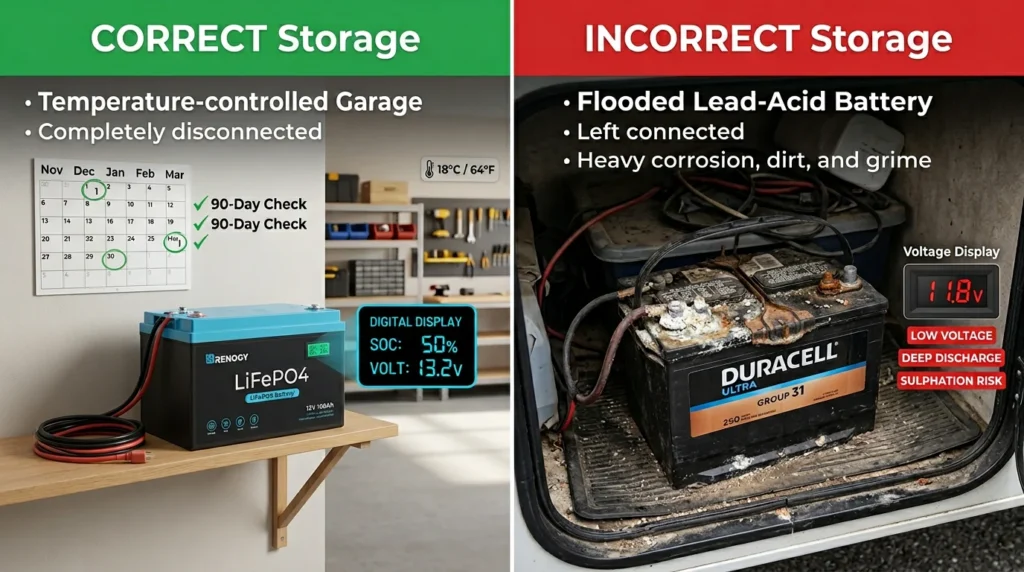
Improper battery storage during the off-season is the most common source of premature battery replacement in the camping and RV world. A battery stored incorrectly for four months ages the equivalent of two years of normal cycling.
Storing lead-acid batteries for the off-season:
Charge the battery to 100% state of charge before disconnecting. A lead-acid battery stored below full charge undergoes progressive sulfation during storage that is proportional to the depth of discharge at storage time. A battery stored at 50% SOC for four months loses significant capacity to sulfation that may or may not be recoverable with equalization.
Disconnect the negative cable or install a battery disconnect switch to eliminate parasitic draw from RV electronics. A typical RV draws 20 to 50 milliamps of parasitic load from clocks, control boards, and detectors with the main switch off. Over four months, this parasitic draw can discharge a 100Ah battery to a damaging state of charge.
Store in a cool, dry location between 50°F and 80°F (10°C and 27°C). Heat accelerates self-discharge and electrolyte loss. Cold above freezing is acceptable and actually slows self-discharge. A battery stored at 32°F self-discharges approximately 1% per month. The same battery stored at 77°F self-discharges 6 to 8% per month.
Check voltage every 30 days during storage. Recharge immediately if voltage drops below 12.4 volts. Never allow a lead-acid battery to remain below 12.2 volts for extended periods during storage. Use a smart maintenance charger (Battery Tender, NOCO Genius, or equivalent) set to its maintenance mode rather than a continuous trickle charger. A maintenance charger monitors voltage and cycles on only when needed. A continuous trickle charger applied for four months overcharges and heats the battery through the very same electrolysis it was meant to prevent.
Storing lithium iron phosphate batteries for the off-season:
LiFePO4 batteries are significantly more forgiving of storage conditions than lead-acid alternatives. The recommended storage state of charge is 40 to 60% SOC rather than 100%, because storing LiFePO4 cells at maximum charge for extended periods stresses the cells at the upper end of their voltage range and reduces cycle life. Store at half charge, not full.
Self-discharge rate for LiFePO4 is 1 to 3% per month, meaning a battery stored at 50% SOC in November will retain 44 to 47% SOC by March with no maintenance charging required. Check SOC every 3 months during storage and recharge to 50% if it has dropped below 20%.
Store in temperatures between 32°F and 95°F (0°C and 35°C). LiFePO4 chemistry does not suffer freeze damage from cold storage at or above freezing in the way that flooded lead-acid batteries can crack from frozen electrolyte. However, never store below 32°F if the battery BMS does not include low-temperature protection.
Battery Monitoring: The Tool That Makes All Other Maintenance Effective
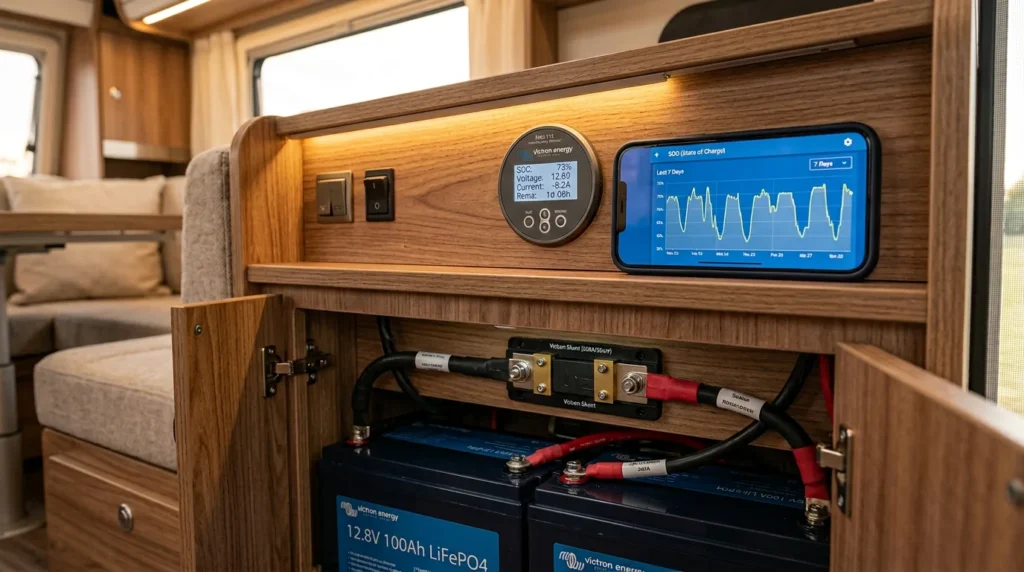
All camper battery health maintenance protocols depend on knowing your battery’s actual state of charge. Estimating SOC from brief voltage checks while loads are connected or charging is ongoing produces inaccurate readings that lead to incorrect decisions. A dedicated battery monitor is the hardware foundation of effective camper battery health maintenance.
A battery monitor with shunt-based coulomb counting (measuring actual current flowing in and out of the battery) provides continuous, accurate SOC readings regardless of load or charging conditions. The Victron BMV-712 Smart and Renogy 500A battery monitor are the two most widely recommended options for RV and camp power systems: both provide real-time SOC, voltage, current, power consumption, and historical data via Bluetooth to a smartphone app.
Voltage-only monitoring is significantly less accurate than shunt-based coulomb counting, particularly for LiFePO4 batteries whose voltage curve is extremely flat across 20 to 80% SOC, making voltage alone a poor indicator of actual charge state. A LiFePO4 battery that reads 13.2 volts could be anywhere from 20 to 95% SOC depending on load and rest conditions without shunt-based measurement.
For portable power stations, the manufacturer’s onboard display provides SOC data directly, typically via LED bar indicators or digital percentage displays. These are generally accurate within 5 to 10% and are sufficient for portable station management without an external monitor.
The monitoring capability also integrates naturally with the broader camp power management system. Understanding daily consumption versus daily solar input versus battery SOC trend is what allows proactive power management rather than reactive scrambling when the battery bank hits a low-SOC alarm. The camp lighting and power gear guide covers the full camp power management framework that a battery monitor feeds into.
Deep Cycle vs Lithium: The Maintenance Comparison at a Glance
| Maintenance Factor | Flooded Lead-Acid | AGM Lead-Acid | LiFePO4 Lithium |
|---|---|---|---|
| Safe discharge depth | 50% max | 50% max | 80 to 90% |
| Charging stages required | 3-stage + equalization | 3-stage only | 2-stage, no float |
| Float voltage | 13.2 to 13.4V | 13.2 to 13.4V | Not recommended |
| Equalization charging | Every 30 to 90 days | Never | Never |
| Water level check | Monthly | Never (sealed) | Never (sealed) |
| Terminal cleaning frequency | Every 1 to 2 months | Every 1 to 2 months | Every 3 months |
| Storage SOC | 100% | 100% | 40 to 60% |
| Storage check interval | Every 30 days | Every 30 days | Every 90 days |
| Charging below 32°F | Acceptable with reduced rate | Acceptable with reduced rate | Never |
| Self-discharge per month | 10 to 15% | 3 to 5% | 1 to 3% |
| Expected cycle life | 300 to 500 cycles | 400 to 600 cycles | 2,000 to 5,000 cycles |
Frequently Asked Questions About Camper Battery Health Maintenance
Q: How often should I check my camper battery as part of regular maintenance?
For flooded lead-acid batteries in active use, check electrolyte levels and terminal condition monthly and verify state of charge weekly. For AGM lead-acid batteries, check terminals monthly and SOC weekly. For LiFePO4 batteries in active use, check terminal torque and SOC monthly. All battery types require pre-trip and post-storage checks as part of the complete camper maintenance checklist review.
Q: What voltage should my 12V camper battery be at when fully charged?
For flooded and AGM lead-acid batteries, a resting voltage (measured after 1 hour off charge with no loads) of 12.6 to 12.7 volts indicates full charge. For LiFePO4 batteries, a resting voltage of 13.3 to 13.4 volts indicates full charge. Voltage measured during charging or immediately after disconnecting the charger reads higher than the true resting voltage and should not be used for SOC assessment.
Q: Can I mix old and new batteries in my RV battery bank?
No. Mixing batteries of different ages, brands, or states of health in a series or parallel bank forces the healthier battery to compensate for the weaker one during every charge and discharge cycle. The stronger battery ends up overworked and reaches the weaker battery’s lifespan rather than its own. Always replace all batteries in a bank simultaneously and use identical makes, models, and production dates where possible.
Q: How do I know if my camper battery has sulfation damage?
Sulfated lead-acid batteries show several characteristics: significantly reduced capacity compared to the rated amp-hour value, voltage that drops quickly under moderate loads (indicating reduced active plate area), and a battery that accepts charge quickly but discharges in a fraction of the expected time. A battery desulfator or an equalization charge can recover mild sulfation. Severe sulfation producing hard crystalline deposits is irreversible and the battery requires replacement.
Q: Is it safe to leave my camper battery on a charger all winter?
For lead-acid batteries: safe only with a smart maintenance charger (Battery Tender, NOCO Genius) that cycles on and off based on battery voltage rather than applying continuous current. Continuous trickle charging over months overcharges and degrades lead-acid batteries. For LiFePO4 batteries: not recommended. Store at 40 to 60% SOC disconnected, check every 90 days, and recharge if SOC has dropped below 20%.
Q: What is the biggest mistake campers make with battery maintenance?
Discharging lead-acid batteries below 50% SOC repeatedly. This single habit, draining the battery too deeply on a regular basis because nobody installed a monitor or set a load-disconnecting relay, is responsible for the majority of premature lead-acid battery replacements in RV and camp power systems. A $40 battery monitor and a $25 low-voltage disconnect relay, combined with a basic understanding of the 50% discharge limit, extend lead-acid battery life from 2 to 3 years to 5 to 7 years.
Q: Does temperature affect camper battery health maintenance protocols?
Significantly. Heat accelerates chemical reactions inside both lead-acid and lithium batteries, increasing self-discharge rate, accelerating electrolyte loss in flooded types, and reducing cycle life in both chemistries. Cold reduces available capacity: a lead-acid battery at 0°F delivers approximately 50% of its rated capacity. LiFePO4 batteries deliver 70 to 80% of rated capacity at 14°F. In cold weather camping, insulating your battery compartment and sizing your battery bank generously above calculated needs compensates for the temperature-related capacity reduction. The cold-weather power management principles apply across the full camp lighting and power gear system.