

I’ve carried the same $20 folding knife for eight years, but when it comes to lighting, I’ve cycled through enough cheap headlamps to fill a landfill.
A few years ago, I was helping coordinate a search and rescue assist in the Tetons. The sun dropped behind the peaks, and suddenly, the terrain went from “challenging” to “lethal.” One of the volunteers had a bargain-bin flashlight that flickered out ten minutes into the dark. He became a liability instantly. We had to guide him out while looking for the lost hiker.
That night reinforced a rule I live by: darkness is the most underrated hazard in the backcountry. Whether you’re trying to find the latrine at 2 AM or navigating a rocky trail, you need reliable photons. And in today’s world, keeping those lights on means understanding power, too. Let’s cut through the tech specs and talk about what actually works.
The Headlamp: Your Primary Tool
If you buy only one light, make it a headlamp. Hands-free lighting isn’t a luxury; it’s a necessity for cooking, pitching tents, or emergency first aid.
But skip the gimmicks. You don’t need 1,000 lumens to roast marshmallows. For 90% of campers, 300 to 400 lumens is the sweet spot. Anything brighter usually burns through batteries too fast or requires a bulky heat sink.
Red Light Mode is Non-Negotiable
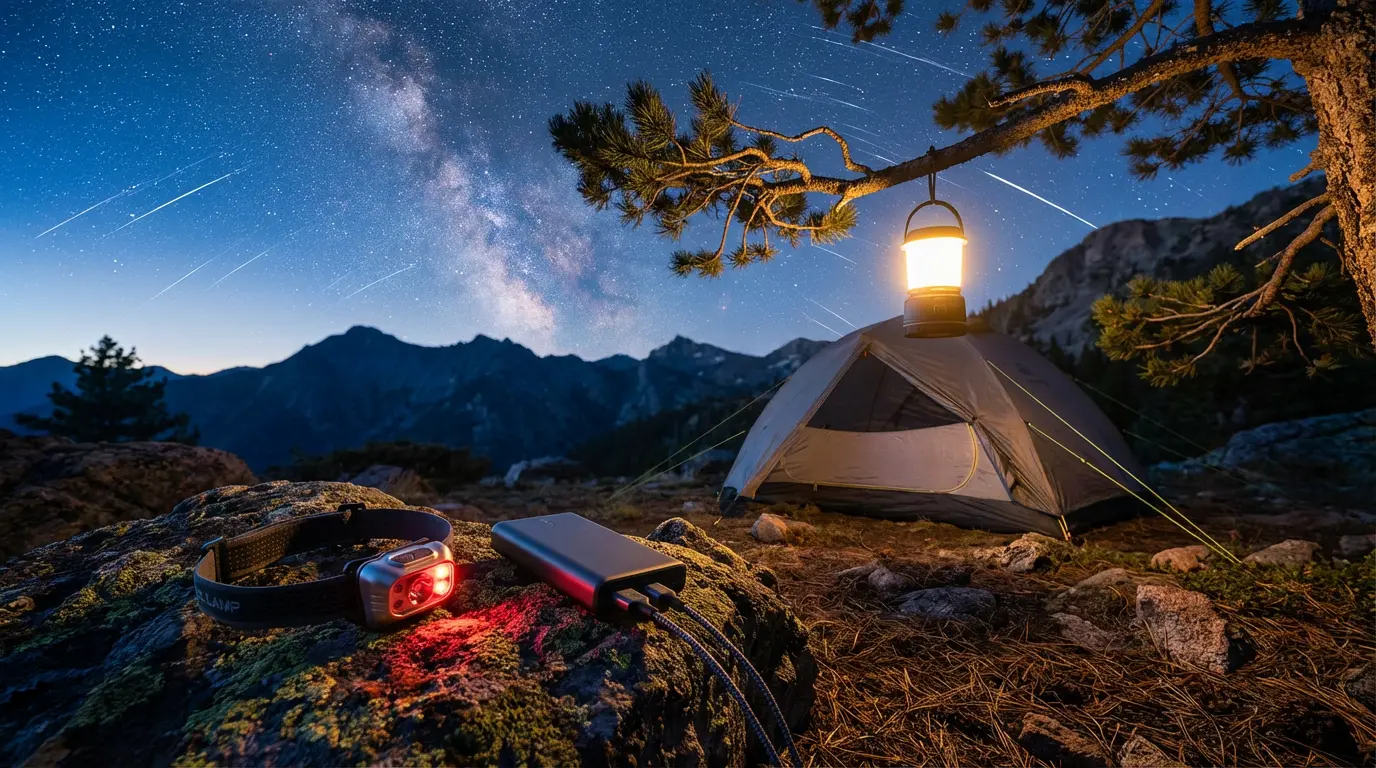
I won’t buy a headlamp without a red light setting. White light destroys your night vision instantly—and blinds your campmates. Red light lets you navigate camp without waking up the entire forest or ruining your ability to see the stars.
Rechargeable vs. Alkaline
I used to be a die-hard AAA battery guy because you can buy them at any gas station. But lithium-ion technology has won me over. Modern rechargeable headlamps hold a charge longer in the cold (alkalines die fast in freezing temps) and save you money long-term. Just make sure your headlamp has a “lock” mode so it doesn’t turn on inside your pack and drain the battery before you arrive. I learned that one the hard way.
Lanterns: Ambient vs. Glare
Here’s what usually happens: someone buys the brightest LED lantern on the shelf, sets it on the picnic table, and suddenly it feels like you’re being interrogated by the FBI.
The goal of a lantern is ambient light, not blinding power. You want a soft, diffused glow that lights up a workspace or tent. Look for “warm white” LEDs (lower Kelvin rating) rather than “cool white,” which feels harsh and sterile.
Honestly? A translucent Nalgene bottle filled with water, with a headlamp strapped around it facing inward, makes a better lantern than half the junk sold in outdoor stores. It diffuses the light perfectly. But if you want a dedicated unit, get one that hangs upside down. Lighting from above eliminates shadows.
Power Banks: The modern Fuel Canister
Ten years ago, running out of power meant your flashlight died. Today, it means your GPS, phone (camera/maps), and satellite communicator die. Power is safety.
For weekend trips, a simple 10,000mAh to 20,000mAh power bank is standard. Don’t let the numbers scare you—10,000mAh charges a standard smartphone about 2-3 times.
The Cold Weather Factor
Lithium batteries hate the cold. If you’re winter camping, keep your power bank in your sleeping bag or an inner pocket close to your body heat. I’ve seen full batteries read “0%” after an hour in near-freezing temps. Keep them warm, and they’ll perform.
Solar Chargers: managing Expectations
I see this constantly: a hiker straps a tiny solar panel the size of a playing card to their pack, expecting it to charge their phone while they walk through a dense forest.
It’s not going to happen.
Solar is great, but it requires direct, uninterrupted sunlight. To actually charge a phone, you need a panel with significant surface area (at least 10-15 watts). Those tiny panels built into power banks? They are emergency backups at best. If you’re base camping in the desert, grab a foldable 20-watt panel. If you’re hiking in the rainy Appalachians, leave the solar at home and just carry an extra battery brick. It’s lighter and more reliable.
Portable Power Stations: The Car Camping Game Changer
If you’re car camping and want to run a laptop, inflate mattresses, or keep a 12V fridge running, you’re looking at a “solar generator” or power station (like Jackery, Goal Zero, or Bluetti).
These are just giant batteries with AC inverters (wall outlets).
- Don’t buy based on peak wattage alone. Look at “Watt-hours” (Wh). A 500Wh station runs a 50W device for roughly 8-9 hours (accounting for efficiency loss).
- Weight is the enemy. These things are heavy. I treat them like car parts—they stay in the vehicle or at the base camp picnic table.
The “One is None” Rule
In the ranger service, we have a saying: “Two is one, and one is none.” Electronics fail. batteries corrode. Cold kills charges.
My system is simple:
- Primary: A quality rechargeable headlamp.
- Backup: A tiny, coin-cell “e-lite” or backup flashlight in my first aid kit.
- Power: A reliable 10,000mAh bank with short, sturdy cables.
Don’t overcomplicate it. You don’t need to light up the woods like a stadium. You just need enough light to see the root that’s trying to trip you, and enough power to call for help if you fall.