Most people buy a tent the same way they buy a winter coat they look at the color, check the price, and read a few reviews. Nobody reads the spec sheet. Then they wonder why they wake up wet.
Fabric is where a tent either earns its price tag or quietly fails you. Not the pole structure. Not the zipper count. The fabric. I spent five years designing tents for a major outdoor brand, and I can tell you that material selection is the single most consequential decision made at the engineering stage. Everything else pole geometry, vestibule size, door placement is secondary to what that nylon or polyester or canvas is actually capable of doing in a storm at 2 AM.
This guide cuts through the jargon. Denier ratings, hydrostatic head, UV degradation, silicone versus polyurethane coatings we’re going to cover all of it in plain language, because understanding these numbers changes how you buy tents forever.
What Denier Actually Means (And Why People Get It Wrong)
Denier (D) is a unit measuring the linear mass density of individual fibers essentially, how thick and heavy each thread is. Higher denier means thicker, heavier yarn. Thicker yarn generally means more abrasion resistance and tear strength.
But here’s the mistake almost everyone makes: they treat denier as a direct measure of quality. It isn’t. It’s a measure of thread thickness, and the right denier depends entirely on the application.
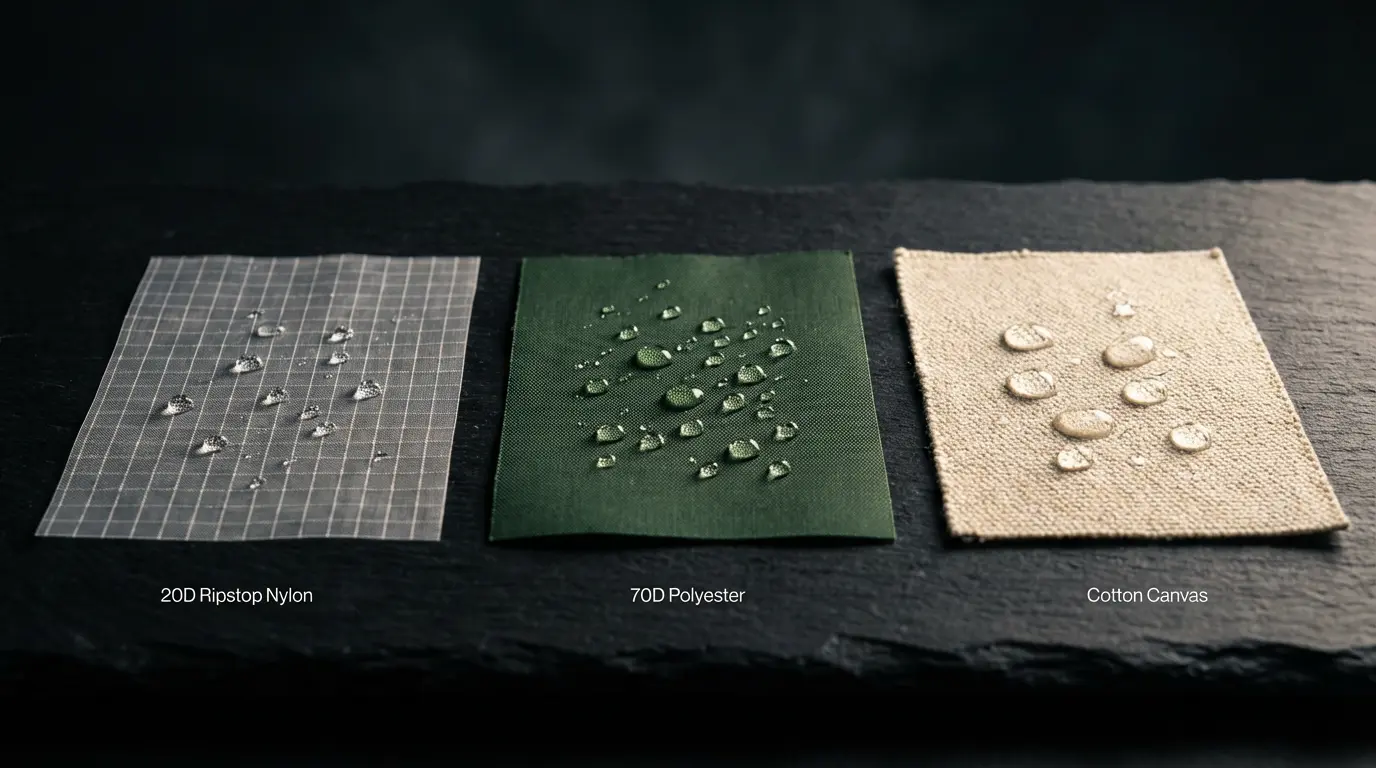
Backpacking tents typically run 20D to 40D nylon. That’s intentionally thin because saving weight is the primary design goal. A 20D ripstop nylon fabric can weigh under 50 grams per square meter and still handle trail conditions when the weave and coating are properly engineered. Push it against granite or drag it through brush, and you’ll find its limits fast. But use it correctly on a cleared, debris-free site and it performs beautifully for years.
Car camping and family tents use 50D to 75D polyester as standard. The extra thread mass absorbs more abuse: rough campground surfaces, gear piled against the walls, UV exposure across multiple seasons. You won’t save weight, but you gain a fabric that forgives rough handling without complaining.
Canvas operates on a completely different measurement system GSM (grams per square meter), typically 300 to 400 GSM. Canvas isn’t competing in the denier game at all. Its durability comes from fiber density and weave structure, not synthetic polymer engineering.
The Hydrostatic Head Rating: Reading the Number That Matters Most

The hydrostatic head (HH) rating measures how much water pressure a fabric can withstand before it leaks, expressed in millimeters. Think of it as a column of water standing vertically on the fabric the higher the number, the taller the column the material resists before water forces through.
Here’s a practical breakdown of what the numbers mean in real conditions:
- Below 800mm: Not waterproof. For decorative or dry-weather use only.
- 1000–1500mm: Light rain protection. Adequate for mild conditions and short-duration showers.
- 1500–3000mm: Genuinely waterproof. Handles sustained moderate rain and standard camping conditions.
- 3000mm and above: High-performance waterproofing for heavy rain, alpine exposure, and multi-day storms.
Backpacking nylon tents typically carry ratings of 1200 to 3000mm. Family polyester tents commonly run 1500 to 4000mm. Canvas achieves water resistance through a fundamentally different mechanism more on that shortly.
One critical nuance that I see ignored constantly: a high HH rating doesn’t automatically mean a dry night. A well-ventilated double-wall polyester tent rated at 2000mm can outperform a single-wall tent rated at 4000mm, because condensation management matters just as much as raw waterproofing. The rating tells you what the fabric resists; it doesn’t tell you what the overall design manages. When choosing your complete camp sleep system, consider HH ratings alongside ventilation design they work together.
Nylon: The Backpacker’s Fabric
Nylon is the dominant fabric in backpacking tents for one primary reason: unmatched strength-to-weight ratio.
Ripstop nylon woven with a reinforcing grid pattern that prevents tears from propagating delivers excellent tear resistance even at low denier counts. A tiny puncture in standard nylon becomes a spreading tear under tension. In ripstop, that same puncture stops at the nearest reinforcing thread. For a fabric intended to live in a compressed stuff sack and be stretched taut repeatedly under varying conditions, ripstop construction is almost mandatory.
The coatings make the fabric waterproof. Raw nylon absorbs water. Manufacturers apply either:
- Silicone coatings (Silnylon/Silpoly): Applied to both sides, creating a fully waterproof, low-friction surface. Extremely durable and lightweight. The downside: seams cannot be taped because tape won’t bond to silicone they must be seam-sealed with liquid sealant.
- Polyurethane (PU) coatings: Applied to the underside. Less water-resistant than silicone initially but allows for heat-taped seams, which is simpler and more reliable for mass production.
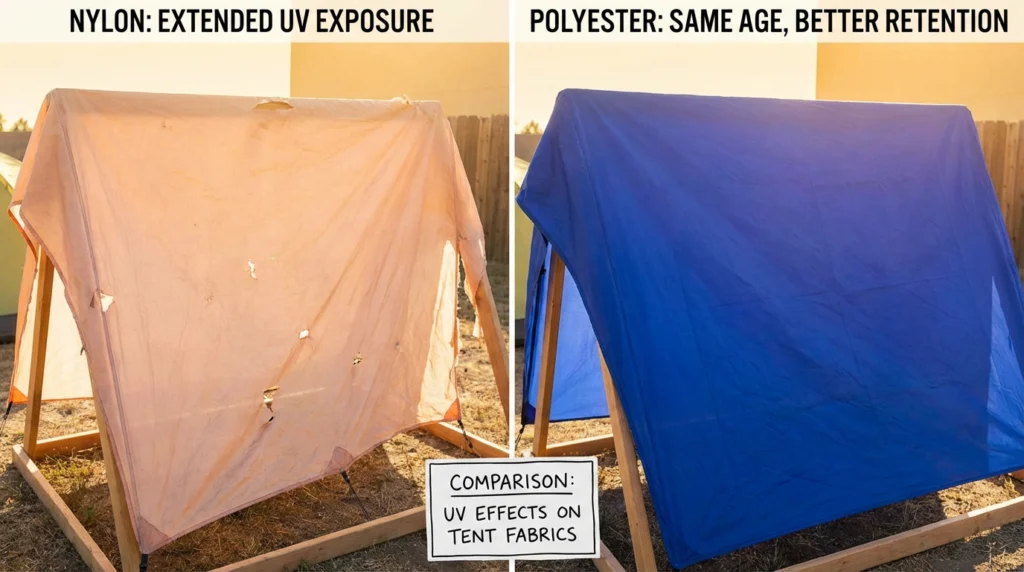
Nylon’s critical weakness is UV degradation. Left in direct sunlight over multiple seasons, nylon loses tensile strength faster than polyester. If your tent lives pitched for weeks at a time in strong sun, nylon rainflies will degrade more visibly than polyester alternatives. Always store nylon tents dry and out of UV exposure when not in use.
Nylon also stretches when wet sometimes noticeably. Guy lines and stake points can go slack after rain, requiring re-tensioning to maintain proper pitch geometry. Silicone-coated nylon (Silnylon) stretches more than polyester-coated versions, which is worth knowing before you’re adjusting your pitch in the dark during a storm.
Polyester: The Weatherproof All-Rounder
Polyester has quietly become the dominant fabric in family and car camping tents, and for good reason: it does almost everything well without excelling dramatically at any single trait.
Unlike nylon, polyester is inherently non-absorbent. It sheds water naturally before any coating is applied. Add a PU coating and you have a highly waterproof fabric that doesn’t stretch when wet, maintains its pitch geometry through overnight downpours, and stays relatively quiet in wind compared to heavily coated nylon.
Polyester’s standout advantage is UV resistance. Polyester retains 20 to 30 percent more tensile strength than comparable nylon after extended UV exposure. For rental fleets, base camp tents, or any shelter left pitched for extended periods, polyester’s UV stability translates directly into a longer service life.
The trade-off is weight and breathability. Polyester runs heavier than equivalent nylon for the same strength level, which is why you won’t find it in serious ultralight backpacking shelters. It also breathes less efficiently than canvas, making condensation management more reliant on ventilation design.
For understanding how polyester tents perform structurally under wind and rain, the principles covered in the dome tent vs cabin tent guide apply directly geometry amplifies or limits what the fabric can actually do.
Canvas: Weight, Age, and Breathability Done Right
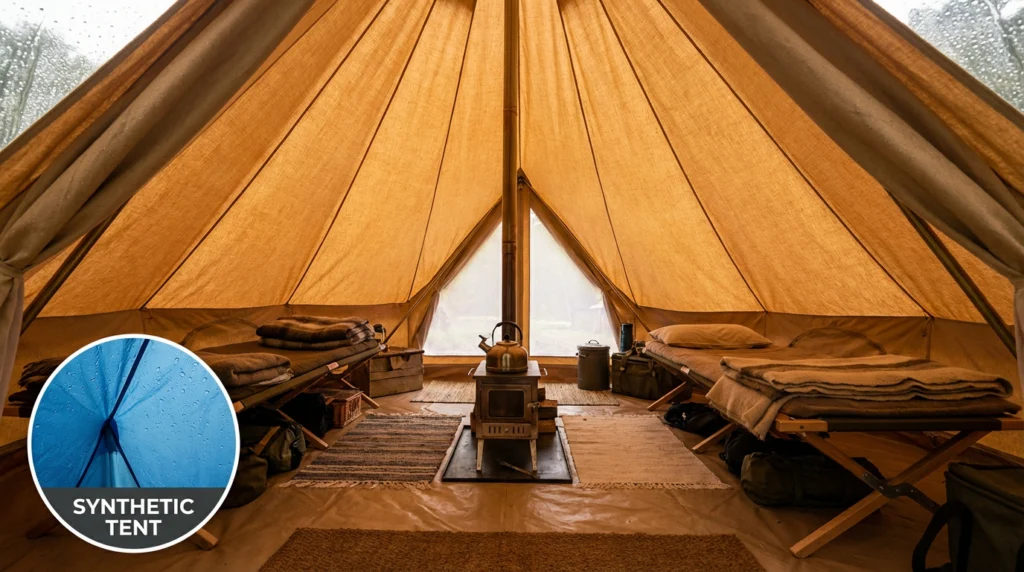
Canvas is the oldest tent material in common use, and in several critical areas, it still hasn’t been surpassed.
Cotton canvas waterproofs itself through a completely different mechanism than synthetic fabrics. When the cotton fibers absorb water, they swell and physically close the gaps in the weave, creating a water-resistant barrier without any chemical coating. This natural self-sealing process means canvas actually gets more waterproof as it ages and seasons the opposite trajectory from PU-coated synthetics, which degrade over time.
Breathability is canvas’s defining advantage. Human respiration generates up to one liter of water vapor per person per night. Synthetic tents trap this vapor, which condenses on interior walls and drips. Canvas allows vapor to migrate outward through the weave, maintaining genuinely drier interior conditions especially valuable in humid climates and during extended stays.
Canvas handles UV exposure and abrasion better than most synthetics, with a lifespan measured in decades rather than seasons when properly maintained. The trade-offs are significant: canvas is heavy (a family canvas tent can weigh 30 to 60 pounds), it must be dried completely before storage to prevent mildew, and it costs substantially more than polyester alternatives.
Polycotton a canvas/polyester blend splits the difference. It’s lighter than pure canvas, retains much of the breathability advantage, and dries faster. For base camp or car camping applications, polycotton deserves serious consideration as a middle-ground material.
Coating Technologies: What Goes On Top Matters
The fabric is only half the equation. The coating defines waterproof performance.
PU coatings have one consistent failure mode: delamination. Over time, the polyurethane layer separates from the fabric base, appearing as peeling or a sticky inner surface. Once delamination begins, the waterproofing fails progressively. High-quality PU coatings last longer, but no PU coating lasts indefinitely. This is why canvas tents, which require no synthetic coating for basic function, can genuinely outlast synthetic counterparts by years.
Ripstop Weave: The Tear-Prevention Architecture
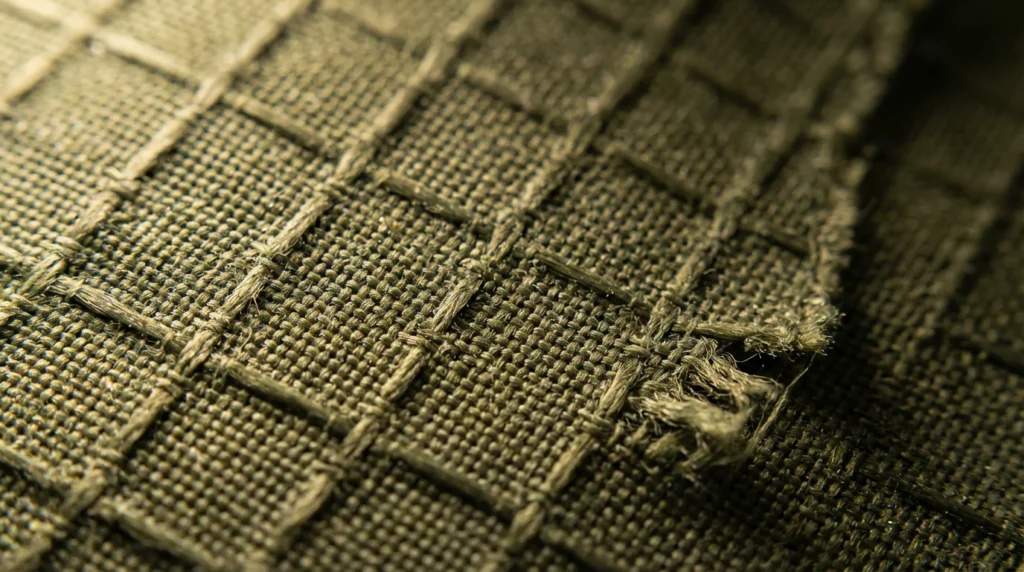
Not all fabrics within a given material use the same weave. Ripstop deserves specific attention because it fundamentally changes performance at low denier counts.
A ripstop weave incorporates thicker reinforcing threads at regular intervals typically every 5 to 8mm forming a visible grid pattern across the fabric surface. When a puncture or tear initiates, it propagates until it reaches the nearest reinforcing thread, where it effectively stops. Without ripstop, the same tear spreads unchecked.
For backpacking tents using 20D to 30D fabrics, ripstop is essentially mandatory. The base denier is too low to resist tear propagation without the reinforcing grid. For heavier car camping fabrics at 60D and above, the base fabric already provides enough resistance that ripstop becomes optional rather than essential though it remains a useful feature.
Full Material Comparison
Which Fabric Should You Actually Buy?
The right material isn’t the one with the highest specs it’s the one aligned with how you actually camp.
Choose nylon if you’re backpacking, counting every ounce, and camping on clean surfaces where you control what the tent floor contacts. You’ll accept the UV trade-off and the re-tensioning after rain in exchange for a shelter that weighs almost nothing. Understanding alternative camping shelters like Silnylon tarps extends this same logic further into ultralight territory.
Choose polyester if you car camp, stay at established sites, leave your tent pitched for multiple days in sun, or want a fabric that ages predictably and requires minimal technical maintenance. It’s the most practical all-round choice for the majority of campers.
Choose canvas if you base camp for extended periods, prioritize breathing air that doesn’t feel like the inside of a plastic bag, and can accept the weight and drying discipline the material demands. Pair it with a solid camping layering system and your interior microclimate stays genuinely comfortable in conditions that leave synthetic tent users fighting condensation.
Whatever fabric you choose, your shelter’s performance depends on the entire system around it. The best tent fabric in the world doesn’t compensate for poor site selection, inadequate camping lighting and power gear for nighttime camp management, or a sleep system that doesn’t match the temperature range. Fabric is the foundation everything else builds on top of it.