

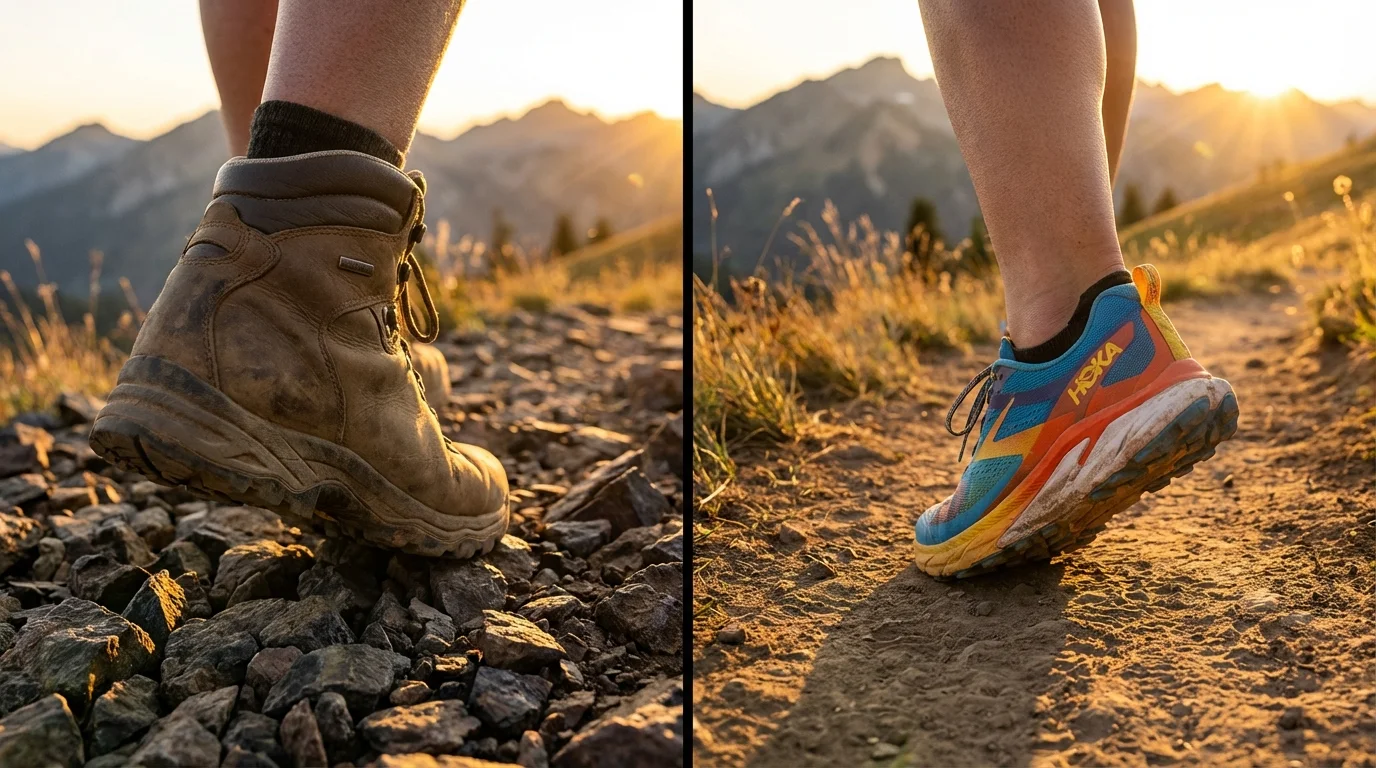
The debate started around a campfire in the Cascades three seasons ago, when a client with brand-new leather boots watched a thru-hiker in beat-up trail runners pass us for the second time that day on a technical ridge section. “Why are her feet faster than mine?” he asked, genuinely confused.
The answer wasn’t simple then, and it isn’t simple now. Hiking boots vs trail runners is one of those gear debates that generates strong opinions from both sides, and honestly, both sides are right, depending on what you’re doing and where you’re doing it. I’ve guided trips in both, thru-hiked in both, and tested everything from budget trail runners to $400 leather mountaineering boots. This guide cuts through the noise.
The Core Trade-Off You Need to Understand First
Before comparing specific features, you need to understand the fundamental engineering trade-off that defines both categories.
Hiking boots prioritize protection and stability at the cost of weight and flexibility. Taller collars, stiffer midsoles, and reinforced uppers create a system that physically supports the ankle joint and shields your foot from impact with rocks, roots, and rough terrain. You feel less of the ground beneath you. That’s a feature, not a flaw, when the ground is hostile.
Trail runners prioritize ground feel and speed at the cost of protection and load-bearing capacity. A lower, lighter, more flexible platform encourages your foot and ankle to move naturally, builds proprioceptive strength over time, and reduces the energy cost of every stride. You feel more of the ground. Again, that’s intentional.
Neither is universally superior. The right choice lives at the intersection of your terrain, your load, your experience level, and how your specific body moves. Choosing based on aesthetics or brand loyalty is how you end up miserable at mile eight.
Ankle Support: The Most Misunderstood Factor
Let’s address the most persistent myth in footwear: that high ankle collars prevent ankle sprains.
They don’t, not in the way most people assume. The majority of ankle sprains on trail occur when the foot lands on an unstable surface and the ankle rolls faster than any external support can respond. The roll happens in milliseconds, faster than a boot collar can react mechanically. What high collars actually provide is proprioceptive feedback, a sensory signal that tells your neuromuscular system where your ankle is in space, and some resistance against extreme range-of-motion events like stepping into a hole.
For people recovering from ankle injuries, carrying heavy loads of 40-plus pounds, or hiking on genuinely loose, unpredictable terrain like talus fields and scree, that structural support is meaningful and real. The external reinforcement compensates for reduced ankle stability caused by injury or fatigue under heavy load.
For fit, experienced hikers on established trails carrying lighter packs, trail runners actually develop better ankle stability over time through natural strengthening of the tendons and supporting muscles. The ankle learns to stabilize itself because it has to, which creates more durable joint resilience than relying on external support.
The honest answer: boots support ankles that need support. Trail runners build ankles that become stronger over time. Both are valid approaches for different populations.
Weight: The Number That Multiplies With Every Step
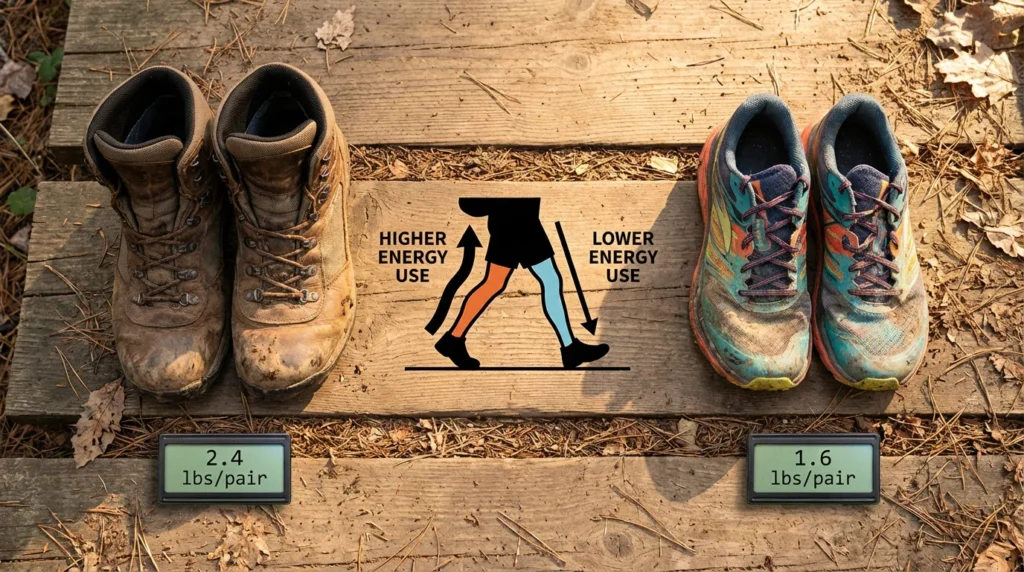
The weight difference between hiking boots and trail runners is not trivial, and I want to give you the math that makes it tangible.
A standard midweight hiking boot runs 2 to 3 pounds per pair. A quality trail runner runs 1.5 to 2 pounds per pair. That difference, roughly half a pound to a pound total, sounds minor until you account for the biomechanics of walking.
Each pound of weight on your feet costs approximately 5 times more energy than the same pound on your back. On a 10-mile hiking day involving roughly 20,000 steps, that half-pound difference at your feet translates to a meaningful energy expenditure gap by afternoon. Experienced ultralight hikers and thru-hikers understand this intuitively, which explains why trail runners dominate long-distance hiking culture regardless of terrain difficulty.
For day hiking or short overnight trips, this energy cost is unlikely to matter significantly. For week-long expeditions, it accumulates into real fatigue. Weight your footwear decision by trip length accordingly.
Waterproofing: Gore-Tex Isn’t Always the Answer
Almost every premium hiking boot offers a Gore-Tex or similar waterproof membrane lining. Most trail runners offer it as an optional variant. Here is the nuanced reality that gear marketing rarely explains honestly.
Waterproof membranes keep water out from external moisture sources, rain, puddles, dew-soaked grass, for a meaningful period. They also trap sweat vapor inside the boot, because water vapor cannot easily escape through the same membrane that keeps liquid water out. In warm or high-output conditions, this creates a boot that stays dry externally while your foot marinates in its own perspiration.
In cold, wet conditions below 45°F where you’re moving at moderate pace, waterproof boots genuinely outperform non-waterproof alternatives. Your sweat output is lower, external moisture is higher, and the membrane provides a real thermal benefit by preventing cold water infiltration.
In warm conditions above 55°F, on stream-crossing routes, or during any high-output activity, non-waterproof trail runners frequently leave your feet drier than waterproof boots, because they drain and dry rapidly rather than holding water inside a sealed membrane once it gets in.
The rules: waterproof boots for cold, damp, low-output conditions. Non-waterproof trail runners or boots for warm conditions, creek crossings, and sustained high output.
Durability and Terrain: Matching Footwear to Ground
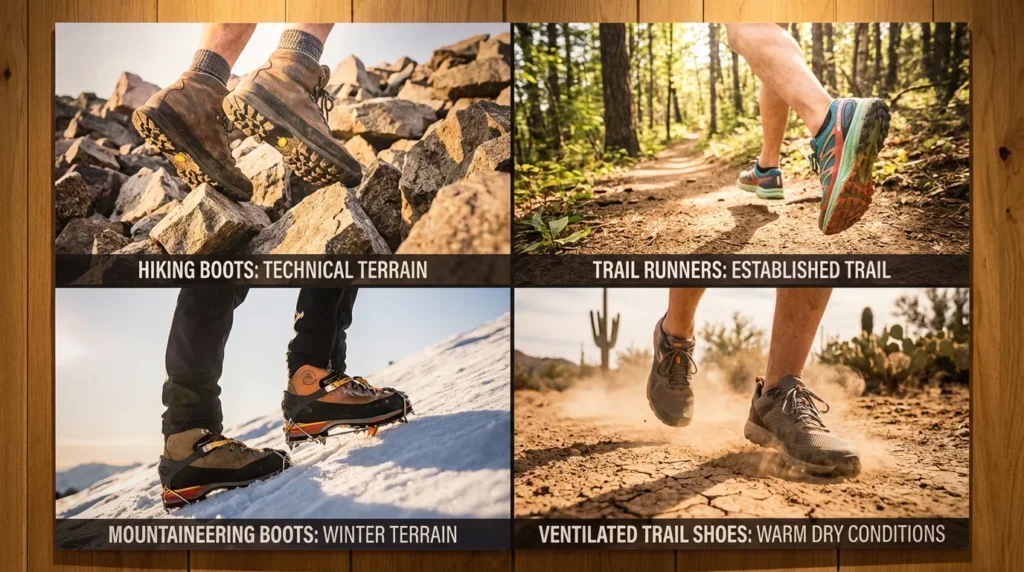
Terrain determines tool selection more than any personal preference should.
Choose hiking boots for:
Loose talus, scree, and boulder fields where rock edges threaten to damage a thin trail runner upper. Technical scrambling where a stiffer sole provides a rigid platform for standing on small footholds. Extended off-trail travel through brush and deadfall where low trail runner uppers guarantee debris inside your shoe within minutes. Multi-day trips carrying 40-plus pound packs where ankle stability under load becomes genuinely important. Snow travel, especially with microspikes or crampons, which require the rigid sole and secure fit that boots provide.
Choose trail runners for:
Established trail systems where surface hazards are manageable. Day hikes and overnight trips with lighter loads under 30 pounds. Long-distance routes and thru-hikes where energy efficiency over hundreds of miles outweighs per-step protection. Hot-weather conditions where breathability and fast-drying properties improve foot health more than protection matters. Technically runnable terrain where agility and ground feel matter more than stiffness.
The Best Performers in 2026
These are the options I currently recommend based on current testing and field use.
Hiking Boots:
The Salomon Quest 4 GTX remains the most versatile all-round hiking boot tested in its category. Supportive enough for heavy loads on technical terrain, light enough at 2.2 lbs per pair to not punish you on easier days. The Contagrip sole handles wet rock with genuine confidence.
The Merrell Moab 3 Mid Waterproof is the honest budget recommendation. Consistently comfortable out of the box, reliable waterproofing, and available in wide widths that most premium boots ignore. Around $130, it outperforms footwear twice its price on moderate trail systems.
For technical mountain terrain, the La Sportiva Trango Tech GTX delivers the stiff, precise platform serious scramblers require. Heavy at 3.1 lbs, not for casual hikers, but extraordinary on technical ground.
Trail Runners:
The Hoka Speedgoat 6 continues to lead the category for aggressive trail use. Maximum cushioning for its weight class, excellent traction on loose terrain, and wide enough to prevent the toe box compression that narrow trail runners cause on descents.
The Altra Lone Peak 8 serves the ultralight and thru-hiker community with its zero-drop platform and foot-shaped toe box. Not for everyone, the zero-drop geometry requires an adjustment period, but converts are fanatical about it for good reason.
The Saucony Peregrine 14 sits in the sweet spot of price and performance for recreational trail use, outstanding grip, reasonable durability, and priced around $140 where most serious trail runners sit.
Break-In Time: A Real Factor in Your Decision
Hiking boots, particularly full-grain leather models, require meaningful break-in periods before becoming comfortable on long days. Hotspots, blisters, and ankle abrasion during break-in are normal and worth anticipating. Never take brand-new hiking boots on a multi-day trip. The Danner Mountain 600 in leather, for example, requires approximately 15 to 20 miles of progressive wear before the leather conforms to your foot geometry. Premium synthetic boots like the Salomon Quest 4 break in faster, typically 5 to 10 miles.
Trail runners arrive essentially ready to wear. The softer, more flexible construction adapts to your foot immediately. For campers and hikers who make gear decisions close to their trip date, this matters practically.
Regardless of footwear choice, fit and function connect directly to the rest of your kit. The boots or trail runners you choose affect your energy levels, which affects how much you lean on your camping layering system for warmth management when you stop moving. They determine how much ankle and knee fatigue you carry into camp, affecting how well your 4-season sleep system actually restores you overnight. And their weight directly factors into your backpack carrying system calculations, since foot weight costs disproportionately more energy than pack weight.
Socks: The Variable Nobody Talks About Enough
I’ve seen hikers in $300 boots develop catastrophic blisters and hikers in $80 trail runners finish 25-mile days without a single hotspot. The difference was socks.
A quality wool or synthetic hiking sock provides padding at the heel and forefoot, moisture management against the skin, and reduces internal friction that causes blisters. The Darn Tough Vermont series in cushioned hiking weight is the most consistent performer across both boot and trail runner applications. The Smartwool Performance Hike Full Cushion is the merino alternative for campers who prioritize the odor resistance of wool over the faster drying of synthetic.
Never hike in cotton socks. This is the one absolute rule in footwear, with no exceptions.
The sock selection follows the same material logic covered in detail in the best base layers for camping guide, where moisture management at skin level determines comfort across every layer above it.