

Nobody talks about this part of camping until they absolutely have to, and by then they’re standing in a dark campsite at 2 AM with a flashlight, questionable options, and serious regret about not researching this before leaving home.
Sanitation is the gear category that gets systematically ignored during the fun part of trip planning, and it is the one that has the most direct impact on camp comfort, hygiene, environmental responsibility, and your campsite relationships with neighboring campers. A well-chosen and properly maintained portable camping toilet system turns one of the least glamorous aspects of extended camping into a complete non-issue. A poorly chosen or badly maintained one becomes the defining memory of the trip for everyone involved.
This guide covers every portable camping toilet system type available in 2026, from basic bucket systems to high-capacity composting units, with honest performance assessments, maintenance protocols, and the specific odor control chemistry that separates a functional system from an olfactory catastrophe.
Understanding the Portable Camping Toilet Category
The term “portable camping toilets” covers a wider range of designs and technologies than most buyers realize when they start researching, and the differences between systems are not merely cosmetic. Each system type handles waste through a different mechanism, requires different maintenance chemicals and protocols, has different holding capacity and weight implications, and is appropriate for a different set of camping use cases.
Buying the wrong type for your camping style is the primary reason portable camping toilets get negative reviews. A cassette toilet optimized for RV use installed in a tent camping setup creates exactly the kind of user experience that fuels one-star reviews, not because the product failed, but because the match between product design and use case was wrong from the start.
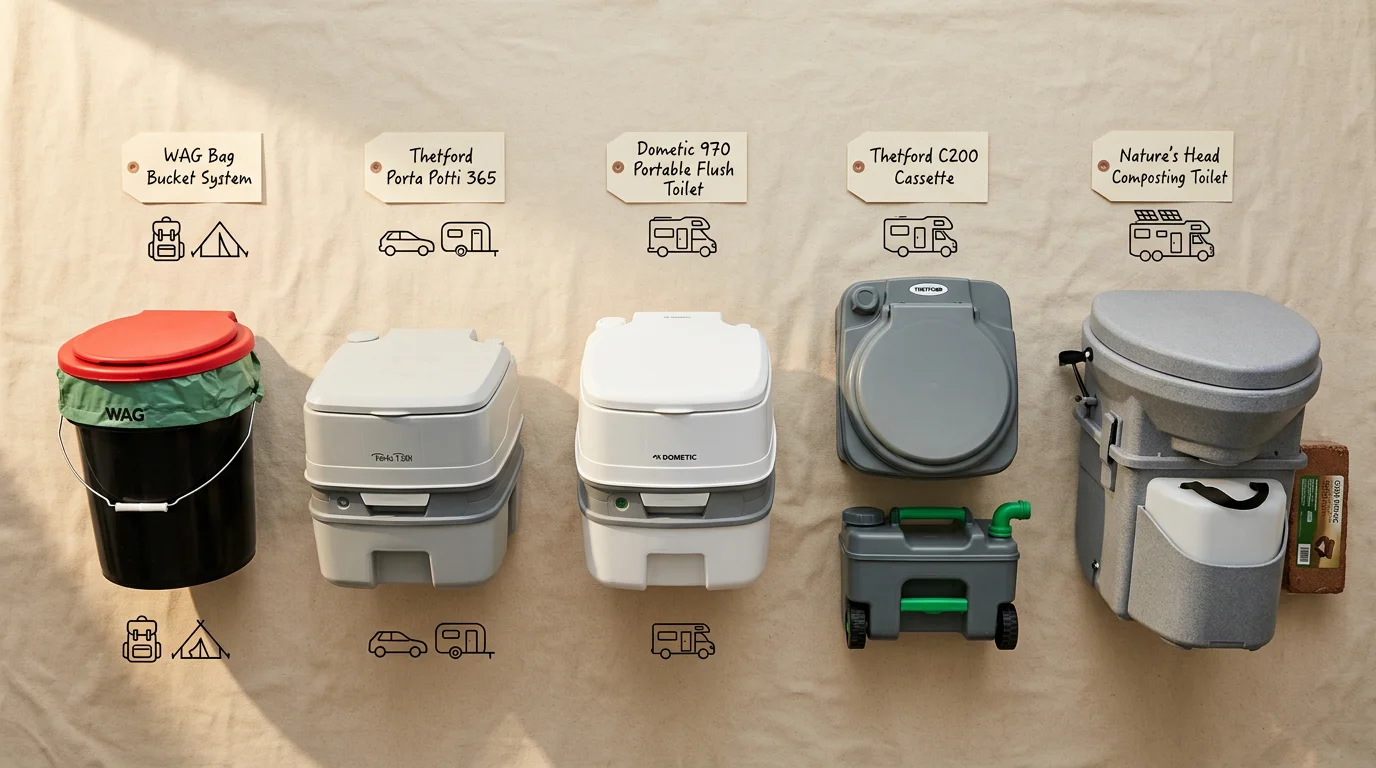
The five primary portable camping toilet system types are: basic bucket and bag systems, self-contained portable flush toilets, cassette toilets (RV-installed or portable), composting toilets, and incinerating toilets (a newer category primarily for off-grid cabins and high-end van builds). Each has a distinct place in the portable camping toilets landscape and distinct maintenance requirements.
Understanding which system your camping style actually needs is the foundational decision that makes every subsequent choice, including chemicals, holding capacity, and odor control strategy, make sense. The same systematic thinking that governs gear selection across your entire kit, covered comprehensively in the camper maintenance checklist guide, applies here: match the tool to the specific use case rather than buying the most feature-rich option available.
System Type 1: Bucket and Bag Systems
The simplest entry in the portable camping toilets category is also the most underestimated by new campers and the most respected by ultralight backpackers and off-grid minimalists who have used every system type and chosen this one deliberately.
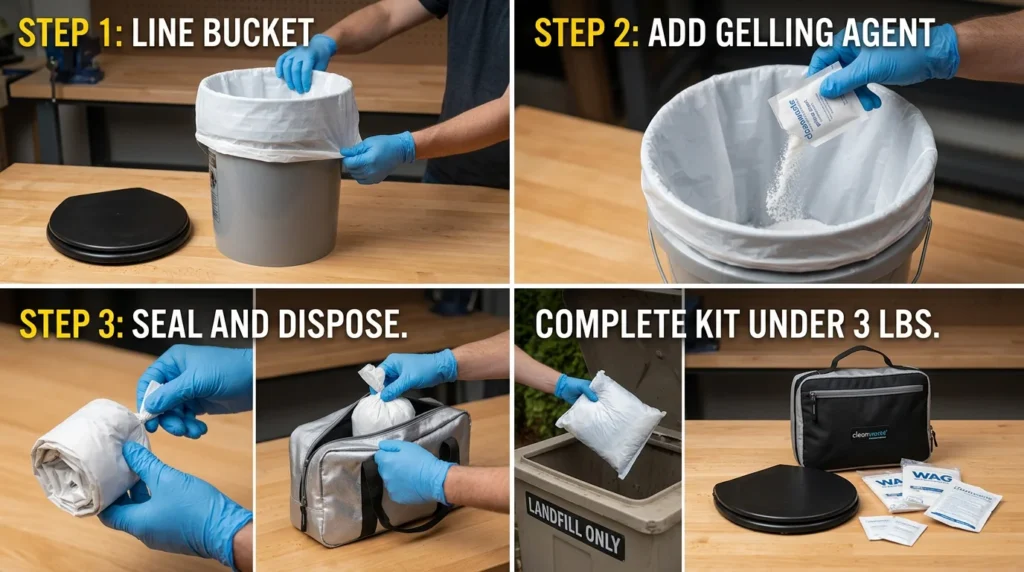
A basic bucket system consists of a 5-gallon bucket with a snap-on toilet seat lid, biodegradable WAG bags (Waste Alleviation and Gelling bags) or compostable liner bags, and a small supply of gelling powder or cat litter as a moisture absorber. The WAG bag lines the bucket interior, receives waste, absorbs and gels liquid with the gelling agent, and then seals for disposal in a standard trash receptacle. The bucket provides structural support and the toilet seat lid provides seating comfort and splash containment.
At approximately $25 to $40 for the complete setup and under $3 per use for WAG bags, this is the most affordable entry point into organized portable camping toilets systems. The weight (under 3 pounds complete with several bags) makes it viable for car camping and base camp setups where the bucket can be transported to the site and stored in a vehicle between uses.
The honest limitations: no holding tank means each use produces a bag for disposal, requiring access to trash disposal infrastructure. It provides no odor containment between uses beyond the sealed bag itself. For multi-day backcountry camping where pack-out waste disposal is required by land managers (most permit areas in the American Southwest), WAG bags are the specifically required system that every other portable camping toilet alternative is measured against.
The Cleanwaste GO Anywhere Toilet Kit and Restop RS2 are the two most field-proven WAG bag systems, both meeting the requirements of land management agencies including the National Park Service and Bureau of Land Management for pack-out waste disposal. Neither product can be substituted with generic garbage bags, which do not provide the gelling, odor control, or structural integrity required for compliant waste pack-out.
System Type 2: Self-Contained Portable Flush Toilets
Self-contained portable flush toilets are the most recognizable entry in the portable camping toilets category and the most commonly purchased by car campers, van lifers, and tent campers making their first organized sanitation investment.
These units consist of an upper flushing tank holding fresh water (typically 3.5 to 5 liters) and a lower holding tank receiving waste (typically 9 to 20 liters depending on model). A piston or bellows flush mechanism moves water from the upper tank through the bowl with each flush, and a sealed valve between the upper unit and holding tank prevents odor from rising into the bowl between uses.
The Thetford Porta Potti 365 (9-liter holding tank, approximately $80) is the entry-level standard that most camping retailers stock as a default recommendation. The Thetford Porta Potti 565E (21-liter holding tank, electric flush, approximately $130) is the upgrade path for longer trips or larger groups where a smaller holding tank requires too-frequent emptying.
The Dometic 970 at approximately $120 is the primary Porta Potti competitor, using a different flush mechanism (a rotary pump rather than a bellows piston) that some users find more reliable under extended use. At equal price points, the Thetford units have broader aftermarket chemical compatibility and more widely available replacement seal kits. Both brands produce quality portable camping toilets with similar real-world performance.
Holding capacity planning is the most commonly underestimated variable in self-contained portable camping toilets selection. A standard 9-liter holding tank accommodates approximately 50 flushes using the minimum recommended water volume per flush. For a couple camping for a three-day weekend, this is adequate. For a family of four on a five-day trip, a 9-liter tank requires daily emptying that removes much of the convenience the system was purchased to provide.
A practical formula: multiply daily flushes per person (typically 4 to 6) by number of campers by number of days between dump station access. Add 20% safety margin. Match the result to the holding tank size of the portable camping toilet you’re considering.
System Type 3: Cassette Toilets
Cassette toilets are the permanent or semi-permanent installed portable camping toilets system found in the majority of RVs, camper vans, and some high-end overland trailers. They share the flush-and-hold mechanism of self-contained portable flush toilets but are integrated into the vehicle’s structure with a residential-style toilet bowl, a rotating blade seal between bowl and cassette, and an externally accessible cassette holding tank that slides out through a panel in the vehicle’s wall for emptying.
The key distinction from self-contained portable camping toilets is the separation between the residential-style fixed bowl and the removable holding cassette. The bowl and flush mechanism are permanent fixtures. The cassette is a removable 15 to 19-liter holding tank that slides out on a wheeled trolley for transport to a dump station or standard toilet.
Thetford C200 and C250 cassettes are the most widely installed units in RV manufacturing and the most commonly serviced in the aftermarket. The C200 uses a fixed blade seal, while the C250 adds a swivel blade that some users find easier to keep clean. Both systems require Thetford Aqua Kem or equivalent cassette-specific treatment chemicals in the holding tank to control odor and liquify solids.
Cassette toilet maintenance differs from self-contained portable camping toilets maintenance primarily in the seal care requirement. The rotating blade seal between bowl and cassette is the highest-wear component in the system and must be lubricated with a non-petroleum-based seal lubricant (Thetford Seal Lubricant Spray or equivalent) every 3 to 4 weeks of active use. Petroleum-based lubricants including WD-40 swell the seal rubber and cause leakage between the bowl and holding cassette, which creates exactly the odor situation the sealed valve exists to prevent.
System Type 4: Composting Toilets
Composting portable camping toilets are the fastest-growing category in the portable camping toilets market, driven by the van life and overlanding communities’ interest in waterless, odorless, and environmentally responsible waste management that does not require dump station access.
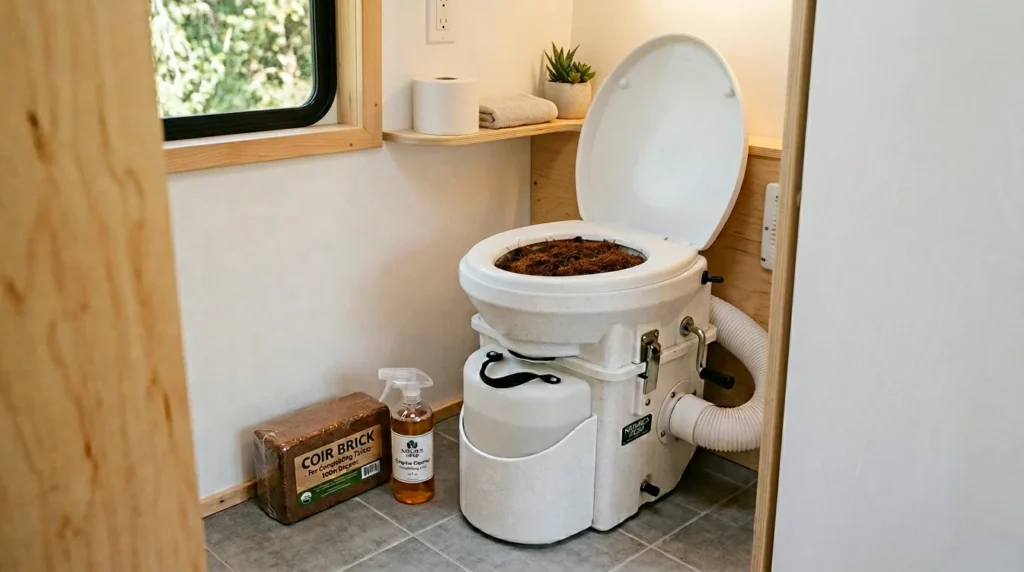
Composting toilets separate liquid and solid waste at the bowl level, preventing the mixture of urine and feces that generates the majority of toilet odor through ammonia production. The liquid diverter channels urine to a separate collection bottle (typically 1 to 2 liters) that can be diluted with water and disposed of in appropriate locations (away from water sources and per local regulations). Solid waste falls into a composting chamber containing a carbon-based bulking material (peat moss, coconut coir, or sawdust) that initiates aerobic decomposition.
The Nature’s Head Self Contained Composting Toilet is the market leader in portable composting units for van and overland use, with a 1.5-gallon solids chamber that accommodates one person’s waste for approximately 4 to 6 weeks before requiring emptying. Mature composted waste from a correctly managed Nature’s Head is a dark, soil-like material with no objectionable odor that can be disposed of in most campsite trash receptacles or in some cases used in non-food garden applications.
The Air Head Composting Toilet offers a similar mechanism with a slightly smaller footprint and a rotating drum in the composting chamber that mixes new waste with existing compost material more consistently than the Nature’s Head’s manual agitation handle. At $925 to $1,000, both units represent a significant investment compared to self-contained portable camping toilets, but for full-time van lifers and overland travelers who camp without dump station access for weeks at a time, they eliminate the recurring chemical cost, dump fee, and tank-emptying logistics of cassette and flush systems entirely.
The critical maintenance requirement for composting portable camping toilets is managing moisture content in the composting chamber. Too wet, and aerobic decomposition stalls, allowing anaerobic bacteria to establish, which produces hydrogen sulfide odor. Too dry, and the composting process slows significantly. The correct moisture level is described consistently as “wrung-out sponge”: the bulking material should hold shape when squeezed but not drip moisture. Monitor moisture with each inspection and adjust by adding dry coir if too wet or a small amount of water if the chamber is visibly desiccated.
The fan ventilation system in composting portable camping toilets is equally critical. A 12V fan runs continuously to draw air through the composting chamber and vent it through a hose to the vehicle exterior. This continuous airflow prevents pressure buildup that would push odors into the vehicle interior and maintains the aerobic environment the composting process requires. Any fan failure requires immediate attention before the composting process reverts to anaerobic conditions.
Odor Control Chemistry: The Difference Between Functional and Miserable
Odor control is the performance variable that users of portable camping toilets care most about after purchase and research least carefully before purchase. The chemical treatment you put in the holding tank or composting chamber has more impact on day-to-day experience than the toilet hardware itself.
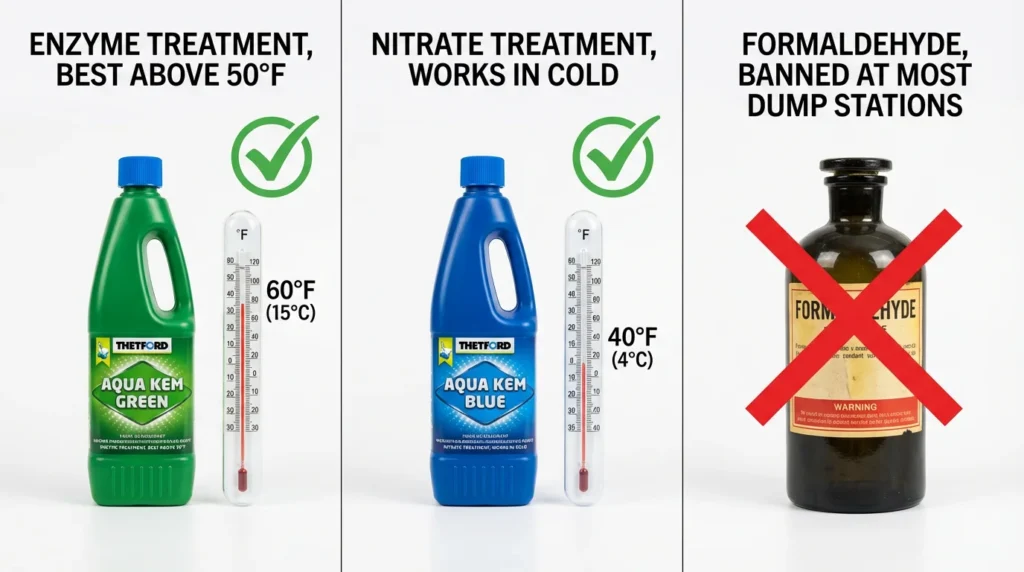
For self-contained flush toilets and cassette systems, holding tank treatments fall into three chemistry categories with meaningfully different performance profiles.
Formaldehyde-based treatments (now largely discontinued in quality products) were the original chemical approach to holding tank odor control. They work effectively but are toxic, banned at many campgrounds and dump stations, and environmentally damaging. If your toilet chemicals smell strongly of formaldehyde, they are an outdated product with no place in modern portable camping toilets management.
Enzyme-based treatments (including Thetford Aqua Kem Green, Camco TST Green, and Eco-Happy) use biological enzyme cultures that digest organic waste material and control odor through actual breakdown of odor-producing compounds rather than masking them with fragrance. Enzyme treatments are biodegradable, accepted at all dump stations and septic systems, and provide genuinely effective odor control when used at the manufacturer’s recommended dosage. They work best at temperatures above 50°F where enzyme cultures remain biologically active. In cold camping conditions below 50°F, enzyme activity slows and odor control performance decreases.
Nitrate-based treatments (including Thetford Aqua Kem Blue) use a different chemical mechanism that does not depend on enzyme activity and therefore maintains consistent performance across a wider temperature range including cold-weather camping. They are slightly more expensive than enzyme treatments but provide more reliable cold-weather odor control, making them the recommended choice for autumn camping, high-altitude use, and any conditions where holding tank temperature may drop below 50°F.
For composting portable camping toilets, odor control is managed through bulking material management and ventilation rather than chemical treatment. Coconut coir (compressed bricks that expand with water) is the most widely recommended bulking material for both odor neutralization and moisture management. Peat moss is an acceptable alternative but is harvested from non-renewable peat bog ecosystems that the outdoor community is increasingly moving away from. Avoid sawdust as a primary bulking material, it provides poor moisture management and poor odor neutralization compared to coir.
Cleaning and Maintenance Protocols by System Type
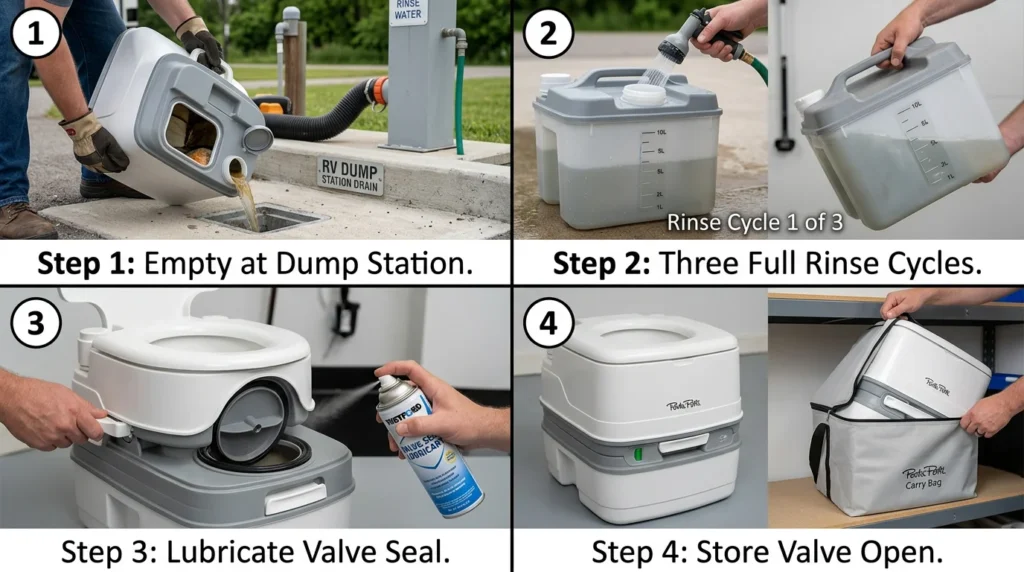
Portable camping toilets maintenance is not optional upkeep for the perfectionists. It is the direct determinant of how long the hardware lasts, how effectively the odor control system works, and whether you are actually comfortable using the system rather than avoiding it.
Self-contained flush toilet maintenance after each trip: empty the holding tank completely at a designated dump station or RV dump facility (never in a standard toilet without explicit permission from the facility owner). Rinse the holding tank three times with fresh water, using the flush mechanism to draw water through the valve seal on each rinse. Add half a tank of clean water with a cap of holding tank cleaner or diluted white vinegar, allow to slosh during transport home, then empty and rinse again. Store with the valve seal in the open position if storing dry for more than two weeks, as extended storage with the rubber seal compressed in the closed position can cause the seal to take a permanent set and leak on next use.
Monthly during active use: apply a small amount of seal lubricant appropriate for your toilet’s valve mechanism to the rotating or sliding seal. Wipe the bowl interior with a non-abrasive cloth and a toilet-safe cleaner. Never use abrasive scouring pads or standard household toilet bowl cleaners containing hydrochloric acid, both destroy the plastic bowl surface and degrade the chemical treatment in the holding tank.
Cassette toilet maintenance follows the same post-use protocol with the additional step of lubricating the blade seal every 3 to 4 weeks. Remove the cassette, clean the cassette interior and blade with a soft brush and diluted enzyme cleaner, inspect the blade seal for nicks or compression damage, apply lubricant to the blade seal face, and reinstall. The cassette vent cap should be opened before emptying to allow air intake during the pour, preventing the gurgling back-pressure that slows emptying and causes splashing.
Composting toilet maintenance requires emptying the solids chamber when it reaches approximately 2/3 full (not when completely full, which makes removal difficult and risks anaerobic conditions developing). Empty the liquid diverter bottle daily during active use, or whenever it reaches the fill indicator. Wipe the liquid diverter funnel clean with a damp cloth after emptying to prevent urine scale buildup that can cause the diverter to lose its hydrophobic surface treatment and allow urine to route into the solids chamber. A quarterly deep clean of the entire unit, including the fan, vent hose, and all interior surfaces, with a diluted enzyme cleaner maintains performance across the unit’s service life.
The detailed cleaning protocols for portable camping toilets integrate naturally with the broader camp systems maintenance approach covered in the annual RV roof maintenance guide, where systematic scheduled maintenance of every installed system prevents cumulative failures across a full camping season.
Choosing by Camping Style
The right portable camping toilet is not the one with the highest review count or the most features. It is the one that matches your specific camping use case, group size, and trip duration.
| Camping Style | Recommended System | Holding Capacity | Key Advantage |
|---|---|---|---|
| Backpacking and permit areas | WAG Bag bucket system | Single-use bags | Land manager compliant, ultralight |
| Weekend car camping, couple | Porta Potti 365 (9L) | Approx 50 flushes | Affordable, familiar flush experience |
| Extended car camping, family | Porta Potti 565E (21L) | Approx 90 to 100 flushes | Reduces emptying frequency |
| Van life and overland, short trip | Porta Potti 565E or Dometic 970 | 20 to 21L | Compact, no installation required |
| Van life full-time, no dump access | Nature’s Head or Air Head | Weeks between emptying | No dump station required |
| RV permanent installation | Thetford C200 or C250 cassette | 15 to 19L cassette | Residential feel, external access |
| Off-grid cabin or base camp | Composting or incinerating | High capacity | No waste transport infrastructure |
Your toilet system’s portability requirements also interact with your shelter and sleep system choices. A composting toilet installed in a van or camper requires a dedicated ventilation pathway through the wall or roof structure, which affects both the van conversion design and the overall camp setup workflow. Understanding these system interactions, including how your sleeping space, kitchen area, and sanitation zone relate to each other in a small camp or vehicle layout, is part of the complete camp organization thinking covered in the camper maintenance checklist guide.
Long-Term Storage and End-of-Season Care
End-of-season portable camping toilet storage is the maintenance step that determines whether your unit comes out of storage in spring in the same condition it went in, or with cracked seals, scale buildup, and chemical residue that requires a major cleaning investment before first use.
For flush and cassette toilets, the winter storage protocol is consistent across brands: empty completely, rinse three full cycles, add a small amount of non-toxic RV antifreeze (propylene glycol, not ethylene glycol automotive antifreeze) to the holding tank and flush mechanism if storing in an environment where temperatures will drop below 32°F. Propylene glycol prevents residual water in the flush mechanism, valve, and holding tank from freezing and cracking the plastic housing.
Store the unit with the valve in the open position to prevent seal compression set during long-term storage. Store in a clean, dry location away from direct UV exposure. UV degrades the polypropylene housing of most portable camping toilets significantly faster than physical use does.
For composting toilets, remove all remaining bulking material and waste from the solids chamber before storage. Clean the interior with a diluted enzyme cleaner, allow to dry completely, and leave the agitator hatch open for ventilation during storage. Disconnect the 12V fan power to prevent battery drain during storage if the unit is installed in a vehicle. Store the liquid diverter bottle separately after cleaning.
For WAG bag bucket systems, the bucket itself requires only a rinse and dry before storage. Inspect unused WAG bags for date expiration (gelling agents have a functional shelf life typically of three to five years) and replace any bags showing degraded packaging integrity or past their expiration date.
Integrating portable camping toilets end-of-season storage into the full suite of camp systems storage protocols, including battery systems, sleeping gear, and cooking equipment, ensures nothing is missed across any category. The camper battery health maintenance guide covers the parallel end-of-season protocols for power systems that undergo the same storage conditioning requirements.
Frequently Asked Questions About Portable Camping Toilets
Q: What is the best portable camping toilet for a first-time buyer?
The Thetford Porta Potti 365 for car campers and van users, and the Cleanwaste GO Anywhere Kit for backpackers and permit-area camping. Both represent the best combination of price, performance, and ease of use for first-time portable camping toilet buyers in their respective use cases. The Porta Potti 365 provides a familiar flush experience with adequate holding capacity for weekend trips, while the WAG bag system meets land manager requirements and imposes zero weight penalty for backcountry users.
Q: How do I control odor in a portable camping toilet?
Match your chemical treatment to your temperature conditions. Enzyme-based treatments (Thetford Aqua Kem Green, Camco TST Green) work well above 50°F and are the most environmentally responsible option. Nitrate-based treatments (Thetford Aqua Kem Blue) provide more consistent odor control in cold-weather camping below 50°F. Never underdose the chemical: a half-dose provides substantially less than half the odor protection. For composting toilets, the combination of correct moisture management in the solids chamber and a functioning 12V ventilation fan provides complete odor control without chemicals.
Q: Where do I empty a portable camping toilet?
Designated RV dump stations are the correct and legal disposal location for portable camping toilet holding tanks. These are available at most RV parks, many state and national campgrounds, some gas stations, and dedicated dumping facilities. Never empty a holding tank into a standard toilet, into a pit toilet, into gray water drains, or on the ground. WAG bags for pack-out systems are sealed waste bags designed for disposal in standard trash receptacles.
Q: How often do I need to empty a portable camping toilet?
Depends on holding tank size and usage rate. For a couple using a standard 9-liter flush toilet with 4 to 6 flushes each per day, expect to empty every 2 to 3 days. For a family of four on the same unit, expect daily emptying. Size your holding tank to your group and trip duration to reduce the frequency to a manageable interval. For composting units, the solids chamber on a Nature’s Head or Air Head accommodates one person’s waste for 4 to 6 weeks.
Q: Can I use regular household toilet cleaner in a portable camping toilet?
No. Standard household toilet bowl cleaners containing hydrochloric acid or bleach destroy the plastic bowl surface of portable camping toilets, degrade rubber valve seals, and kill the enzyme cultures in biological holding tank treatments. Use only cleaners specifically labeled as safe for portable toilet use. Diluted white vinegar is a safe general-purpose cleaning agent for plastic surfaces and does not harm valve seals or chemical treatments.
Q: Is a composting toilet worth the cost for casual camping?
Not typically. At $900 to $1,000, a composting toilet makes economic and practical sense for full-time van lifers, overlanders without regular dump station access, and off-grid cabin users who would otherwise pay recurring chemical and dump fee costs while managing ongoing cassette emptying logistics. For weekend campers with regular campground access and a dump station on route, a $80 to $130 flush toilet provides comparable day-to-day comfort with significantly lower upfront investment.
Q: What chemicals are safe for a composting portable camping toilet?
Composting toilets require no holding tank chemicals in the solids chamber. The composting process is entirely biological, and chemical treatments in the solids chamber kill the bacterial cultures responsible for composting. The liquid diverter bottle can be rinsed with diluted white vinegar to prevent urine scale buildup. Use only enzyme-based cleaners on the interior plastic surfaces, never bleach or acid-based cleaners that would inhibit future composting activity.