

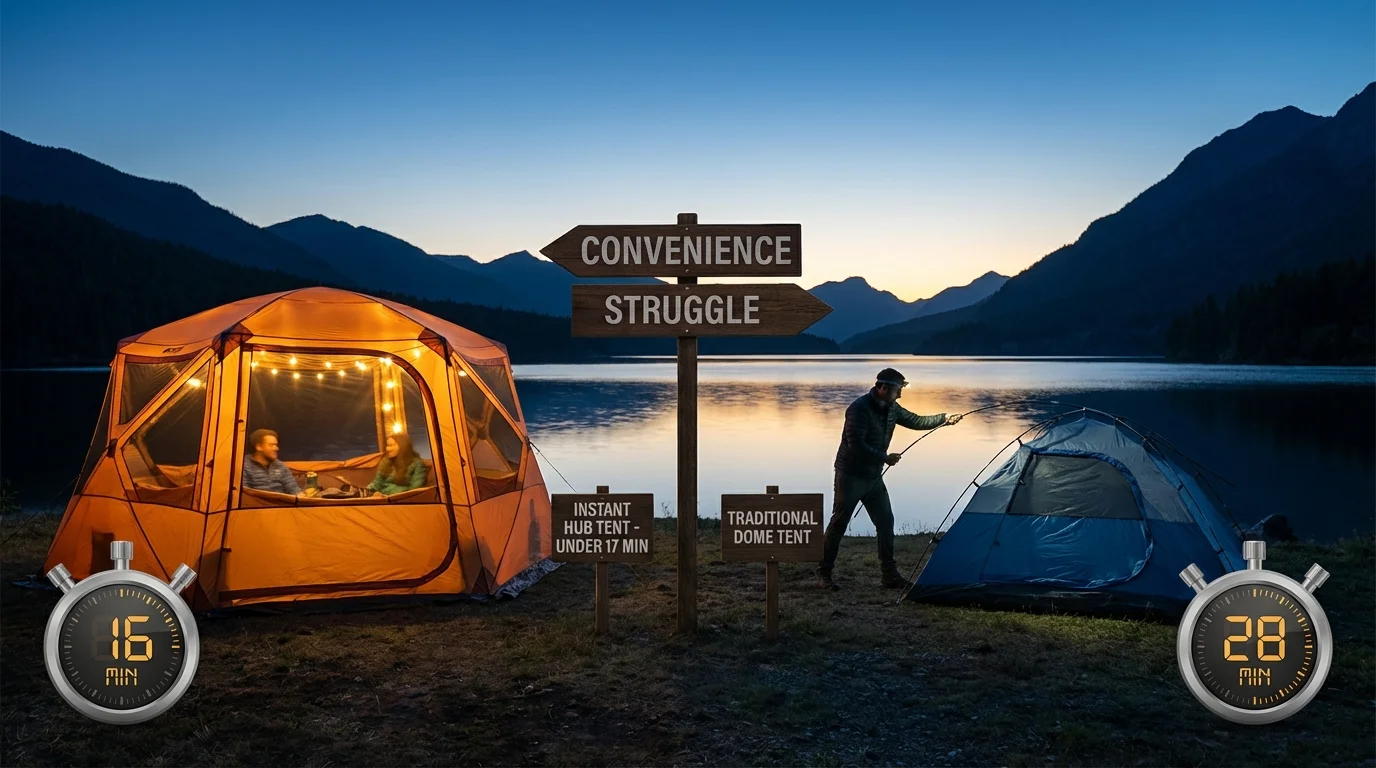
Here is a situation most campers know: you pull into the campsite at 7 PM after a three-hour drive with two tired kids, a dog, and a sky that is turning gray at the edges. Your traditional tent, the one with seventeen poles and a rainfly that requires reading the instructions each time, is sitting at the bottom of the gear bag. Forty-five minutes later, in the dark, you are still untangling guy lines.
That scenario is precisely what instant setup tents were designed to eliminate. And for a significant portion of the camping population, they do exactly that. But instant setup tents represent genuine engineering trade-offs that go beyond simple convenience, and understanding those trade-offs is what separates a great purchase decision from an expensive disappointment that sits in a garage after three uses.
This guide is an honest, experience-based evaluation of instant setup tents in 2026: how the technology works, which designs hold up and which ones disappoint, what you genuinely sacrifice in durability and packed weight compared to traditional alternatives, and exactly which camper profile will find them worth every dollar of their premium pricing.
What Instant Tents Actually Are :
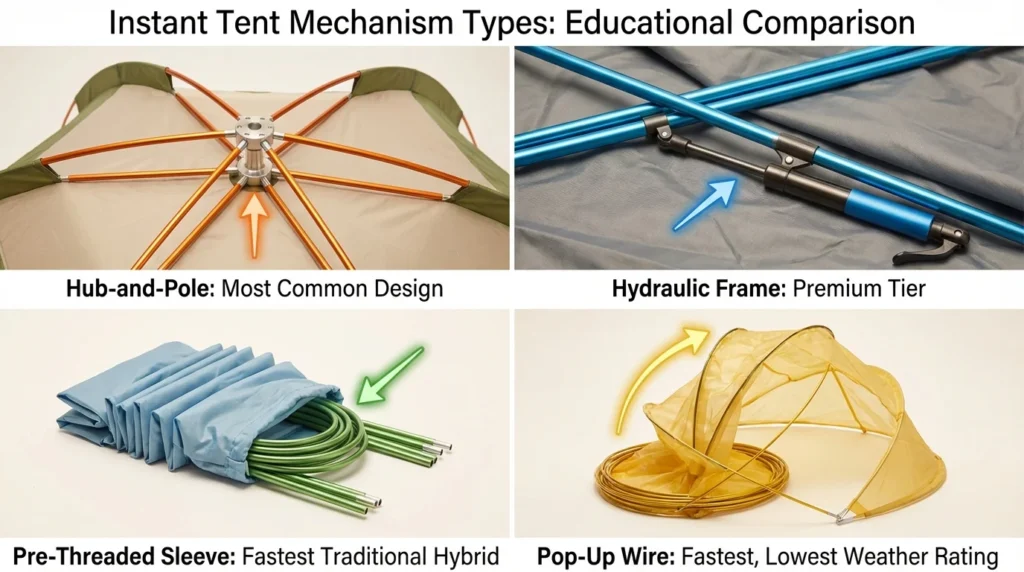
The term “instant setup tents” covers a wider range of designs than most buyers realize when they start researching. Not all quick-pitch shelters use the same mechanism, and the differences between design types have significant implications for durability, setup time, and long-term reliability.
Hub-and-pole instant setup tents use a pre-assembled pole structure where all poles are connected at a central hub and fold down accordion-style for storage. Pop-up the hub, the frame expands outward, and the tent body (pre-attached to the frame) rises with it. Coleman’s Instant Cabin series and Core Equipment’s Instant Tent line use this mechanism. Setup time for a 6-person hub tent runs 60 to 90 seconds for the frame deployment, plus 3 to 5 minutes for rainfly attachment and staking, for a realistic total of 5 to 7 minutes from bag to ready.
Hydraulic-frame instant setup tents are the premium tier of the instant setup tents category, used in high-end expedition and glamping applications. A hydraulic or gas-strut mechanism stores energy in compressed chambers that release on a single trigger, raising the entire frame structure simultaneously. These are the tents you see set up in 30 seconds flat in marketing videos, and the mechanism genuinely works as advertised. The trade-off is weight, complexity, and cost that puts them in a different budget category from hub-and-pole designs entirely.
Pre-assembled sleeve-and-pole instant setup tents use poles that are pre-threaded through the tent body at the factory and fold together without requiring re-threading on site. The Kelty Late Start and similar designs use this approach. They are not truly “instant” in the hub-pole sense but reduce a traditional 15 to 20-minute setup to 4 to 6 minutes through pre-threading alone.
Pop-up tents (distinct from hub-and-pole instant setup tents) use a coiled wire frame under tension that springs into a fixed shape when released from its compressed storage configuration. These are the circular beach and festival tents that expand in under 10 seconds. They are the fastest instant setup tents available and the ones with the most significant durability and weather performance limitations, primarily because the coiled wire frame cannot be configured for structural optimization the way traditional pole-and-hub designs can.
Understanding which mechanism a specific instant setup tent uses is the most important pre-purchase research step, because each design type has distinct strength and weakness profiles that determine which camping scenarios it handles well.
The Real Setup Time Comparison :
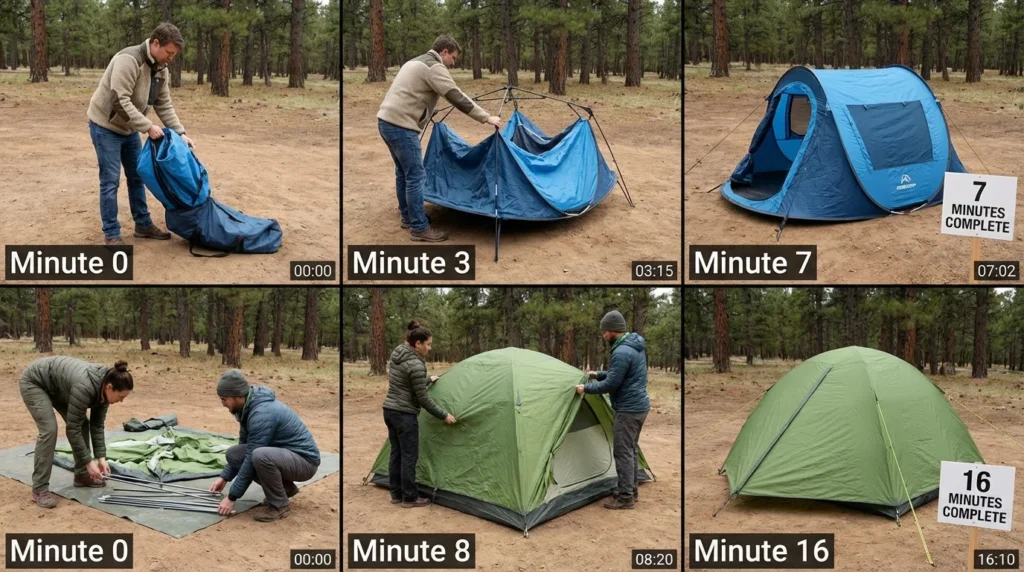
Marketing claims for instant setup tents deserve scrutiny because they are measured under conditions that rarely match real campsite scenarios. A “60-second setup” typically means one experienced adult on flat ground in good lighting, deploying only the tent body without the rainfly, with the tent already correctly positioned before timing begins.
For an honest setup time comparison across shelter types, here is what real-world field experience produces for a 4-person shelter:
A traditional freestanding dome tent with pre-attached poles requires 12 to 18 minutes for a first-time setup and 8 to 12 minutes for an experienced user. A traditional non-freestanding backpacking tent requires 15 to 25 minutes including guy line configuration.
A hub-and-pole instant setup tent of equivalent size requires 5 to 8 minutes for a complete setup including rainfly and staking, for both experienced and first-time users, because the assembly sequence is genuinely simpler and does not require learning pole threading or sequence.
A pop-up tent requires 1 to 3 minutes for body deployment but the same 3 to 5 minutes for rainfly and staking as any other design, making the effective complete setup time 4 to 8 minutes.
The time advantage of instant setup tents is real, particularly for families and infrequent campers where setup familiarity with traditional tents never develops through repetition. For experienced solo campers who have set up the same traditional tent hundreds of times, the time gap narrows considerably and the trade-offs in instant setup tents (weight, durability) become harder to justify.
The time advantage also compounds meaningfully over a weekend trip. Setting up on Friday evening, breaking down Saturday to move to a new site, and setting up again Saturday afternoon means the time difference between a traditional tent and an instant setup tent accumulates to 15 to 30 minutes of actual trip time saved. That is not negligible when you factor in tired children or weather pressure.
Durability : The Honest Assessment
Durability is where the honest evaluation of instant setup tents requires the most careful nuance, because the answer is genuinely “it depends” in ways that matter significantly to different buyer profiles.
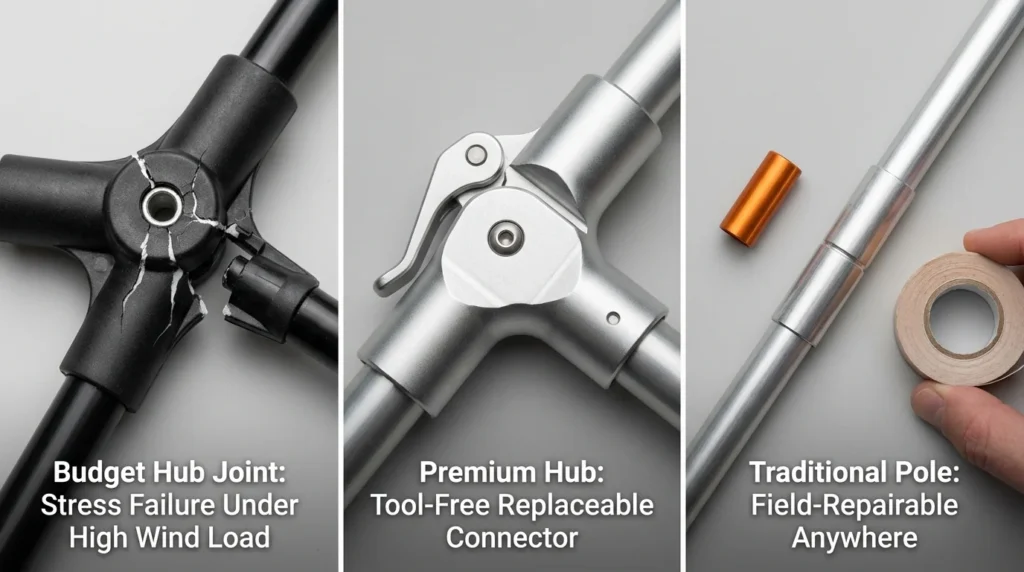
Frame durability is the primary concern with instant setup tents, and it is where the design trade-offs are most significant. Traditional tent pole systems, where individual pole sections are separate until assembly, allow damaged sections to be replaced individually. A broken pole section on a conventional tent is a $15 to $30 repair. A broken or bent hub on an instant setup tent may require replacing the entire frame assembly, which is either unavailable from the manufacturer or costs a significant fraction of the tent’s original price.
The integrated hub mechanism in most instant setup tents also creates stress concentration points at the hub joints that do not exist in straight-pole traditional designs. Under high wind loading, the force that would bend a single pole section in a traditional tent instead stresses the hub joint in an instant setup tent. Hub joint failures are the most commonly reported durability issue across instant setup tent reviews, and they occur disproportionately under wind loads that traditional tents of equivalent quality handle without damage.
Fabric durability in instant setup tents is generally comparable to traditional tents at equivalent price points. The same denier ratings, waterproof coatings, and seam construction are available in both design categories. The primary fabric concern specific to instant setup tents is the repeated fold-and-pack stress that pre-attached pole-and-fabric assemblies experience at the fold lines, where the fabric flexes through the same crease points every time the tent is packed. This accelerates coating delamination at fold lines faster than traditional tents where the fabric and poles are stored separately.
Rainfly performance in instant setup tents is frequently the weakest point in the design because the hub deployment mechanism requires the body and fly to deploy simultaneously or in a fixed sequence that limits how the fly is designed to shed water. Traditional tents allow optimal fly-to-body geometry across a wide range of designs. Instant setup tent flies are constrained by the frame geometry and often provide less vestibule coverage than equivalent traditional designs.
At the $150 to $250 price point, instant setup tents from Coleman, Core Equipment, and Ozark Trail provide adequate durability for 3-season car camping with moderate weather exposure. They are not appropriate for extended use in high-wind conditions, exposed alpine sites, or technical weather environments where a quality traditional tent is the correct tool.
At the $350 to $600 price point, instant setup tents from Kelty, Eureka, and Marmot incorporate higher-quality hub hardware and fabric that closes the durability gap with traditional tents significantly. These are the products that experienced campers who genuinely need the setup speed can choose without significant durability compromise in normal camping conditions.
Packed Weight and Transport Reality :
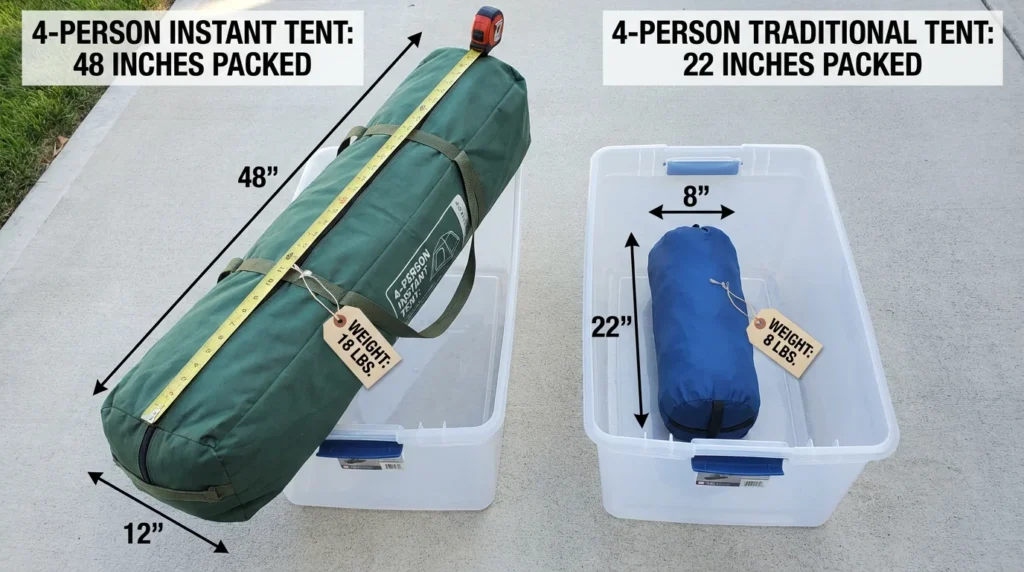
Packed weight is the specification category where instant setup tents consistently disappoint buyers who did not read the specs carefully before purchasing.
The pre-assembled frame structure of instant setup tents, where poles remain connected at hubs and threaded through sleeves, cannot be disassembled into the compact individual sections of a traditional tent pole set. This means the packed dimensions of instant setup tents are constrained by the minimum fold dimension of the integrated frame, which is consistently larger and heavier than an equivalent traditional tent.
A traditional 4-person dome tent packs into a stuff sack approximately 8 inches in diameter and 20 inches long, weighing 7 to 9 pounds. An instant setup tent for the same capacity packs into a bag approximately 8 inches in diameter and 36 to 48 inches long, weighing 12 to 18 pounds.
The packed length difference is the practically important dimension. An instant setup tent that packs to 48 inches (4 feet) long does not fit in most standard camping storage containers, inside most vehicle cargo spaces without a specific orientation, or in overhead storage compartments in many RV configurations. This is not a theoretical concern, it is the most commonly cited real-world frustration in instant setup tent reviews from buyers who received their purchase and discovered it did not fit the storage space they had planned for it.
Measure your storage space before purchasing any instant setup tent. The bag’s minimum packed dimension, not the tent’s floor area or peak height, is the specification that determines whether the purchase actually works in your specific setup.
For backpacking, instant setup tents are essentially not viable as a category. The lightest hub-and-pole instant setup tents weigh 12 to 15 pounds, which is 8 to 12 pounds heavier than an equivalent-capacity backpacking tent. This weight penalty is not a trade-off, it is a categorical mismatch between product design and intended use case. Instant setup tents are car camping products, and evaluating them as anything else produces unfair and misleading comparisons.
The complete gear organization thinking that includes proper storage planning for bulky items like instant setup tents is part of the systematic pre-trip preparation covered in the camper maintenance checklist guide, where equipment dimensions and storage configurations are reviewed alongside mechanical and systems checks.
Best Instant Tents in 2026 : Specific Recommendations
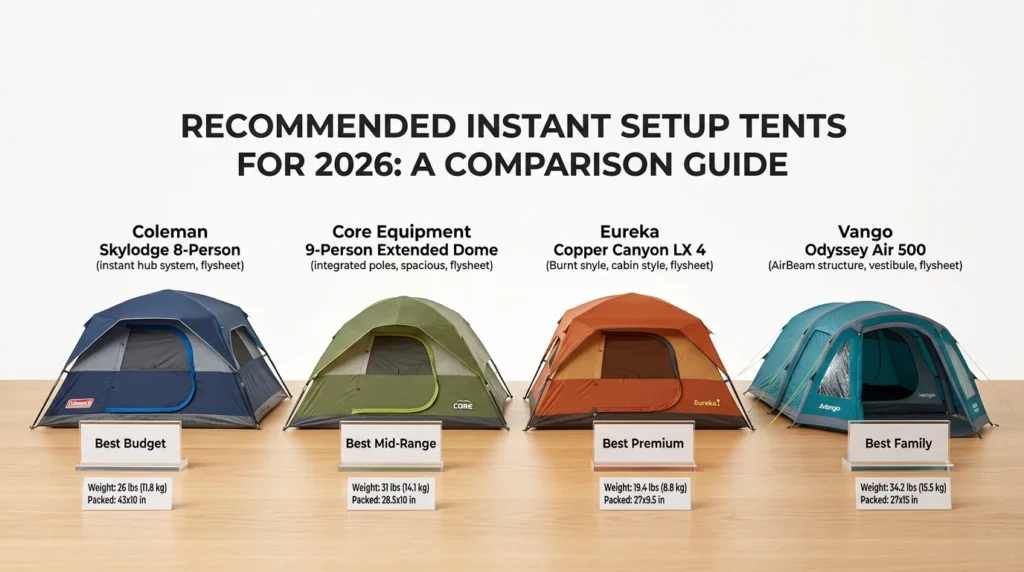
The instant setup tents market has matured significantly in 2026 compared to the early category entries that gave quick-pitch designs their reputation for hub failures and poor weatherproofing. Current production quality across all price tiers is meaningfully better than products from five years ago.
Best Budget Instant Setup Tent: Coleman Skylodge 8-Person Instant Setup Tent
At approximately $180 to $220, the Coleman Skylodge delivers genuine hub-pole instant deployment in a cabin-style geometry that provides excellent headroom (6 feet peak) and floor area for car camping families. The 150D polyester floor and 75D flysheet represent adequate but not exceptional fabric specifications. The hub mechanism has been revised in the current generation to address the joint stress failures of earlier Coleman Instant models. Realistic setup time: 6 to 8 minutes complete including rainfly and staking. Packed dimensions: 24.4 inches by 10.3 inches by 10.3 inches. Weight: 17.9 pounds.
Best Mid-Range Instant Setup Tent: Core Equipment 9-Person Extended Dome Instant Tent
At approximately $200 to $250, the Core Equipment 9-person instant tent is the most reviewed and most consistently recommended mid-range instant setup tent in the current market. Its extended dome geometry provides better wind resistance than the flat-panel cabin geometry of the Coleman alternatives, and its factory-sealed seams eliminate a weatherproofing step that budget instant setup tents skip. The H2O Block technology (2000mm waterproof rating) performs adequately in heavy rain in the verified testing record. Weight: 21.2 pounds. Packed dimensions: 24 inches by 13 inches.
Best Premium Instant Setup Tent: Eureka Copper Canyon LX 4
At approximately $350 to $400, the Eureka Copper Canyon LX 4 uses a modified instant setup frame with reinforced hub joints and 150D ripstop fabric that closes the durability gap with premium traditional tents. The extended vestibule geometry provides better rainfly coverage than most instant setup tents at any price point. The LX 4’s hub system uses a tool-free replacement mechanism for the hub connector, addressing the repairability concern that makes hub failures catastrophic in lesser instant setup tent designs. Weight: 13.8 pounds. This is the one instant setup tent in the current market that experienced campers can recommend without significant qualification.
Best Family Instant Setup Tent: Vango Odyssey Air 500
At approximately $280 to $320, the Vango Odyssey Air 500 uses an inflatable beam structure rather than a hub-and-pole frame, representing a genuinely different instant setup mechanism. Inflate the beams with the included pump (60 seconds), stake the perimeter, attach the inner tent, done. The air beam design eliminates the hub stress concentration failure mode entirely because there are no rigid hubs, only flexible pressurized tubes. Deflated packed weight is comparable to hub-and-pole designs at 17.6 pounds, but the packed dimensions are smaller because deflated beams fold more compactly than rigid pole assemblies.
When Instant Tents Are and Are Not the Right Choice :
The honest answer to whether instant setup tents are worth the investment depends entirely on matching the product design to the actual use case.
Instant setup tents are the right choice when:
You camp with children or non-camping partners who find traditional tent assembly frustrating or time-consuming. You camp at multiple sites in a single trip where repeated setup and breakdown time compounds. You camp occasionally (2 to 6 times per year) and never develop the muscle memory for traditional tent assembly that makes the time advantage disappear. You prioritize arrival-to-relaxation time over absolute durability or minimum weight. You camp exclusively in established car camping sites without technical weather exposure.
Instant setup tents are not the right choice when:
You camp in exposed, high-wind, or technical weather environments where structural integrity under load is the priority. You camp frequently enough that traditional tent assembly becomes quick through practice. You need to fit your shelter into a compact storage space with specific dimensional constraints that most instant setup tents cannot meet. You backpack or carry your shelter any meaningful distance. You want a product that is field-repairable when the most vulnerable component (the hub) fails.
The durability and performance considerations for your complete shelter and weather protection system, including both tent and awning components, are covered with practical specificity in the annual RV roof maintenance guide where the same waterproofing principles that govern tent fly performance apply to integrated shelter systems.
Caring for your Instant Tent :
The maintenance requirements of instant setup tents differ from traditional tents in ways that directly affect how long the hub mechanism and pre-attached frame remain functional.
The most important maintenance step specific to instant setup tents is drying completely before packing. The integrated frame structure creates enclosed spaces at hub joints and along pole sleeves where moisture is trapped more effectively than in a traditional tent where separated components can dry independently. A hub-and-pole instant setup tent packed wet develops mildew in the enclosed hub spaces within 48 to 72 hours, and that mildew is nearly impossible to fully eliminate because the hub geometry prevents thorough cleaning access.
Set up the instant setup tent in a covered outdoor space or in a garage after every wet-weather use and allow it to dry completely, typically 4 to 8 hours with good air circulation, before packing. This single habit prevents the most common non-mechanical failure mode in the instant setup tent category.
Hub joint lubrication using a dry silicone spray applied to all hub joint surfaces every 5 to 10 deployments reduces friction wear on the nylon or aluminum joint surfaces and prevents the stiff, resistant deployment that precedes hub joint failure. Apply with the frame in the deployed position, work each joint through its full range of motion, and allow to dry before folding for storage.
Seam resealing every 2 to 3 seasons maintains the waterproof function of factory-applied seam tape, which delaminiates from UV exposure and repeated folding stress faster in instant setup tents than in traditional designs because the seams experience more repeated flexion at the same crease points during packing. Gear Aid Seam Grip WP applied to any seam showing tape lifting or fabric staining (the indicator of seam infiltration) restores waterproof function at that location.
The full pre-storage maintenance protocol for camping shelters, including fabric treatment, waterproofing renewal, and long-term storage conditions, is part of the complete seasonal gear care framework in the camper maintenance checklist guide.
The accessories that make any tent more functional and comfortable regardless of its setup mechanism, including gear lofts, interior lighting systems, upgraded stakes, and vestibule organizers, are covered comprehensively in the tent accessories guide, where each item is evaluated for the specific functional improvement it provides across different tent types and camping scenarios.
Instant Tents Comparison at a Glance
| Feature | Budget Instant Setup ($150 to $250) | Premium Instant Setup ($350 to $600) | Traditional Tent ($200 to $500) |
|---|---|---|---|
| Setup time (complete) | 5 to 8 minutes | 5 to 8 minutes | 10 to 20 minutes |
| Packed weight | 15 to 22 lbs | 10 to 16 lbs | 6 to 12 lbs |
| Packed length | 36 to 52 inches | 24 to 36 inches | 18 to 24 inches |
| Hub repairability | Difficult or impossible | Tool-free hub replacement | Individual pole sections replaceable |
| Weather rating (3-season) | Moderate conditions | Good conditions | Excellent conditions |
| Fabric waterproofing (HH) | 1500 to 2000mm | 2000 to 3000mm | 2000 to 3000mm |
| Seam sealing factory | Partial | Full | Full (premium models) |
| Durability expectation | 3 to 5 seasons light use | 5 to 8 seasons moderate use | 7 to 15 seasons |
| Best suited for | Occasional family camping | Regular family/group camping | All-condition versatile use |
Frequently Asked Questions About Instant Tents :
Q: How long do instant setup tents actually take to set up?
In real-world conditions with a single adult including rainfly attachment and full staking, hub-and-pole instant setup tents take 5 to 8 minutes for a 4 to 6 person size. The “60-second” and “2-minute” claims in marketing refer to tent body frame deployment only, without the rainfly, staking, and guy line configuration that a complete functional setup requires. The 5 to 8 minute complete setup is still a significant improvement over 12 to 20 minutes for an equivalent traditional tent, particularly for infrequent campers who never develop setup speed through repetition.
Q: Are instant setup tents waterproof?
It depends entirely on the price point and specific model. Budget instant setup tents under $200 typically provide 1500mm hydrostatic head waterproofing with partial seam sealing that performs adequately in moderate rain. Premium instant setup tents at $350 and above match traditional tent waterproofing specifications with 2000 to 3000mm ratings and full factory seam sealing. In heavy sustained rain, budget instant setup tents with unsealed seams will eventually leak at seam intersections regardless of their HH rating. If wet-weather performance is a priority, either choose a premium instant setup tent with full seam sealing or apply seam sealer to all interior seams before the first use.
Q: Can instant setup tents be repaired in the field if the frame breaks?
Partially. Fabric tears on instant setup tents are repaired identically to traditional tents using Gear Aid Tenacious Tape. Frame repairs are more challenging because the integrated hub mechanism cannot be splinted the way a straight pole section can. A pole splint sleeve addresses cracks in the straight pole sections between hubs but cannot repair a fractured hub joint. For this reason, carrying a complete pole splint kit and knowing which failure modes can and cannot be field-repaired is important for any camper using instant setup tents in remote locations.
Q: How do instant setup tents hold up in wind?
Less well than equivalent-quality traditional tents at the same price point, in most cases. The hub stress concentration issue means that instant setup tents under sustained high wind loading stress the hub joints in ways that traditional pole configurations distribute more evenly across longer pole spans. At well-established car camping sites with natural windbreaks and standard 3-season conditions, most instant setup tents perform adequately. In exposed sites, coastal environments, or conditions where sustained wind above 35 mph is expected, a quality traditional tent with a full guy line configuration handles the loading more reliably.
Q: What is the packed size of a typical instant setup tent?
A 4-person instant setup tent packs to approximately 24 to 36 inches long by 10 to 13 inches in diameter. A 6-person model packs to 36 to 48 inches long. These packed dimensions are significantly larger than equivalent-capacity traditional tents, which pack to 18 to 24 inches long. The packed length is the most practically important dimension: a 48-inch packed length (4 feet) does not fit in most standard storage bins, vehicle cargo areas without specific positioning, or RV compartments designed around traditional tent packs. Always verify packed dimensions against your specific storage space before purchasing.
Q: Are instant setup tents good for camping with kids?
Yes, for most car camping scenarios with children. The setup speed and simplicity means children can participate in tent assembly without frustration or errors that extend setup time. The cabin-style geometry common in family instant setup tents provides good standing headroom that makes getting kids dressed and organized in the morning significantly easier than a low-profile dome tent. The primary consideration for family use is that instant setup tents are heavier and bulkier than equivalent traditional tents, so they are a car camping and campsite product rather than a hike-in family camping solution.
Q: Do instant setup tents come with footprints?
Rarely at the budget price point. Coleman and Core Equipment instant setup tents in the $150 to $250 range do not include footprints. Premium instant setup tents from Eureka and Kelty sometimes include a footprint or offer one as an accessory purchase. Given that the integrated frame structure of instant setup tents makes the floor fabric more difficult to replace than on a traditional tent (where only the floor panel typically needs replacement), using a footprint with any instant setup tent is a more important protective measure than with traditional designs. Custom-cut Tyvek or polycryo ground cloth sized 2 inches inside the tent floor perimeter is an inexpensive DIY footprint solution for any model that does not offer a manufacturer footprint.