

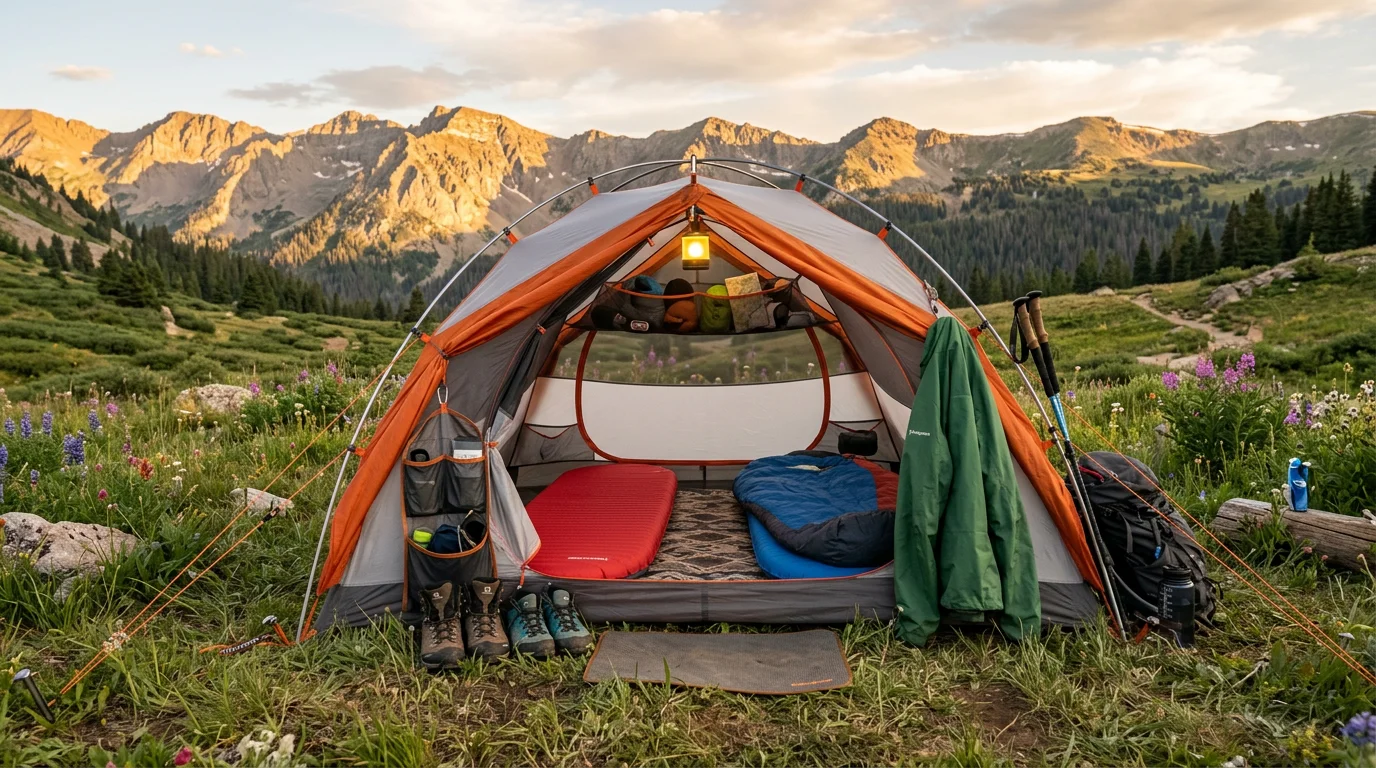
Picture this: you’re inside a perfectly good tent at 9 PM, unable to find your headlamp because everything you own is piled at your feet in a single compressed heap. The rain started an hour ago, your boots are soaked because you left them outside the vestibule without a mat, and you’re eating cold food because your lantern hook can’t hold the weight of anything useful. The tent itself is fine. Everything else is the problem.
That scenario plays out at campsites across the world every weekend because most campers invest heavily in shelter and almost nothing in the accessories that transform that shelter from a waterproof box into a genuinely functional living space. The right tent accessories do not just add convenience, they fundamentally change how organized, comfortable, and efficient your camp interior is from the first night.
This guide covers the 10 essential tent accessories that deliver the biggest real-world improvements to your shelter experience, from gear organization systems that eliminate the pile-at-your-feet problem to staking systems that keep your shelter anchored in conditions that standard wire stakes simply cannot handle.
Why Tent Accessories Matter More Than Most Campers Realize
A tent without accessories is hardware. A tent with the right accessories is a home. The distinction sounds like marketing language until you spend a week in the backcountry with a gear loft, a quality lighting system, a proper door mat, and upgraded stakes, and then return to a bare tent setup. The comfort gap is immediately and viscerally obvious.
Beyond comfort, the right tent accessories address genuine functional problems that affect safety, sleep quality, and gear longevity. A tent without a footprint loses floor material to abrasion faster than the manufacturer’s warranty period in rocky terrain. A tent without a quality lighting system forces you into headlamp use that disrupts your partner’s sleep every time you need to find something at night. A tent without a proper stake system loses its structural integrity in wind events that well-staked shelters handle without drama.
Tent accessories also interact with each other. A good vestibule organizer reduces the time you spend searching for items, which reduces the number of times you open the main tent door, which reduces moisture and cold air infiltration. Small efficiency gains compound across a multi-day trip into a meaningfully better overall experience.
The gear ecosystem thinking that governs good tent accessory selection is the same systematic approach covered in the camper maintenance checklist guide, where each piece of equipment is evaluated not in isolation but in terms of how it functions within the complete camp system.
Accessory 1: Footprint (Ground Cloth)
If you own only one tent accessory and nothing else on this list, make it a footprint. A tent footprint is a shaped ground cloth that fits precisely under your tent floor, protecting it from abrasion, puncture, and moisture wicking from below.
Tent floors are typically the thinnest material in a tent’s construction, measured in denier values that reflect a deliberate weight-saving trade-off made by the manufacturer. A 20D or 30D tent floor in regular contact with rocky, rooty, or abrasive ground develops micro-punctures and abrasion thinning faster than most campers notice until they feel moisture coming through on a wet night.
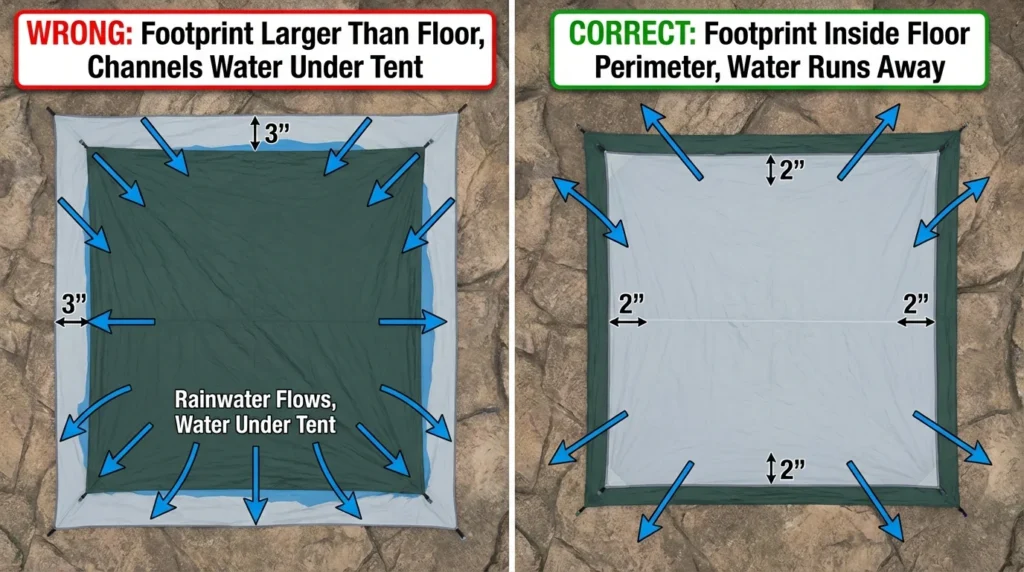
A properly fitted footprint from your tent’s manufacturer (REI, MSR, Big Agnes, and most major brands offer them) adds an abrasion layer that takes the wear instead of the tent floor. Custom-fit footprints are the best option because they match the tent’s floor geometry precisely. Generic polycryo or Tyvek ground cloths cut 2 inches inside the tent footprint perimeter work as effective DIY alternatives at significantly lower cost.
The one sizing rule for footprints: always cut or select a footprint that fits inside the tent’s floor perimeter by at least 1 to 2 inches on all sides. A footprint that extends beyond the tent floor channels rain runoff under the tent rather than away from it, defeating the moisture protection function entirely.
Accessory 2: Gear Loft (Interior Storage System)
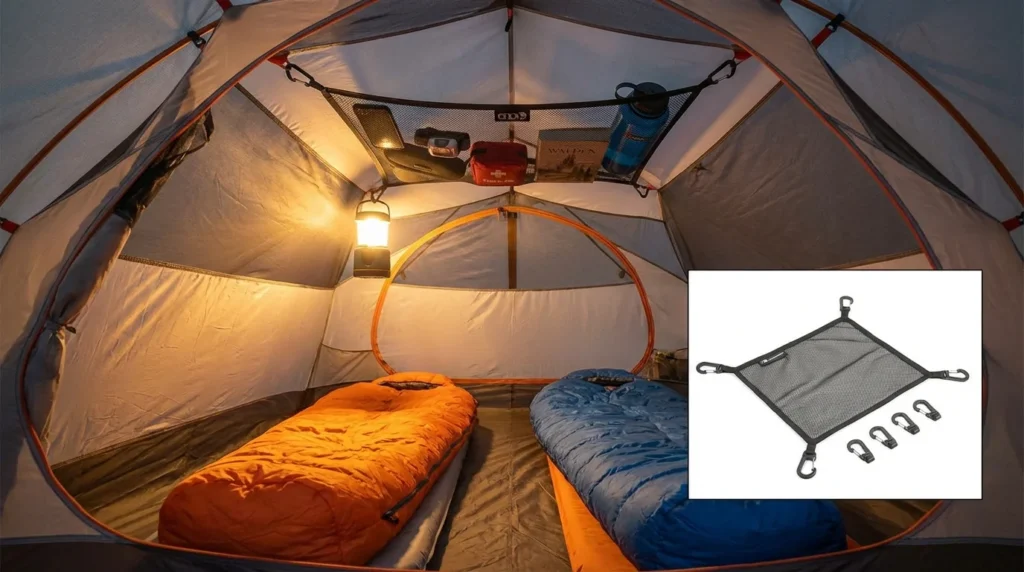
The gear loft is the single tent accessory that most consistently produces an “I should have bought this years ago” reaction from first-time users. It is a mesh hammock-style shelf that clips to the tent’s interior ceiling loops and creates overhead storage space that utilizes the cubic volume above sleeping campers that would otherwise be completely wasted.
A quality gear loft (ENO Glow Gear Loft, Sea to Summit Hanging Organizer) holds a phone, headlamp, glasses, book, water bottle, and small first aid kit overhead where they are accessible without sitting up, visible without searching, and completely out of the sleeping area where they previously created the pile-at-your-feet problem described in this article’s opening.
For two-person tents with two occupants, a gear loft eliminates the “which side did I put my headlamp on” problem that forces one person to rummage while the other is trying to sleep. Each camper’s essentials hang directly above them, clearly organized, retrievable in the dark by position rather than by sight.
Weight on high-quality gear lofts runs between 2 and 6 ounces, making this one of the highest comfort-per-gram investments in the tent accessories category. Look for lofts with multiple clip attachment points (four minimum) and a mesh base fine enough to prevent small items like earplugs or lip balm from falling through during the night.
Accessory 3: Tent Lighting Systems
Proper interior lighting is a tent accessory category where the difference between a thoughtful choice and a default choice is felt on every single night of every trip.
A headlamp is not interior tent lighting. It is task lighting that requires you to wear something on your head, points wherever you look (which means it points directly into your companion’s eyes whenever you have a conversation), and provides no ambient illumination that makes the tent interior feel like a livable space rather than a cave.
Dedicated tent lighting tent accessories fall into three types: hanging LED lanterns, adhesive or clip-on strip lights, and clip-mount puck lights. Each serves a different function in the tent interior.
Hanging LED lanterns (Black Diamond Moji, Goal Zero Crush) provide broad ambient illumination from the tent’s ceiling attachment point. The Black Diamond Moji at 100 lumens maximum output with a dimmer switch is the most widely recommended option for two-person tent use because its output range covers both “reading in the tent” and “ambient low light that doesn’t disturb sleep” modes without the harsh bright spots of a bare LED puck.
LED strip lights clipped or adhesively mounted along the tent’s interior ridge create even ambient illumination without hot spots. BioLite’s Basecamp string lights are designed specifically for tent use with clip attachment to interior loops and a battery pack that doubles as a USB phone charger.
Puck lights and compact rechargeable lanterns serve as secondary lights for vestibule use, map reading, or as a child’s night light in family camping configurations. The Nitecore LR10 is a pocket-sized rechargeable lantern with 250 lumen output and a dedicated tent-hang clip, making it the most versatile single light for tent use in the accessory category.
The power management considerations for rechargeable tent lighting connect directly to the full camp power system covered in the camp lighting and power gear guide, where battery capacity planning for multi-night trips determines whether your lights last the trip or leave you in the dark on night three.
Accessory 4: Upgraded Tent Stakes
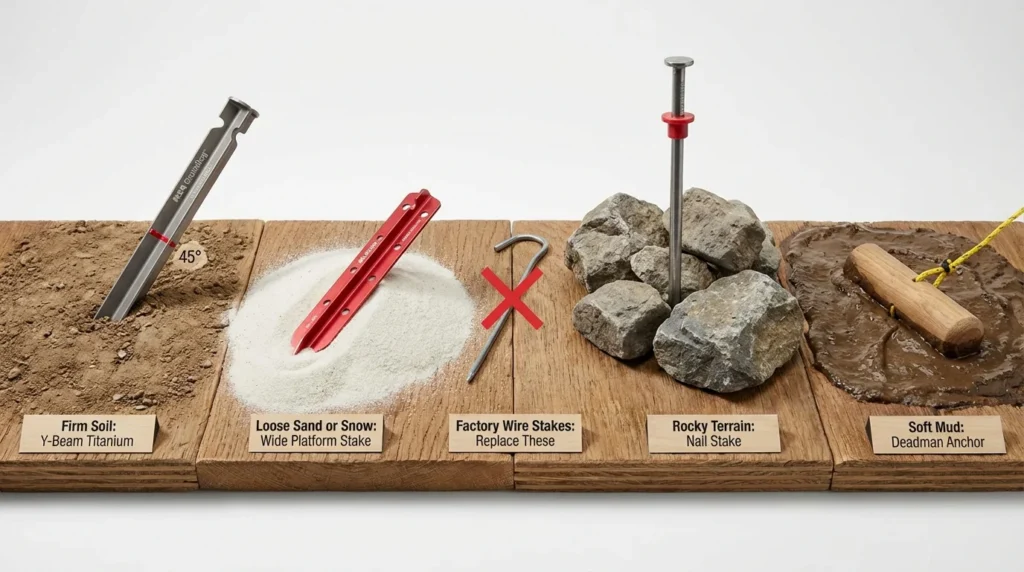
The stakes that come with most tents, including many premium tents at $400 and above, are functional in ideal conditions and inadequate in real ones. Standard wire shepherd’s hook stakes pull out of sandy, loose, or frozen ground under moderate wind load. Upgrading your stake system is one of the most safety-relevant tent accessories investments you can make.
Titanium shepherd’s hook stakes (MSR Groundhog, Vargo Titanium) are the trail-standard upgrade from wire stakes: same light weight, dramatically stronger, with a Y-beam cross-section that resists rotation in the ground under load. MSR Groundhogs are the most widely tested and most consistently recommended upgrade stake in the tent accessories market.
Sand and snow stakes (MSR Blizzard Snow Stake, Vargo Dig Stake) address the specific failure mode of shepherd’s hook stakes in soft substrates. Their wide cross-section distributes pull load across a larger soil volume, resisting extraction in sand, snow, and loose soil conditions where standard stakes pull through easily.
Nail stakes and rock anchors for rocky terrain where soil stakes cannot penetrate provide secure anchoring through rock-face attachment and crack-wedge techniques. For desert and alpine camping where rocky surfaces are the norm, a mixed stake kit with both standard and specialty stakes covers the full range of surfaces encountered.
A practical stake kit recommendation for versatile use: replace factory stakes with 8 MSR Groundhog Y-beam stakes for primary guy point anchoring, supplement with 4 MSR Blizzard stakes for soft soil applications, and carry 2 to 4 long nail stakes for rocky terrain. The total weight penalty over factory stakes is under 3 ounces. The security difference in a wind event is the difference between waking up inside a collapsed tent and sleeping through the storm undisturbed.
Accessory 5: Vestibule Organizer
The vestibule, the covered exterior space under the tent’s fly but outside the main sleeping area, is the most underutilized space in most tent setups. A vestibule organizer is the tent accessory that turns this liminal space into a genuinely functional gear staging and storage zone.
Vestibule organizers hang from the tent’s fly or pole structure and provide pockets, hooks, and loops for organizing boots, wet gear, cooking equipment, and anything that should not come inside the sleeping space but also should not be left completely exposed to weather. The Cotopaxi Allpa Tent Organizer and Sea to Summit Tent Hanging Dry Bag are purpose-designed for vestibule use with weatherproof material and multiple compartment configurations.
Beyond formal organizers, a simple set of gear hooks clipped to the vestibule’s guy line attachment points provides boot and wet jacket hanging that eliminates the mud-onto-sleeping-area tracking that comes from stepping over or around gear piled at the tent entrance.
A vestibule footprint or door mat at the vestibule entrance, a flat absorbent mat that captures boot mud before it enters the vestibule proper, reduces the cleaning and mud management workload across a multi-day trip significantly. The EVA foam camp mat format works well for this purpose: lightweight, easy to shake clean, and water-resistant.
Accessory 6: Tent Repair Kit
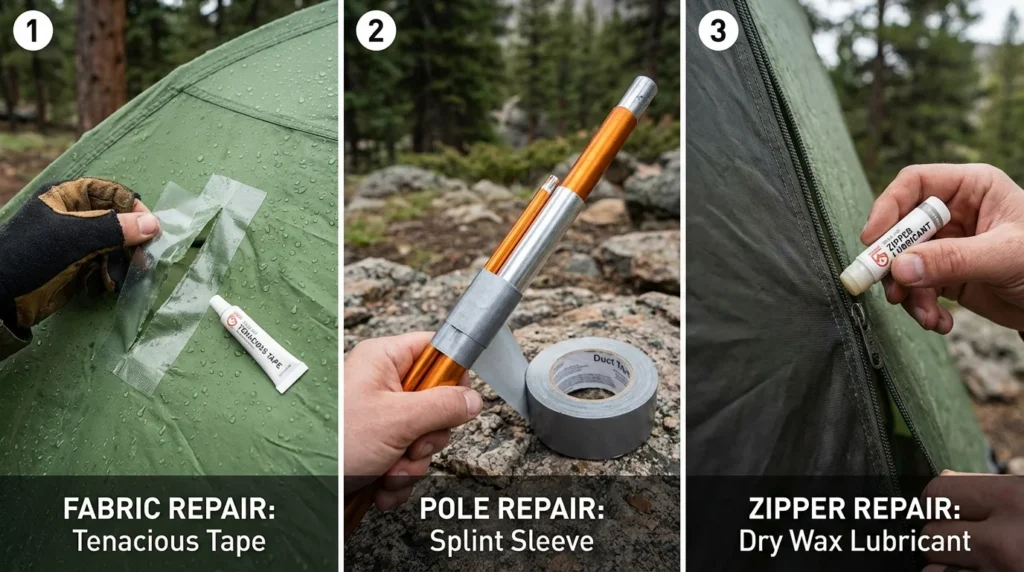
A tent repair kit is the tent accessory category that most campers think they don’t need until 11 PM in the rain, 40 miles from the nearest gear store, with a pole sleeve torn through and a seam pulling apart over their sleeping area.
A complete tent repair kit as a tent accessory addresses the three most common field failure modes: pole damage, fabric tears, and zipper failures.
For pole damage, a section of aluminum pole splint sleeve (typically included with quality tents, replaceable for under $5 from any gear retailer) allows a broken or cracked pole section to be splinted and functional until return from the field. Duct tape over a splinted pole provides additional structural support.
For fabric tears, Gear Aid Tenacious Tape is the standard field repair solution for tent body, fly, and floor material. Available in clear or fabric-matched colors, Tenacious Tape bonds to coated nylon and polyester fabrics without primer preparation and maintains adhesion through rain and temperature cycling. A 3-inch by 20-inch strip of Tenacious Tape handles most field repair scenarios.
For seam failures, a small tube of Gear Aid Seam Grip WP applied to delaminating or leaking seam tape repairs the seam’s waterproof function within 2 hours of application. Seam Grip is also the correct product for resealing seams on a tent whose factory seam tape is delaminating from age or UV exposure.
Zipper failures are addressed with Gear Aid Zipper Lubricant (a dry wax formulation that reduces zipper friction without attracting dirt) and a zipper repair pull replacement if the pull itself has failed. Carry both. A sticking or jamming zipper on a tent door is a minor inconvenience in good conditions and a serious problem in rain or cold.
Accessory 7: Sleeping Pad Insulation System
While a sleeping pad itself is not a tent accessory, the pad attachment and organization system that keeps it positioned correctly through the night absolutely is.
Sleeping pads that migrate, shift, or fold during the night destroy sleep quality by waking you when you roll off an edge onto cold ground. Tent accessories designed to manage pad position include pad attachment straps, pad clips that anchor to the tent’s interior loops, and integrated sleeping bag and pad systems where the bag and pad are connected.
For solo campers, a neoair XTherm or similar self-inflating pad with integrated surface texture that resists shifting provides passive management without hardware. For side sleepers and active sleepers who move significantly during the night, a pad retention strap set that clips the pad to the sleeping bag or to tent interior attachment points solves the rolling-off-the-pad problem that lighter sleepers may not experience but that heavier or more active sleepers deal with every night.
Foam pad underlayers beneath inflatable pads serve as both insulation enhancement and anti-shift stabilizers. A 2mm closed-cell foam layer between the inflatable pad and tent floor increases R-value meaningfully in cold-ground conditions while providing a surface with more friction than bare tent floor fabric, reducing the shifting problem at its source rather than managing it after the fact.
This thermal insulation layering from below ties directly into the complete sleeping system considerations covered in the camper maintenance checklist guide, where sleeping surface thermal management is one of the comfort factors reviewed in the seasonal gear preparation framework.
Accessory 8: Condensation Management Tools
Condensation inside a tent is one of the most persistent comfort problems in camping, and it has a set of tent accessories specifically designed to address it that most gear guides completely overlook.
Interior condensation forms when warm humid air from your breath and body contacts the colder tent fabric surfaces and releases its moisture content as liquid water droplets. In cold weather, this can produce a light rain inside the tent that wets sleeping bags, gear, and your face. Managing condensation is partly a ventilation behavior (keeping roof vents open regardless of temperature outside) and partly a tool-and-accessory problem.
Absorbent interior panels clipped to the tent’s interior ceiling fabric at the areas of highest condensation collect moisture before it drips onto sleeping campers. Sea to Summit’s Camp Kitchen Sink doubling as an absorbent panel, or dedicated condensation-collecting interior panels made of microfiber, absorb collected moisture that can be wrung out at morning, removing the moisture from the tent interior rather than allowing it to re-evaporate and recondense repeatedly.
Silica gel desiccant packets placed in the corners of the tent interior (where condensation pools are highest) absorb ambient humidity and slow condensation formation rate. Replace or recharge (dry at 250°F for 2 hours) desiccant packets after every two to three trips.
A small squeegee is the fastest tool for clearing condensation from tent fabric before packing. Tent fabric that is rolled wet into its stuff sack and stored promotes mildew growth that degrades waterproofing coatings and creates the musty smell that most campers attribute to unavoidable aging. A 30-second squeegee pass across the interior surfaces before packing removes most condensation and extends the fabric’s functional waterproof lifespan significantly.
Accessory 9: Tent Fan
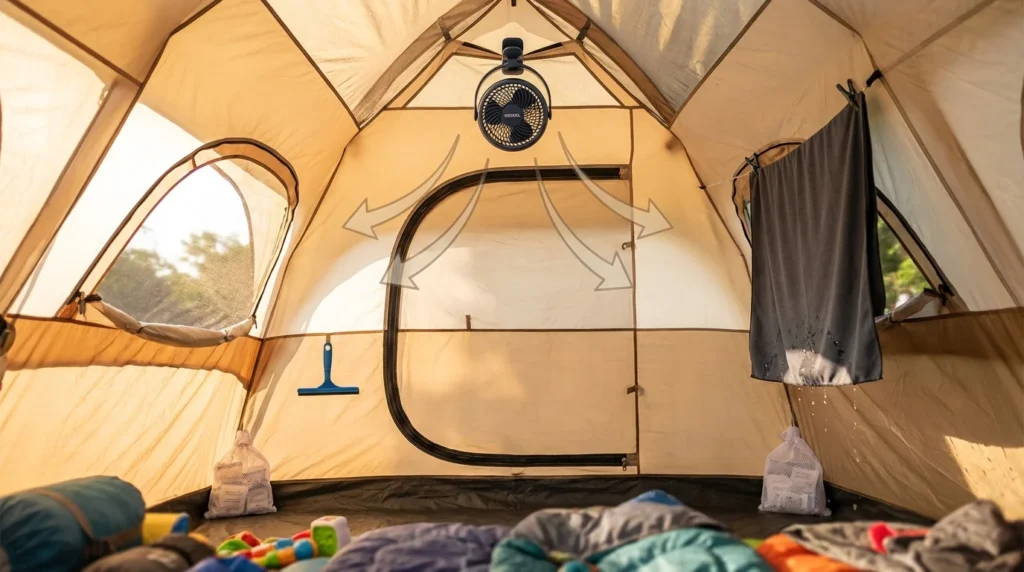
A battery-powered tent fan is the tent accessory that transforms warm-weather camping from something to endure into something to actually enjoy, and it addresses condensation management simultaneously through increased air circulation.
The O2COOL 10-Inch Battery Operated Fan and the Treva 10-Inch Battery Operated Fan are the two most consistently recommended tent fans in the outdoor gear community, both because of their airflow output (sufficient to create meaningful air movement in a two-person tent) and their battery efficiency (both operate for 8 to 12 hours on standard D-cell or C-cell batteries).
For campers running a 12V power system in their camp setup, the Opolar USB Clip Fan and similar USB-powered small fans provide continuous operation from a power bank or camp power station without battery replacement. A 10,000mAh power bank runs a USB tent fan for 12 to 20 hours depending on speed setting, making USB-powered fans the most cost-effective ongoing operation choice for campers with charging infrastructure.
Position a tent fan at one end of the tent blowing across the interior length rather than aimed directly at sleeping campers. This cross-ventilation pattern moves air across the full interior space more effectively than a fan aimed at one sleeping position, reduces condensation on the downwind fabric surfaces, and creates a consistent cooling effect without the drafty discomfort of direct fan exposure during sleep.
The battery and power system management for running tent fans alongside lighting and other 12V accessories is covered comprehensively in the camper battery health maintenance guide, where daily power consumption calculations determine whether your battery bank covers the full trip or runs dry on the second night.
Accessory 10: Durable Tent Carpet or Floor Insert
The tent carpet or floor insert is the least glamorous item on this list and the one that produces the most immediate and obvious comfort improvement in car camping and base camp applications where weight is not a limiting constraint.
A tent carpet, typically a cut-to-size outdoor rug or purpose-made tent floor insert, covers the tent floor completely and provides four simultaneous benefits: thermal insulation between the ground and sleeping surfaces, cushioning for movement within the tent, a surface that collects and contains tracked-in grit rather than grinding it into the tent floor material, and a genuine sense of domestic comfort that bare tent floor fabric categorically does not provide.
The ENO SkyLite Hammock Tarp material repurposed as a tent floor cover, or a purpose-made camping rug from Kelty or Coleman, weighs between 8 ounces and 3 pounds depending on size and material. For car camping where a few pounds of gear weight are irrelevant to the trip experience, a quality tent carpet is among the most transformative tent accessories in terms of raw comfort per dollar spent.
In multi-night base camp setups where the tent is a living space rather than just a sleeping space, the floor covering makes movement, dressing, and gear organization significantly more comfortable and efficient than bare tent floor use. Paired with the gear loft and vestibule organizer from earlier in this list, a tent carpet completes an interior organization system that makes a backpacking tent feel genuinely habitable for extended stays.
Tent Accessories by Camping Style
| Tent Accessory | Backpacking | Car Camping | Base Camp | Family Camping |
|---|---|---|---|---|
| Footprint | Essential | Essential | Essential | Essential |
| Gear Loft | Highly recommended | Recommended | Recommended | Recommended |
| Tent Lighting | Essential | Essential | Essential | Essential |
| Upgraded Stakes | Essential | Recommended | Essential | Recommended |
| Vestibule Organizer | Recommended | Highly recommended | Essential | Essential |
| Tent Repair Kit | Essential | Recommended | Essential | Recommended |
| Sleeping Pad System | Essential | Recommended | Recommended | Recommended |
| Condensation Tools | Recommended | Recommended | Highly recommended | Recommended |
| Tent Fan | Skip (weight) | Essential | Essential | Essential |
| Tent Carpet | Skip (weight) | Essential | Essential | Essential |
Frequently Asked Questions About Tent Accessories
Q: What are the most important tent accessories for a beginner camper?
Start with four essentials: a footprint to protect the tent floor, upgraded stakes to replace factory wire stakes, a gear loft for interior organization, and a quality hanging LED lantern for ambient lighting. These four items address the most commonly experienced problems in new campers (wet floors, tent movement in wind, chaotic gear management, and inadequate interior lighting) at a combined cost of approximately $60 to $100. Every other tent accessory on this list adds genuine value, but these four produce the most immediate quality-of-life improvement for first-time tent users.
Q: Do I need a tent footprint if my tent has a thick floor?
Yes. Even a thick tent floor (150D or above) benefits from a footprint’s abrasion protection in rocky or rooty terrain. Floor thickness translates to weight penalty before it translates to abrasion resistance, and the abrasion a tent floor takes from ground contact over multiple camping seasons is cumulative. A footprint costing $30 to $60 extends the tent’s useful floor life by years in regular use conditions and eliminates the risk of unexpected floor failure when moisture wicking through a compromised floor damages sleeping gear mid-trip.
Q: What tent stakes are best for different ground types?
MSR Groundhog Y-beam stakes for firm soil (the best general-purpose stake), MSR Blizzard stakes for snow and loose sand, long nail stakes for rocky desert terrain, and bamboo or wooden deadman anchors for ultrasoft sand or mud. Carry a mixed kit of 6 to 8 Groundhogs for standard use and 2 to 4 specialty stakes for the terrain you specifically expect on each trip. The $30 to $50 investment in a quality stake kit is one of the highest safety-to-cost ratios in all tent accessories.
Q: How do I reduce condensation inside my tent?
The most effective condensation reduction strategy is behavioral: keep all roof and wall vents fully open regardless of outside temperature. Condensation is primarily a ventilation problem, and closing vents to retain warmth produces exactly the humid interior environment where condensation is highest. Supplemental tent accessories for condensation management include interior absorbent panels, silica gel desiccant packets in the corners, and a tent fan that increases air exchange rate. A morning squeegee pass before packing removes residual condensation that would otherwise promote mildew during storage.
Q: Can I use any LED light as a tent light?
Technically yes, but purpose-made tent lighting provides features that general LED lights lack: the correct mounting hardware for tent interior attachment loops, appropriate output levels (100 to 200 lumens maximum for tent use, which is much less than a typical headlamp’s maximum output), dimmer controls for adjusting from reading light to sleep-mode ambient, and battery life appropriate for multi-night use. A general LED flashlight in a plastic bag hung from a loop works as emergency illumination. A Black Diamond Moji or Goal Zero Lighthouse provides a genuinely better experience because it was designed specifically for the tent environment.
Q: Are tent accessories different for three-season versus four-season tents?
The fundamental tent accessories (footprint, stakes, gear loft, lighting) apply equally to both tent types. Where tent accessories diverge between three-season and four-season applications is in the stake system (four-season use in snow requires snow stakes and possibly deadman anchors that three-season camping rarely needs), condensation management tools (four-season use produces dramatically more interior condensation due to the temperature differential between warm interior and cold exterior), and the repair kit composition (four-season tent poles experience higher stress loads and pole repair materials should be sized appropriately for the larger diameter poles common in four-season designs).
Q: What is the best tent accessory for family camping with young children?
A quality tent carpet combined with a hanging LED lantern on a dimmer. Young children move around the tent interior constantly, and a carpet surface protects both the tent floor and small knees and feet from bare nylon floor contact while providing the soft, familiar surface that makes the tent feel safe and comfortable. A dimmable lantern provides a night-light setting that allows children to sleep without complete darkness while not disturbing adult sleep with full illumination. These two tent accessories together address the comfort and security needs of family camping more directly than any other combination on this list.