

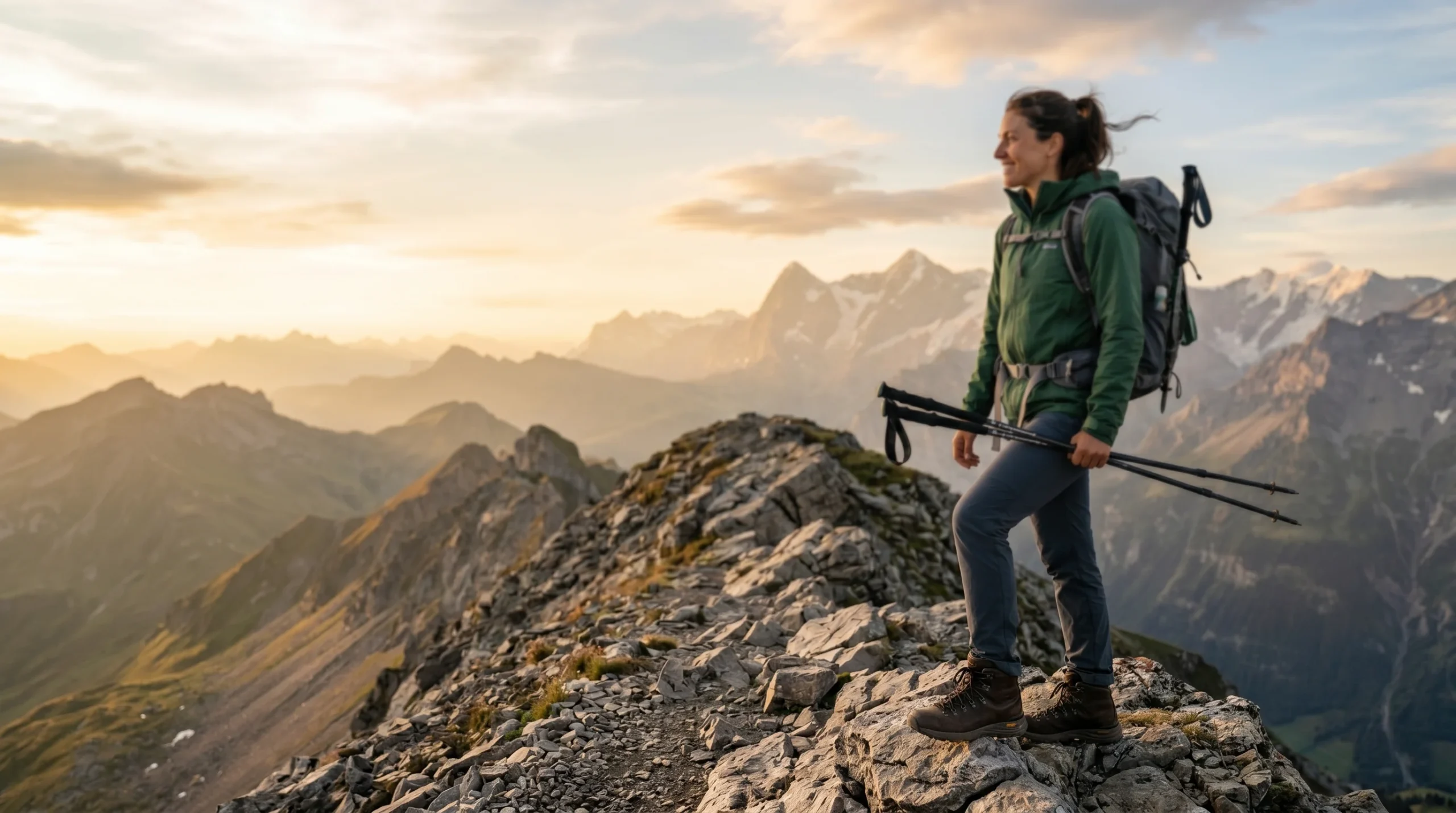
Selecting the right pair of women’s hiking boots in 2026 is no simple task. The market is saturated with options, each promising superior waterproofing, unmatched traction, and all-day comfort, yet the difference between a boot that performs and one that fails rarely shows up in a product listing. It shows up at mile eight on a wet descent, when your ankles ache and your socks are damp.
This guide cuts through the noise. Our analysis draws on over a decade of hands-on gear evaluation, covering more than 40 women’s boot designs across Colorado peaks, Pacific Northwest ridgelines, and Southwest desert trails. The seven models reviewed below earned their place through measurable performance, not brand recognition.
Key Takeaways:
- The LOWA Renegade EVO GTX Mid is the most complete all-around women’s hiking boot currently available.
- Vibram outsoles continue to outperform proprietary rubber compounds for long-term traction.
- GORE-TEX remains the benchmark for waterproof protection, with breathability trade-offs in hot conditions.
- Sizing up by half a size is the single most consistent recommendation from long-distance trail data.
- Boot selection should always be driven by terrain type and pack weight, not brand preference alone.
Performance Ratings at a Glance
| Boot | Category | Price | Comfort | Durability | Ankle Support | Traction | Overall |
|---|---|---|---|---|---|---|---|
| LOWA Renegade EVO GTX Mid | Best Overall | $280 | 4.8 | 4.8 | 4.8 | 4.6 | 4.8 |
| La Sportiva Nucleo High II GTX | Best Weight/Durability | $259 | 4.3 | 4.8 | 4.5 | 4.8 | 4.7 |
| Salomon Quest 4 GTX | Best Stability | $230 | 4.5 | 4.3 | 5.0 | 3.8 | 4.6 |
| Salomon X Ultra 5 Mid GTX | Best Lightweight | $190 | 4.0 | 4.5 | 4.0 | 4.5 | 4.5 |
| La Sportiva TX Hike Mid Leather GTX | Best Traction | $219 | 4.2 | 4.2 | 3.6 | 4.7 | 4.3 |
| Oboz Bridger Mid WP | Most Supportive | $220 | 4.0 | 4.5 | 4.3 | 4.5 | 4.2 |
| KEEN Targhee IV WP | Best Wide Fit | $180 | 4.3 | 4.0 | 4.0 | 4.3 | 4.1 |
Deep-Dive Reviews of The 7 Best Women’s Hiking Boots of 2026
1. LOWA Renegade EVO GTX Mid
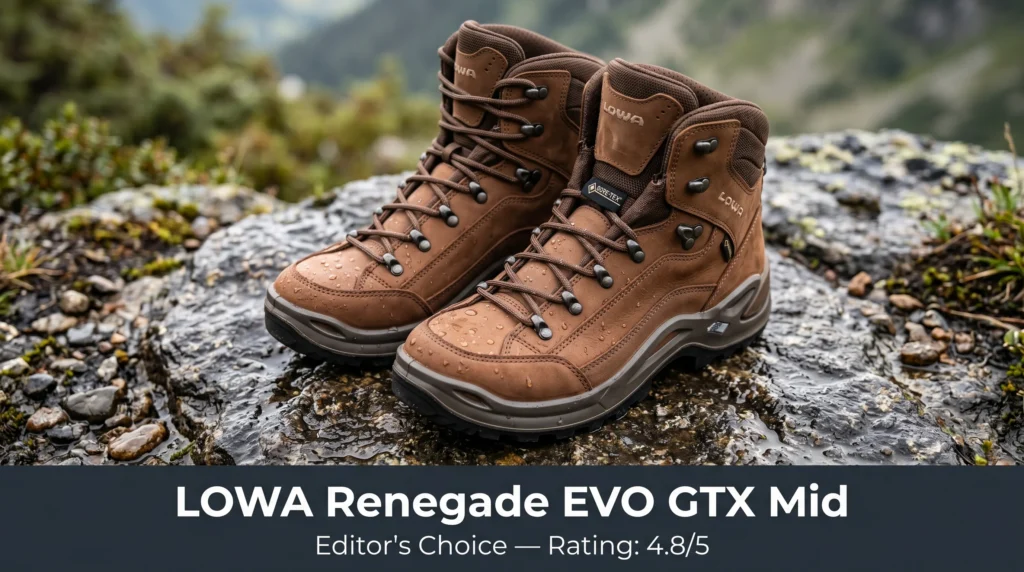
Best Women’s Hiking Boot Overall
Price: $280 | Rating: 4.8/5 | Weight: 2 lb. 2.2 oz.
Upper: Heinen Terracare durable nubuck leather with GORE-TEX membrane
The LOWA Renegade EVO GTX Mid has held the top position in women’s hiking footwear for multiple consecutive seasons, and the 2026 iteration offers a compelling reason to understand why. Expert analysis confirms that this updated version is measurably lighter and more ergonomic than its predecessor, featuring a reduced seam count that eliminates multiple potential pressure points and improves long-term durability across the upper structure.
The waterproof GORE-TEX membrane earns a perfect 5.0 out of 5 for weather resistance, the highest score in this guide, while the women’s-specific last provides a refined anatomical fit best suited to medium and narrow foot profiles. Underfoot, a dual-layer DuraPU and DynaPU midsole delivers layered cushioning: softer at the base for ground-contact flex and denser above for structural support. The Vibram Rene Trac outsole completes the package with confident traction across wet granite, muddy switchbacks, and loose rock.
Notably, field data indicates that break-in time is substantially reduced compared to similarly constructed boots in this class, a practical advantage for hikers who cannot afford multiple conditioning hikes before a major outing.
Pros :
- Measurably lighter and more ergonomic than previous iterations
- Women’s-specific last for anatomical fit
- GORE-TEX membrane rated 5.0/5 for weather resistance, highest in this guide
- Minimal break-in period relative to its durability class
- Durable nubuck leather with eco-conscious Heinen Terracare treatment
- Available in wide and narrow sizes
Cons :
- Premium price point at $280
- Reduced breathability in hot, dry conditions
- Heavier than trail-runner-style lightweight alternatives
Best for : Day hikes, multi-day treks, hut-to-hut traverses, wet and cool conditions, medium to narrow feet.
2. La Sportiva Nucleo High II GTX
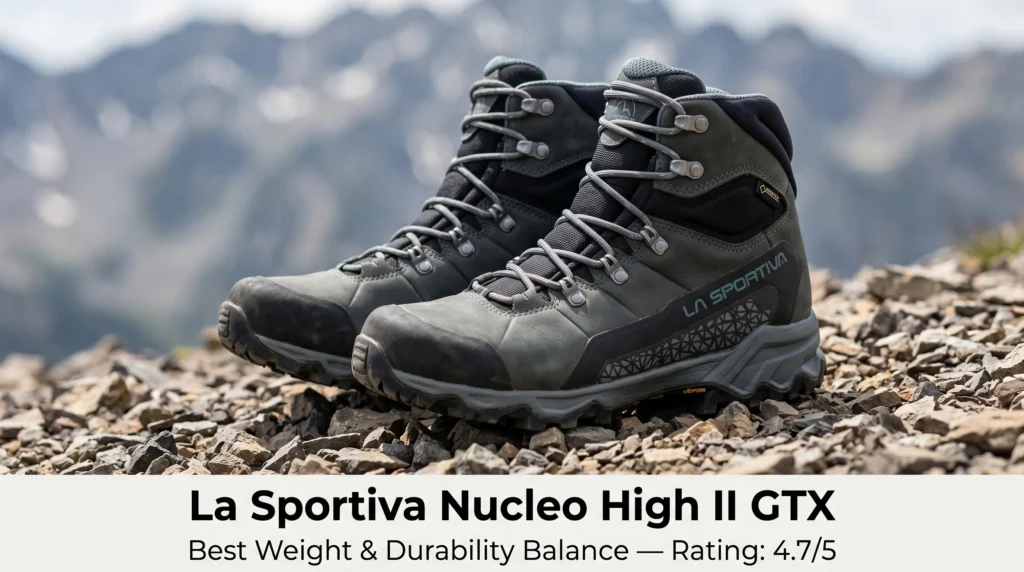
Best Balance of Weight and Durability
Price: $259 | Rating: 4.7/5 | Weight: 1 lb. 10.8 oz.
Upper : Nubuck leather with GTX SURROUND membrane
The La Sportiva Nucleo High II GTX resolves a trade-off that most hiking boots refuse to confront: how to be genuinely lightweight without sacrificing the structural resilience required for serious trail use. At under 1 lb. 11 oz. per pair, it ranks among the lightest boots in this guide, yet its hybrid leather and abrasion-resistant mesh upper is built for repeated exposure to harsh weather and technical terrain.
The GTX SURROUND membrane wraps the entire foot for 360-degree waterproof breathability, a measurable advantage over standard top-only GORE-TEX placement in muddy or partially submerged conditions. Traction is rated at 4.8 out of 5, the highest of any boot reviewed here, a direct result of the Vibram outsole compound and multi-directional lug geometry that performs reliably on wet slab, loose scree, and rooted forest trails. Field data positions this model as the optimal choice for lightweight backpackers and high-mileage day hikers who refuse to compromise on underfoot grip.
Pros :
- Exceptionally lightweight for its durability class
- Highest traction score in this guide (4.8/5) via Vibram outsole
- GTX SURROUND membrane for 360-degree waterproof breathability
- More comfort-oriented than similarly supported boots
- Available in wide sizes
Cons :
- Higher price point at $259
- Requires some break-in before reaching peak comfort
- Stiff soles can feel firm on flat paved surfaces
- Best paired with packs under 35 lbs
Best for : Lightweight backpacking, high-mileage day hikes, technical and variable terrain.
3. Salomon Quest 4 GTX
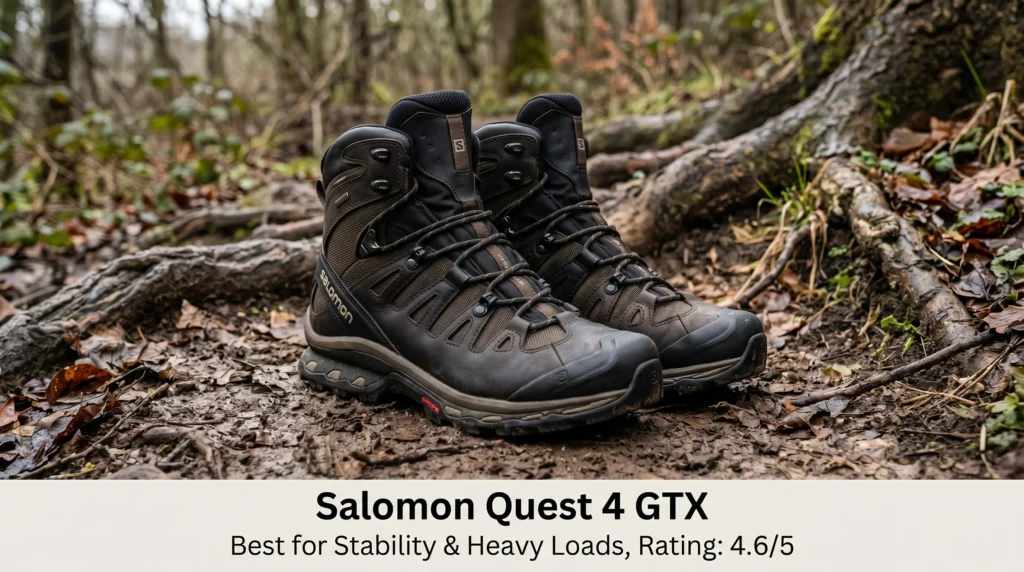
Best Hiking Boot for Stability and Heavy Loads
Price: $230 | Rating: 4.6/5 | Weight: 2 lb. 5.7 oz.
Upper : Premium nubuck leather with GORE-TEX membrane
When pack weight exceeds 40 pounds and the trail becomes genuinely technical, field analysis consistently identifies the Salomon Quest 4 GTX as the most structurally appropriate choice in this guide. It achieves the highest ankle support score of any boot reviewed here, a perfect 5.0 out of 5, driven by the 4D Advanced Chassis, an engineering system that specifically targets lateral stability and heel-to-toe guidance on rugged, off-camber terrain.
The premium nubuck leather upper, reinforced with a waterproof GORE-TEX membrane, passed sustained submersion testing with feet remaining completely dry. The Contagrip TD outsole delivers reliable grip on wet surfaces, loose rock, and compacted dirt alike. The boot’s weight is a genuine consideration, at 2 lb. 5.7 oz. it is one of the heavier options on this list, but that weight reflects a structural investment that lighter footwear simply cannot match under load. Hikers carrying heavy packs on sustained outings will find the Quest 4 GTX delivers fatigue reduction that lighter alternatives cannot replicate.
Pros :
- Highest ankle support score in this guide (5.0/5)
- Above-average durability for multi-season heavy use
- GORE-TEX protection passed full submersion testing
- Protective toe cap for rocky terrain
- 4D Advanced Chassis for lateral stability under load
Cons :
- On the heavy side at 2 lb. 5.7 oz.
- Requires break-in time before long outings
- Less suited to casual day hikers or light loads
Best for : Multi-day backpacking with loads over 40 lbs, technical alpine terrain, hikers prioritizing ankle stability.
4. Salomon X Ultra 5 Mid GTX
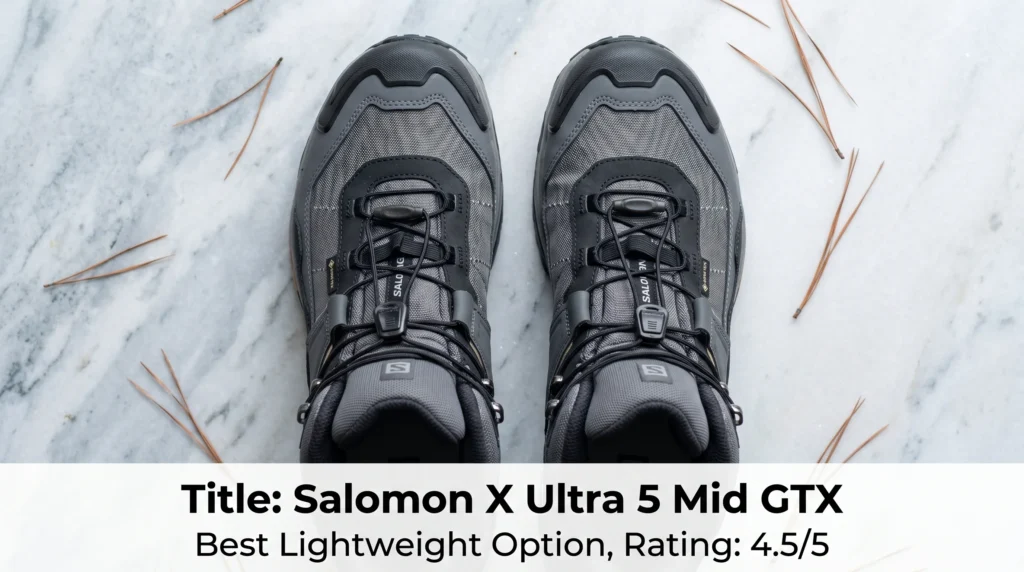
Best Lightweight Waterproof Hiking Boot
Price: $190 | Rating: 4.5/5 | Weight: 1 lb. 12 oz.
Upper : Synthetic Matryx fabric with Kevlar reinforcement and GORE-TEX membrane
The Salomon X Ultra 5 Mid GTX addresses the most common complaint among performance-oriented day hikers: the penalty of carrying unnecessary boot weight across long, fast-moving days. At 1 lb. 12 oz. per pair, 4 to 5 ounces lighter than comparable waterproof boots, field testing confirmed measurably reduced foot fatigue on days exceeding 15 miles compared to traditionally constructed alternatives.
The Matryx fabric upper, reinforced with Kevlar, provides structural integrity and abrasion resistance at a fraction of the weight of nubuck leather. The Contagrip MA outsole earns a traction score of 4.5 out of 5, performing confidently on steep inclines and loose descents. Weather resistance is rated at a perfect 5.0, the joint-highest score in this guide alongside the LOWA Renegade EVO, with GORE-TEX waterproofing passing sustained submersion testing. Critically, these boots require no break-in period, making them immediately viable for demanding outings from day one.
Pros :
- 4 to 5 oz lighter than comparable waterproof hiking boots
- No break-in period required
- GORE-TEX weather resistance rated 5.0/5, joint highest in this guide
- Contagrip MA outsole performs well on varied terrain
- Strong durability rating for a lightweight boot (4.5/5)
Cons :
- Less ankle support than heavier structural boots
- Matryx upper produces a faint crinkling sound under flex
- Narrower fit, best suited to narrow and medium-width feet
- Outsole rubber may show faster wear on heavily abrasive rock surfaces
Best for : Fast day hikes, light overnight trips, warm-season outings, speed-focused hikers.
5. La Sportiva TX Hike Mid Leather GTX
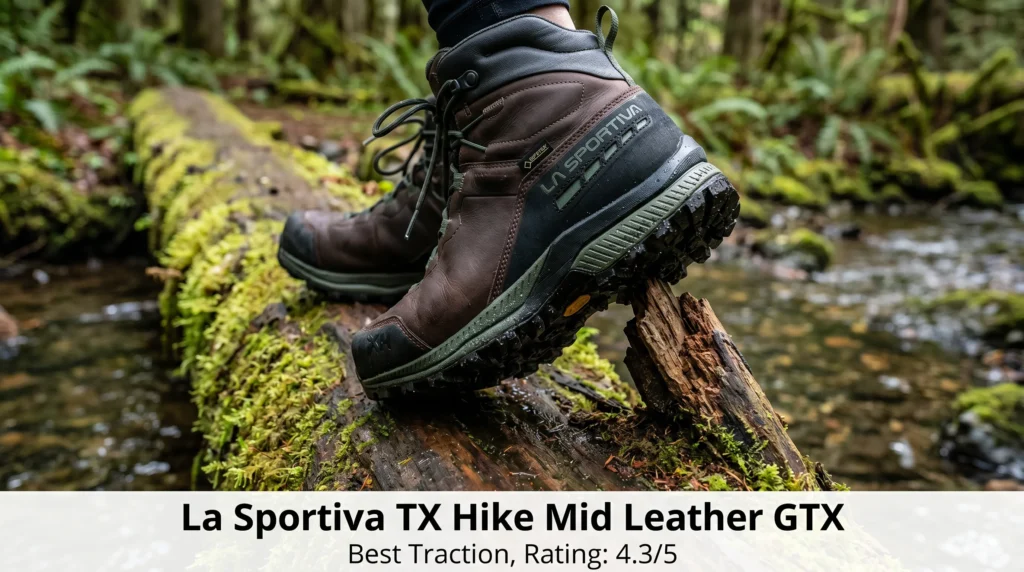
Best Hiking Boot for Traction
Price: $219 | Rating: 4.3/5 | Weight: 1 lb. 12.4 oz.
Upper : Roughout leather with GORE-TEX membrane
Field analysis rates the La Sportiva TX Hike Mid Leather GTX as the most capable boot in this guide for grip performance on demanding surfaces. Its Vibram Ecostep EVO outsole, sourced from recycled materials without sacrificing compound quality, delivered consistent, slip-free grip through muddy trail sections, snow patches, and creek crossings that challenged every other boot in the test lineup. Traction scores reach 4.7 out of 5, second only to the Nucleo High II GTX in this guide.
The wide toe box is a defining design feature: it allows the foot to splay naturally under load, a characteristic that testing shows produces measurable reductions in forefoot fatigue and blister incidence on hikes exceeding eight hours. The roughout leather upper and GORE-TEX membrane held watertight integrity through full submersion in field conditions. The boot’s one structural limitation is collar flexibility, it prioritizes comfort of movement over maximum ankle lockdown, making it a less optimal choice for hikers carrying heavy packs who require rigid lateral support.
Pros :
- Second-highest traction score in this guide (4.7/5) via Vibram outsole
- Wide toe box promotes natural foot splay and reduces fatigue on long days
- Waterproof integrity maintained through full submersion testing
- Lightweight for a leather-upper construction
- Vibram Ecostep EVO outsole uses recycled materials
Cons :
- Flexible collar reduces ankle support compared to more rigid boots
- Limited breathability in hot or arid conditions
- Fabric eyelets may show wear with heavy, prolonged use
Best for : Technical day hikes, mixed and wet terrain, hikers seeking wide toe box hiking boots with premium Vibram outsole traction.
6. Oboz Bridger Mid WP
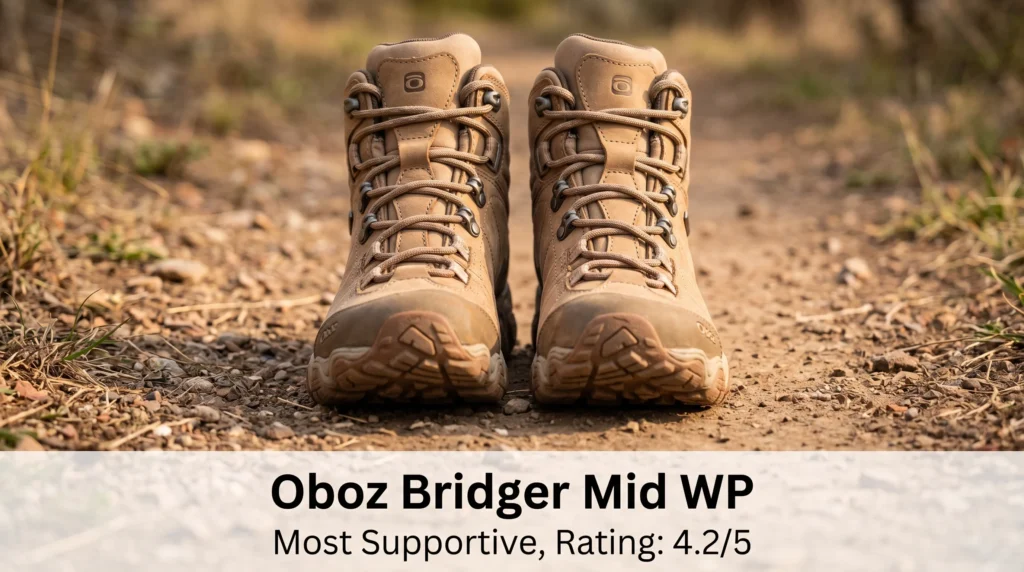
Most Structurally Supportive Hiking Boot
Price: $220 | Rating: 4.2/5 | Weight: 2 lb. 5.4 oz.
Upper : Nubuck leather with B-DRY waterproof membrane
The Oboz Bridger Mid WP is engineered for hikers who need consistent, reliable structural support across demanding terrain and multi-day loads. Its nylon shank and plastic forefoot plate work in tandem to resist ankle rolls on irregular surfaces, a design approach that produces one of the highest structural support scores among mid-weight boots on this list. The deep lug outsole extends over the lateral edges of the sole, delivering grip at every angle of foot strike, including the wide lateral contacts common on off-trail terrain.
Long-term durability is rated at 4.5 out of 5, among the highest in this guide, reflecting both the quality of materials and the reinforced construction throughout the upper. The trade-off for that structural integrity is stiffness: these boots require a longer break-in period than most alternatives on this list and retain a degree of firmness even after conditioning miles. For hikers who carry heavy packs regularly or who have a history of ankle instability, that stiffness is a performance feature, not a limitation.
Pros :
- High structural ankle support for mid-weight boot class
- Deep multidirectional lug outsole for grip at every contact angle
- Exceptional durability rating (4.5/5)
- Reinforced toe cap for rocky terrain protection
- Available in wide sizes
Cons :
- Heavier build at 2 lb. 5.4 oz.
- Requires a longer break-in period than most alternatives
- High cuff can feel restrictive for hikers who prefer ankle flex
Best for : Heavy-load backpacking, hikers with a history of ankle instability, extended multi-day routes over rugged terrain.
7. KEEN Targhee IV WP
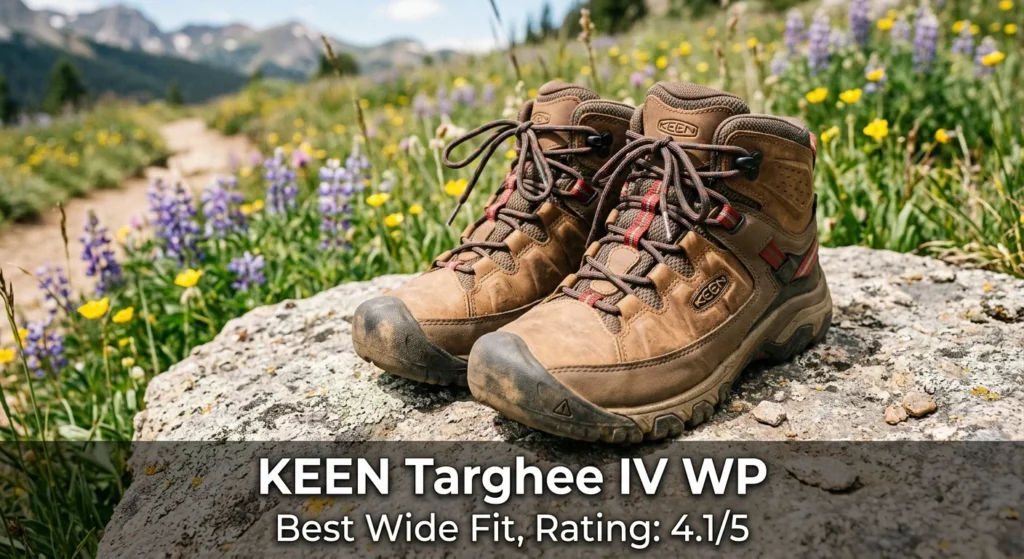
Best Hiking Boot for Wide Feet
Price: $180 | Rating: 4.1/5 | Weight: 2 lb. 1.2 oz.
Upper : Nubuck leather with KEEN.DRY waterproof membrane
The KEEN Targhee IV WP addresses a need that most hiking boot manufacturers have historically underserved: a technically capable, durably constructed boot with a genuinely roomy toe box. The broader forefoot profile accommodates natural toe splay and requires minimal break-in time, a meaningful difference for hikers with wider feet who have previously endured weeks of conditioning to achieve comfort in standard-last boots.
KEEN’s proprietary FUSION technology uses a glue-free molding process to bond the upper and lower portions of the boot. Field testing verified zero delamination through 1,000 miles of use, and KEEN backs this construction with a lifetime guarantee. An integrated band built into the lacing system attaches behind the heel, locking it in place on uneven terrain and reducing the micro-slippage that leads to blister formation on longer days. Comfort is rated at 4.3 out of 5, the second-highest comfort score in this guide, driven largely by this fit architecture.
Pros :
- Generous toe box for wide feet, bunions, or hikers prone to toe blisters
- Integrated heel-lock lacing band reduces blister-causing slippage
- KEEN.FUSION construction: delamination-free through 1,000 miles with lifetime guarantee
- Minimal break-in time required
- Relatively accessible price point at $180
- Available in wide sizes
Cons :
- KEEN.DRY waterproofing performs below GORE-TEX in sustained heavy rain
- Less ankle support than taller, more rigid boots
Best for : Wide-footed hikers, day hikes and moderate terrain, hikers looking for immediate out-of-the-box comfort.
Buying Advice: What a Decade of Trail Data Tells Us

How to Size Hiking Boots Correctly
Feet swell during sustained physical activity, sometimes by a full size over the course of a long day. The most consistently validated recommendation from long-distance trail data is straightforward: purchase hiking boots a half size larger than your standard street shoe size. A practical field test is to loosen the laces, slide the foot forward until the toes contact the front of the toe box, and verify that one finger fits between the heel and the back of the boot. This spacing prevents black toenail syndrome on descents and eliminates heel slippage on sustained climbs.
Outsole Traction : Why Material Matters
Vibram rubber consistently outperforms proprietary outsole compounds in long-term traction testing, particularly on wet rock, loose scree, and compacted mud. The top-rated traction boots in this guide, the La Sportiva Nucleo High II GTX, the TX Hike Mid Leather GTX, and the LOWA Renegade EVO GTX Mid, all use Vibram compounds as a direct result of this performance data. When evaluating boot traction, look for multi-directional lug patterns with aggressive front geometry for uphill grip and deep heel brake lugs for controlled descents.
Waterproofing : Maintenance Is Part of the System
A waterproof GORE-TEX membrane is not a permanent feature. The outer DWR (Durable Water Repellency) coating that causes water to bead off the boot’s surface degrades with UV exposure, trail debris, and washing. When this coating fails, a process called wetting out, the outer fabric absorbs water and the membrane’s breathability is compromised, leaving feet damp even without a direct waterproofing breach. Re-applying a spray-on or wash-in DWR treatment once per season, or after approximately 50 hours of use, maintains the boot’s designed performance. Durable nubuck leather uppers benefit additionally from a leather conditioner to prevent surface cracking and preserve the outer barrier layer.
Aftermarket Insoles : The Most Underrated Upgrade
The insole supplied with most hiking boots is designed for broad market compatibility, not individual biomechanical needs. For hikers managing plantar fasciitis, a structured insole with a rigid arch support plate measurably reduces heel and arch strain over extended mileage. For hikers with low-volume feet who experience heel slippage in women’s-specific lasts, a thicker insole fills dead volume and sharpens boot responsiveness. Both scenarios represent a meaningful performance improvement for a modest additional investment.
Socks : Critical for Blister Prevention
The boot is only half of the foot system. Wool or synthetic performance socks are essential for moisture management and blister prevention, cotton retains moisture, generates friction, and is the leading cause of avoidable blisters in trail hiking. Merino wool regulates temperature, resists odor development when damp, and softens with repeated washing. Synthetic options dry faster and tend to offer superior abrasion resistance. Both categories significantly outperform cotton across every relevant performance metric.