
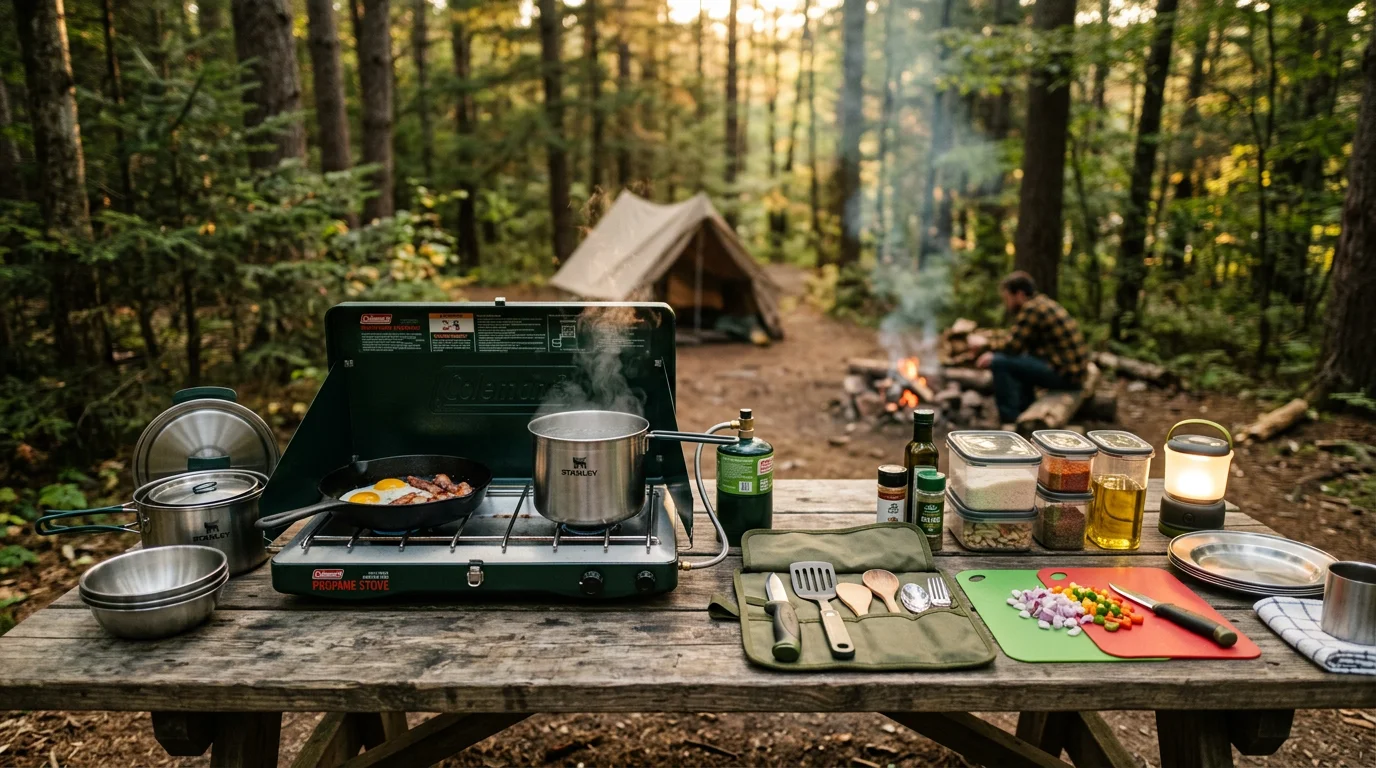
Forget everything you’ve seen in glamping influencer posts with $400 cast iron sets and $200 pour-over stations. Real camp cooking, the kind that produces hot food at the end of a long trail day or a morning coffee that tastes better than anything you’d get in a city café, does not require a premium budget. What it requires is the right gear chosen intelligently within a tight spending limit.
The camp kitchen gear market is flooded with overpriced “essentials” marketed to new campers who don’t yet know what they actually need. The honest truth is that a complete, fully functional camp kitchen can be assembled for under $100, and it will handle the cooking demands of 90% of camping scenarios most people will ever encounter. This guide tells you exactly what to buy, what to skip, and how to get the most cooking capability per dollar spent.
Why Budget Camp Kitchen Gear Can Outperform Expensive Alternatives
There is a ceiling on what better materials and engineering actually add to the camp cooking experience, and that ceiling is lower than premium pricing suggests. A $25 hard-anodized aluminum pot set transfers heat as effectively as a $120 titanium alternative for any cooking task achievable on a single-burner camp stove. A $15 folding utensil set performs every cooking function a $60 branded set performs. The premium pricing in camp kitchen gear reflects weight savings and brand prestige more than it reflects functional cooking improvements.
For car camping, weekend trips, and family camping where base weight is not a constraint, budget camp kitchen gear delivers full functional cooking capability. The trade-offs in budget options appear in longevity under heavy use and packed weight, both of which matter more to ultralight backpackers than to the car camping and casual camping audience this guide is designed for.
Choosing budget camp kitchen gear intelligently means prioritizing the categories where material quality genuinely matters (stove reliability, pot heat distribution, knife edge retention) and accepting budget-tier quality in categories where it does not (plates, utensils, storage containers).
The systematic gear selection approach that prevents overspending on features you don’t need is the same philosophy applied across all gear categories in the camper maintenance checklist guide, where each piece of equipment is evaluated functionally rather than aspirationally.
The Foundation: A Reliable Camp Stove Under $50
The stove is the one piece of camp kitchen gear where material quality and engineering have direct functional consequences, and where the temptation to go cheapest carries the highest risk of a cold meal at a campsite far from a backup option.
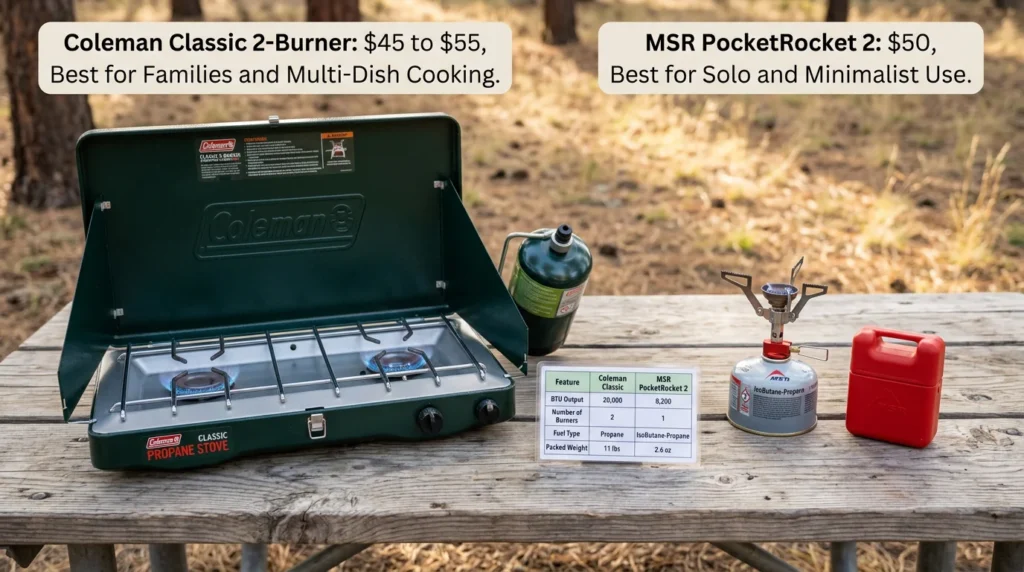
Coleman Classic Propane Stove (2-Burner), approximately $45 to $55, is the most widely used and most widely tested budget camp stove in the market. It runs on standard 1-pound propane cylinders widely available at hardware stores, gas stations, and outdoor retailers. The two-burner configuration allows simultaneous cooking, boiling water for coffee while cooking eggs, or maintaining a simmering sauce while heating a separate dish. The wind panels fold up for protection in light wind conditions. At 60,000 BTU total output, it produces enough heat for any car camping cooking task.
The Coleman Cascade Classic at approximately $40 is a slightly more recent design with the same two-burner layout and propane compatibility at a marginally lower price point. Both represent the same fundamental design: proven, simple, repairable, and widely supported with replacement parts that are available at most outdoor retailers.
For solo campers or minimalist setups where a two-burner stove exceeds the cooking need, the MSR PocketRocket 2 at approximately $50 is the lightweight single-burner backpacking stove that produces 8,800 BTU from a compact unit weighing 2.6 ounces. It connects to standard isobutane-propane fuel canisters and boils a liter of water in under four minutes. The MSR PocketRocket 2 exceeds the $50 threshold slightly at most retailers but comes in at or under $50 during sales and at warehouse retailers.
What to avoid in budget stoves: single-burner alcohol stoves under $15 from no-name brands that produce insufficient heat output for cold-weather cooking and have no flame adjustment mechanism. The $10 to $15 savings over a quality stove produces a cooking experience that limits what you can cook and when you can cook it.
Cookware: Getting Full Functionality for $30 to $65
A complete cookware set for two to four campers does not require spending more than $30 to $65 on camp kitchen gear that covers every cooking scenario a camp stove makes possible.
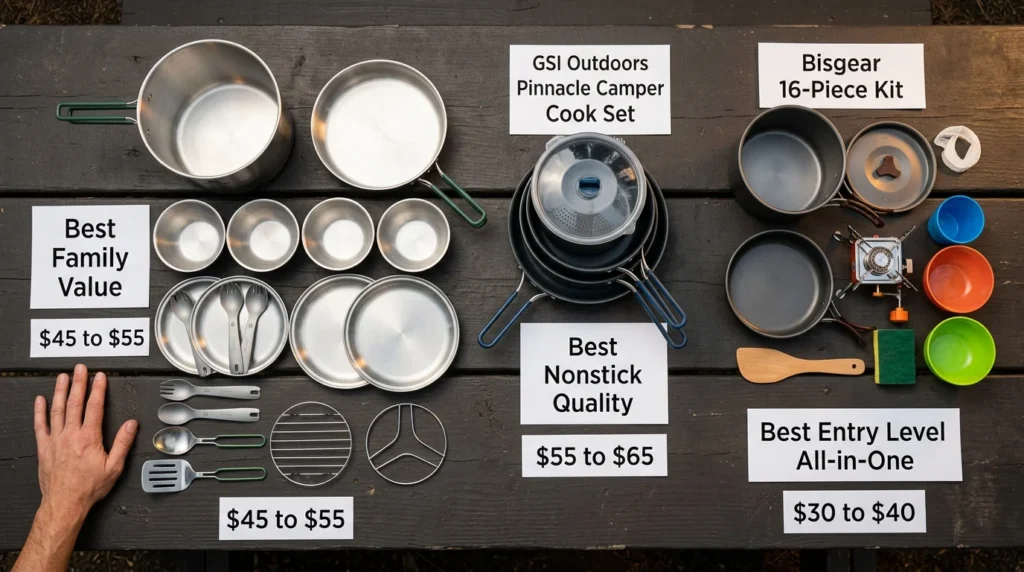
Stanley Base Camp Cook Set for 4, approximately $45 to $55, is the most consistently recommended family-camp cookware value in the market. The 21-nested-piece set includes four stainless steel plates, four bowls, four cups, a frying pan, a large pot with lid, and utensils, all nesting into the largest pot for a compact carry configuration. The stainless steel construction is rust-proof and scratch-resistant at a level that budget aluminum sets cannot match. It regularly goes on sale at $35 to $40 at REI and Amazon.
For solo or two-person camp cooking, the GSI Outdoors Pinnacle Camper Cook Set at approximately $55 to $65 offers a nonstick coating on the cookware interior that significantly improves cooking experience for eggs, fish, and anything that sticks to raw aluminum. At the two-person configuration it includes a 1.8L pot, 1L pot, frying pan lid, and two bowls, all in an incredibly compact nest.
The budget floor for functional camp kitchen gear cookware is the Bisgear 16-Piece Portable Cookware Kit at approximately $30 to $40, which includes a mini stove with piezo ignition, an anodized aluminum pot and frying pan, utensils, and a carry bag. For new campers who want to try cooking their own camp meals without significant investment before committing to better equipment, this all-in-one kit provides the complete setup at a price that represents minimal financial risk.
Material selection note: hard-anodized aluminum is the correct budget cookware material for camp kitchen gear. It heats evenly, is lightweight, resists corrosion, and takes a nonstick coating well. Avoid raw (non-anodized) aluminum pots, which react chemically with acidic foods and develop a metallic taste transfer that ruins tomato-based dishes and citrus recipes.
Cutlery and Utensils: The $15 Category That Completes the Kitchen
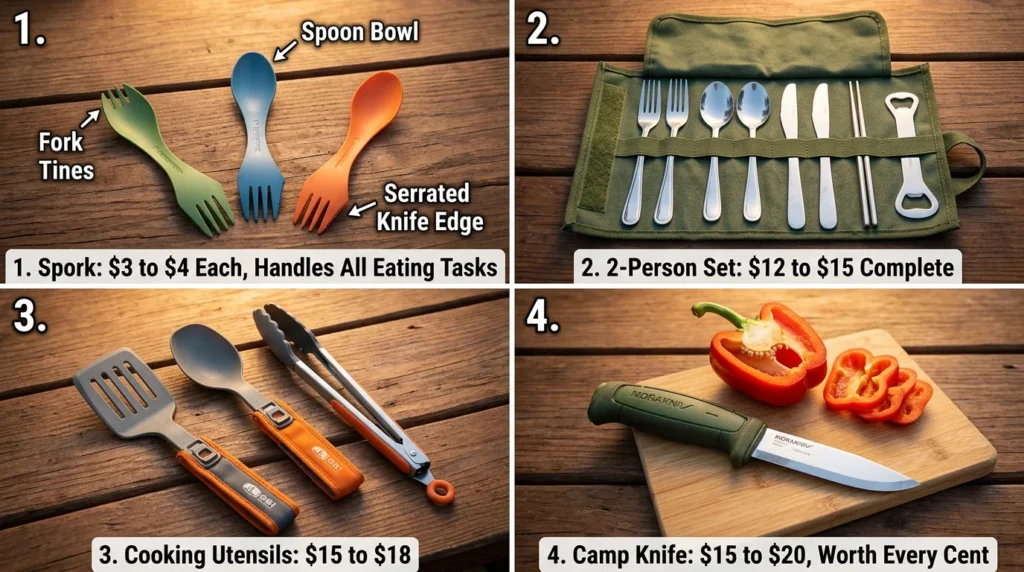
Camp kitchen gear cutlery and cooking utensils are the lowest-stakes purchasing category in the camp kitchen budget because the functional performance gap between budget and premium options is genuinely negligible.
Light My Fire Spork Original, approximately $3 to $4 per unit, is the most widely used individual eating utensil in the camping community for good reason. The combined spoon, fork, and knife-edge design handles all eating tasks without carrying three separate utensils. Buy two per person for $6 to $8 per person. They are dishwasher safe, virtually indestructible, and have a textured handle that prevents slipping in wet conditions.
For a complete two-person cutlery set, the Wealers Stainless Steel Camping Cutlery Set at approximately $12 to $15 provides two full sets of fork, spoon, knife, chopsticks, and bottle opener in a compact roll-up case. The stainless steel construction is rust-proof and significantly more durable than plastic alternatives.
Cooking utensils for a budget camp kitchen gear setup require three items: a folding spatula for frying, a long-handled spoon for stirring, and a set of tongs. The GSI Outdoors 3-Piece Folding Utensil Set at approximately $15 to $18 covers all three in a compact fold-flat configuration. Alternatively, a standard hardware store or dollar store kitchen spatula, spoon, and tongs set at $8 to $12 performs identically for camp cooking if you’re willing to sacrifice the fold-flat compactness.
The one cutting tool worth investing slightly more than the absolute minimum is a camp kitchen knife. A cheap knife with poor edge retention makes food prep frustrating and slow. The Morakniv Companion at approximately $15 to $20 is a fixed-blade knife with a Scandinavian-grind edge that holds sharpness through a full camping season without sharpening under normal use. It handles food prep, camp tasks, and kindling work in a single tool that represents outstanding functional value for its price.
The connection between a well-organized cutlery and utensil system and the broader camp organization approach applies across food storage and sanitation, which connects to the portable camping toilets guide where the same camp hygiene principles that govern food handling apply to waste management in an integrated campsite setup.
Food Storage and Containers: The $20 That Prevents Wasted Meals
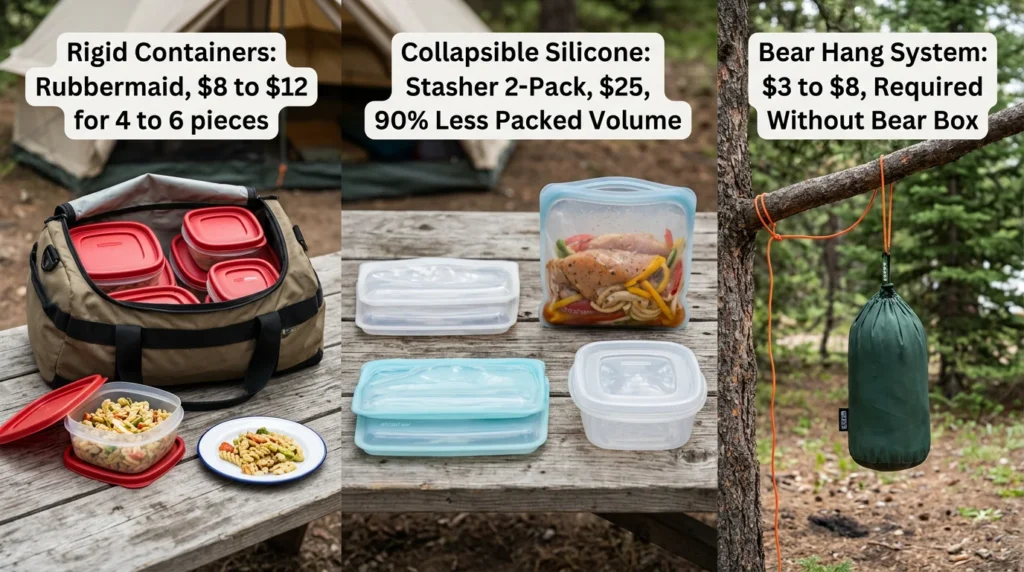
Food storage is the camp kitchen gear category most directly connected to food safety and to avoiding the scenario where tonight’s dinner becomes tomorrow’s bear visit or an overnight spoilage loss.
Nesting food storage containers for camp kitchen gear use should be airtight, odor-resistant, and durable enough to survive the compression of a loaded camp bag or vehicle cargo area without cracking. The Rubbermaid Easy Find Lids 42-Piece Container Set at approximately $25 to $30 provides more storage configurations than any camping trip requires in a set that nests compactly and is available at every major retailer. Select 4 to 6 containers from the set appropriate for your trip duration rather than carrying the full set.
Collapsible silicone containers represent the space-efficiency upgrade in camp kitchen gear food storage. The Stasher Reusable Silicone Storage Bags (2-pack) at approximately $25 to $30 collapse to near-flat when empty, are airtight, boilable (usable directly in hot water for cooking), and handle everything from dry food storage to marinated proteins. Carrying three to four Stasher bags replaces a collection of rigid containers at one-fifth the packed volume.
A hanging food bag system for car camping and campground use does not require investing in a designated bear canister at campgrounds with bear box infrastructure. A simple nylon stuff sack and 20 feet of paracord to hang food from a tree branch at any campsite without a bear box provides adequate food security at a material cost of $3 to $8. For areas requiring hard-sided bear canisters (most wilderness permit areas in California, Colorado, and similar heavily regulated regions), the BearVault BV500 at approximately $80 to $90 fits within the $100 total budget when combined with the lowest-cost options elsewhere in the kitchen kit.
The food storage and cooler management principles that connect camp kitchen gear to temperature-controlled food safety are covered in detail in the camper cooler fridge gasket care guide, where the complete thermal management and condensation control approach keeps food safe across multi-day trips.
The Camp Kitchen Prep Station: Organization for Under $20
Camp kitchen gear organization is the difference between a frustrating cooking experience where nothing is where you expect it and an efficient cooking flow where food prep to plate happens smoothly even in low light or limited space.
A folding camp kitchen organizer or roll-up utensil pouch solves the loose-utensils-at-the-bottom-of-the-bag problem that every new camper encounters on their first trip. The MIER Outdoor Camping Cookware Organizer Bag at approximately $18 to $22 provides a main compartment for cookware, side pockets for utensils and condiments, and a carry handle that converts to a hanging loop for campsite organization from a tree or cargo rack. At this price point it is genuine organizational infrastructure for a camp kitchen that costs a fraction of branded camp kitchen organizer systems.
A collapsible camp sink completes the functional camp kitchen gear setup by providing a designated washing station that keeps dishwater off the ground and away from cooking surfaces. The Sea to Summit Ultra-Sil Kitchen Sink at approximately $20 to $25 packs to palm-size and provides 10 liters of washing capacity for full post-meal dish washing. Camp kitchen hygiene that properly manages dishwater and food waste is the foundation of both food safety and minimum-impact camping practice.
A packable cutting board is the final prep station item. The Kikcoin Flexible Cutting Mats 4-Pack at approximately $10 to $12 provides color-coded flexible cutting surfaces that roll flat for packing, clean easily, and separate the cutting surfaces for proteins and vegetables that basic camp kitchen hygiene requires.
Lighting the Camp Kitchen: Because Night Cooking Is Real
Every experienced camper learns the same lesson on their first night arrival at a campsite: dinner does not happen before dark. A dedicated camp kitchen gear lighting solution positioned at the cooking area, distinct from your personal headlamp, transforms after-dark cooking from a frustrating squinting exercise into a normal and enjoyable task.
The Black Diamond Moji Lantern at approximately $20 to $25 is the most widely recommended camp lighting solution for kitchen areas. At 100 lumens maximum output with a dimmer switch, it provides broad ambient illumination from the tent’s ceiling or a hanging point above the camp kitchen area. Its magnetic base allows attachment to metal camp furniture, vehicle bodies, and the steel poles of camp kitchen organizer systems.
A headlamp reserved specifically for camp kitchen tasks (food prep, reading recipe cards, finding spices in a bag) allows hands-free cooking without imposing on other campers. The Petzl Tikkina at approximately $20 provides 150 lumen output with three modes and a runtime of 180 hours at the minimum setting on standard AAA batteries. This is sufficient for a full camping season of evening food prep without battery replacement.
The complete power and lighting management for a camp kitchen area, including rechargeable lanterns and solar-powered options, is part of the full camp power system covered in the camp lighting and power gear guide, where the kitchen lighting requirement is integrated into the total camp power budget across all lighting and electronics.
Complete Budget Camp Kitchen Gear Build Under $100
| Item | Recommended Product | Budget Price | Priority |
|---|---|---|---|
| 2-burner stove | Coleman Classic Propane | $45 to $55 | Essential |
| Cookware set | Stanley Base Camp 4-Person | $35 to $45 | Essential |
| Cutlery set | Wealers Stainless Set (2-person) | $12 to $15 | Essential |
| Cooking utensils | GSI Outdoors 3-Piece Folding | $15 to $18 | Essential |
| Camp knife | Morakniv Companion | $15 to $20 | Essential |
| Food storage | Rubbermaid 4-6 containers | $8 to $12 | Essential |
| Kitchen organizer bag | MIER Cookware Organizer | $18 to $22 | Recommended |
| Cutting mats | Kikcoin Flexible Mats 4-pack | $10 to $12 | Recommended |
| Lantern | Black Diamond Moji | $20 to $25 | Recommended |
| Complete Kit Total | $85 to $100 |
Budget tip: The Coleman stove is the highest single expense in this camp kitchen gear build. If you already own a functioning stove or have access to campfire cooking, reallocate those $45 to $55 toward a better cookware set (GSI Pinnacle Camper) and a Stasher bag set, producing a higher-quality cooking kit within the same total budget.

Frequently Asked Questions About Budget Camp Kitchen Gear
Q: What camp kitchen gear is absolutely essential for a first camping trip?
For a first camping trip, three items are non-negotiable in your camp kitchen gear: a reliable stove, a basic cookware set, and a means of eating (utensils and bowls). Everything else, organizer bags, dedicated cutting boards, collapsible sinks, adds organization and convenience but is not essential for basic cooking function. The Coleman Classic stove, a Bisgear or Stanley Base Camp cookware set, and a $12 to $15 cutlery set covers all three categories for under $70 and handles everything from boiling morning oatmeal to cooking a two-course dinner.
Q: Is cheap camp kitchen gear durable enough for regular camping?
Budget camp kitchen gear from established brands like Coleman, Stanley, and GSI is durable enough for 10 to 15 or more camping seasons of regular car camping use with basic care. The durability gap between budget and premium camp kitchen gear is most evident in cookware nonstick coating longevity (premium anodized aluminum coatings last longer than budget versions under abrasive cleaning) and stove component wear (premium stoves have more precisely machined valves and connectors that maintain consistent performance over hundreds of uses). For campers who go out 5 to 10 times per year, budget options represent excellent multi-year value.
Q: Can I cook real meals with a single-burner camp stove?
Yes, with the right cooking sequence. Single-burner stoves require sequential cooking rather than simultaneous multi-dish preparation. Experienced camp cooks produce complex, multi-component meals from a single burner by keeping cooked items warm in insulated containers, using pot lids efficiently, and sequencing dishes from longest to shortest cooking time. The practical limitation is hosting a dinner for more than two people where dish temperatures drop significantly during sequential preparation. For two-person cooking, a single-burner stove handles 95% of camp kitchen gear scenarios.
Q: What cookware material is best for camp kitchen gear on a budget?
Hard-anodized aluminum is the best budget camp kitchen gear cookware material for most camping use cases. It provides even heat distribution, is lightweight, resists corrosion, and accepts nonstick coatings well. Stainless steel (used in the Stanley Base Camp set) is heavier but more durable and easier to clean without damaging the cooking surface. Avoid raw (non-anodized) aluminum for cooking acidic foods. Avoid cast iron in a budget backpacking context due to weight, though a small cast iron skillet is a legitimate and affordable option for car camping where weight is not a constraint.
Q: How do I clean camp cookware without a sink?
The two-bucket method is the camp kitchen gear field cleaning standard: first bucket contains hot soapy water for washing, second bucket contains clean rinse water. Add a small amount of biodegradable camp soap (Sea to Summit Trek & Travel Pocket Soap, approximately $7) to the first bucket. Scrape all food residue into the trash before washing. Dispose of dishwater in a cat hole or designated gray water drain, never directly into a water source. A collapsible sink makes this process cleaner and more contained than using flexible cookware as wash basins.
Q: Do I need a camp kitchen table or can I cook on the ground?
A camp kitchen table or hard surface at standing height is strongly recommended but not essential for basic camp kitchen gear function. Cooking at ground level creates back strain during extended meal preparation, increases food contamination risk from ground contact, and makes stove leveling and stability more challenging. A folding camp table at approximately $25 to $40 (Coleman Folding Camp Table being the budget standard) is a worthwhile addition if your budget allows extending beyond the $100 kitchen kit. Many campgrounds provide picnic tables that eliminate this need entirely.
Q: What is the most common mistake new campers make with camp kitchen gear?
Overpacking. New campers consistently bring more cookware, more utensils, more condiments, and more cooking equipment than any camping trip requires. Two pots, one pan, one knife, one cutting surface, and the right utensils cover every camp cooking scenario that most campers will encounter. The instinct to replicate the home kitchen at a campsite produces a heavy, disorganized camp kitchen gear bag that takes longer to set up than the cooking itself. Start with minimal camp kitchen gear on your first several trips and add only the specific items you discover you actually need through field experience.