

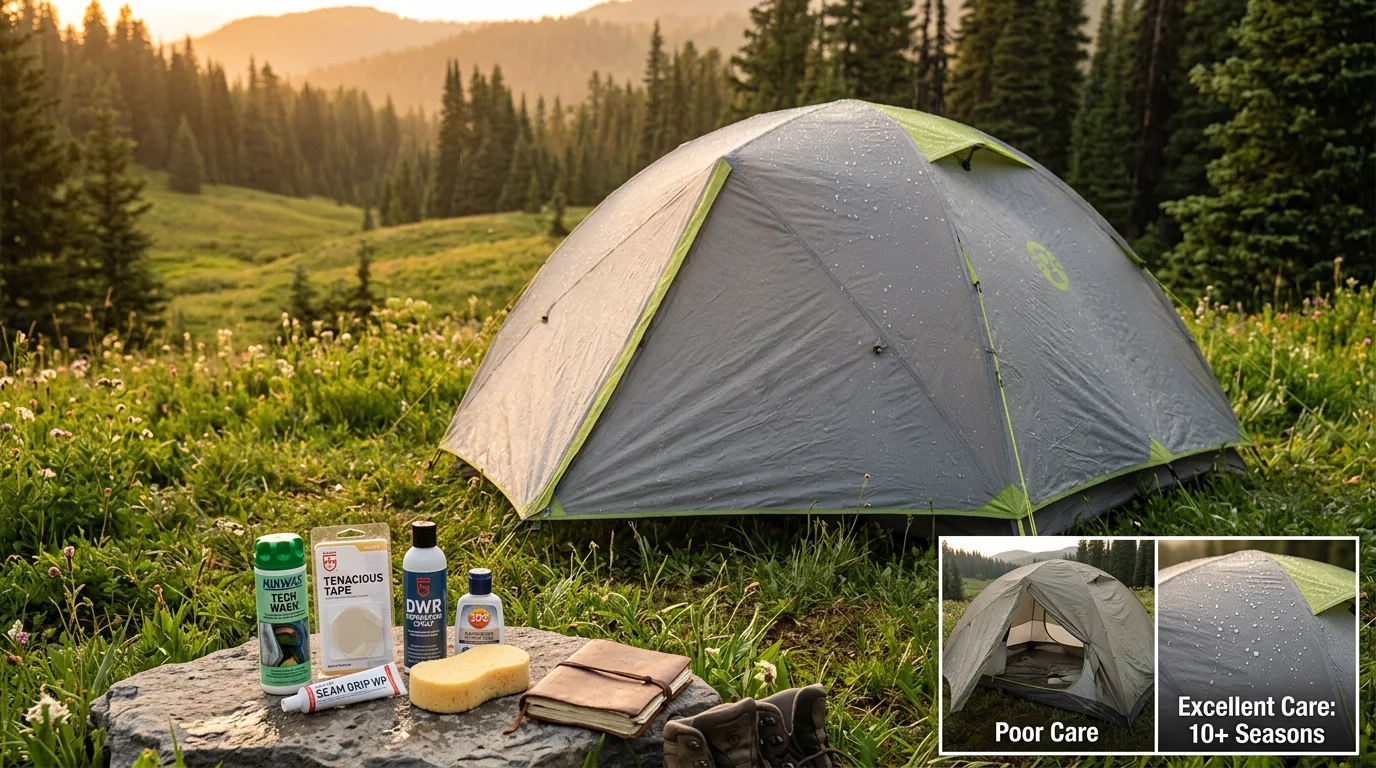
Three seasons into owning a $400 backpacking tent, a friend of mine noticed water pooling on her sleeping bag during a light overnight drizzle. The tent had been stored in a hot garage for two summers, packed wet twice after rainy weekend trips, and never treated with a waterproofing refresh. The delaminated floor coating and the failed DWR on the fly were not the tent’s failure. They were the entirely predictable result of three seasons of care decisions that slowly destroyed a product built to last a decade.
The lifespan of camping tents is not a fixed number printed on a specification sheet. It is a variable outcome determined almost entirely by how the owner treats the tent across its service life. A $150 entry-level tent stored correctly, cleaned after every trip, and UV-protected during storage will outlast a $500 premium tent stored in a hot attic, packed wet, and never re-waterproofed. The materials determine the ceiling. The care determines where in the range between that ceiling and catastrophic early failure your tent actually lands.
This guide covers everything that determines the camping tents lifespan : the fabric and coating degradation mechanisms you are either accelerating or slowing with every care decision, the correct cleaning protocols for each tent material type, the UV protection strategies that prevent the most common form of premature degradation, and the storage conditions that either preserve or destroy your tent between camping seasons.
The 4 Things That Determine How Long Your Tent Lasts
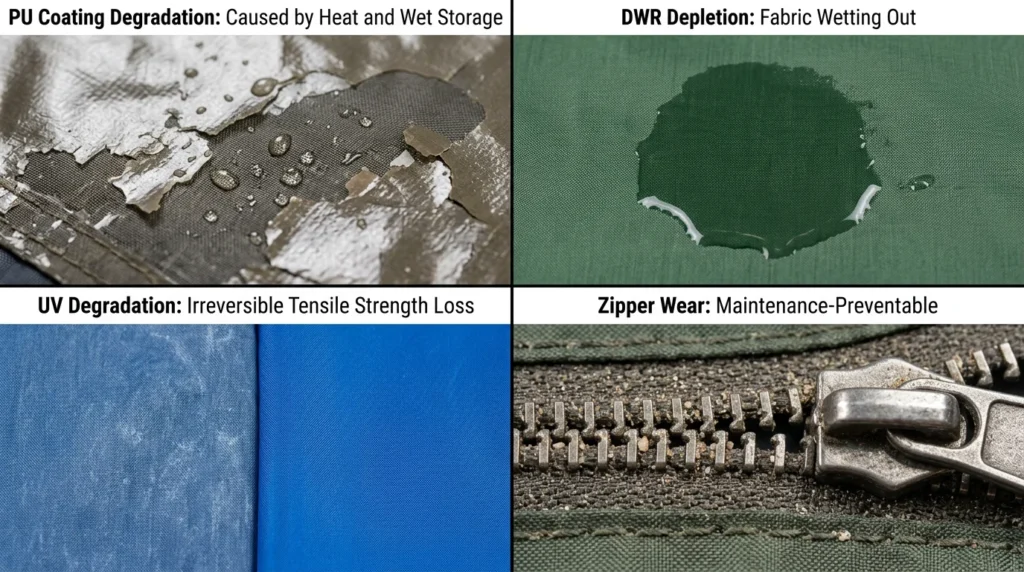
The lifespan of camping tents is governed by four independent degradation mechanisms, each of which progresses at a rate determined by care behavior rather than time alone. Understanding these mechanisms transforms tent care from a vague obligation into a rational maintenance strategy.
Hydrostatic head coating degradation is the mechanism that eventually causes every tent to leak, regardless of initial quality. The waterproof coating on tent floors (typically polyurethane, PU) and flies (either PU or silicone) degrades through UV exposure, abrasion from packing and unpacking, chemical exposure from cleaning agents, and hydrolysis from moisture exposure during storage. The factory hydrostatic head rating of your tent, whether 1500mm or 3000mm, decreases with each exposure event. A tent stored wet in a hot environment loses coating integrity at a rate that shortens its functional waterproof lifespan from a potential 10 years to 2 to 3 years.
DWR (Durable Water Repellent) depletion on the tent fly is a distinct failure from coating degradation, though they compound each other. DWR is a surface treatment that causes water to bead and roll off the fly fabric rather than saturating it. Saturated fly fabric reduces breathability, increases the tent’s total weight when wet, and places greater hydrostatic pressure on the underlying coating. DWR depletes with each use, heat exposure, and laundering cycle. A tent fly that no longer beads water needs DWR renewal, not replacement.
Fabric degradation from UV exposure is the most consistently underestimated factor affecting the lifespan of camping tents. Ultraviolet radiation breaks down the polymer chains in nylon and polyester tent fabric, reducing tensile strength and tear resistance progressively. A tent stored in direct sun or in a space with UV penetration (a vehicle, a garage with skylights, an outdoor storage shed) loses measurable tensile strength within a single season of UV exposure. The degradation is invisible until the fabric tears under loads it would previously have handled easily.
Zipper, pole, and hardware degradation is the mechanical dimension of tent lifespan. Zippers that are not cleaned and lubricated develop the grit-induced wear that produces missed teeth and slider failures. Pole sections with corroded ferrules and elastic that has lost tension produce loose, imprecise pole assemblies that create additional fabric stress at sleeve contact points. These are maintenance-addressable failure modes with long service lives under correct care.
Knowing these four mechanisms makes every care decision in this guide make sense as cause-and-effect rather than habit-for-its-own-sake.
How Long Does a Camping Tent Last ? By Budget and Type
Before discussing care protocols, establishing realistic lifespan of camping tents benchmarks by category gives context for the return on investment that proper maintenance delivers.
Budget tents ($50 to $150) use lower-denier fabrics, thinner pole sections, and entry-level coatings. Under adequate care (dry storage, post-trip cleaning, no UV exposure), realistic lifespan is 3 to 5 seasons of moderate use, meaning 15 to 30 camping trips. Under poor care, budget tents fail within 1 to 2 seasons regardless of limited initial use.
Mid-range tents ($150 to $350) use 20D to 40D ripstop nylon or polyester fabrics, DAC or equivalent aluminum pole systems, and 2000 to 3000mm waterproof ratings. Under correct care, realistic lifespan is 7 to 10 seasons of regular use. These tents represent the best value category for most campers because the initial investment is reasonable and the care-extended lifespan delivers a low cost-per-use across their service life.
Premium tents ($350 to $800 and above) use high-tenacity fabrics, precision-machined pole systems, and advanced coating technologies including silicone-polyurethane (SilPU) hybrids that outlast straight PU coatings significantly. Under excellent care, realistic lifespan is 10 to 15 seasons of regular use. MSR, Big Agnes, Hilleberg, and similar premium brands design for repairability and long service lives, with replacement fabric panels, pole sections, and zipper sliders available as aftermarket parts.
The lifespan of camping tents across all categories extends dramatically with correct care and contracts dramatically without it. The difference between best-case and worst-case lifespan for any category is not 20%. It is 200 to 400%, which represents thousands of dollars of premature replacement cost across a lifetime of camping.
How to Clean Your Tent After Every Trip ? And Why It Matters
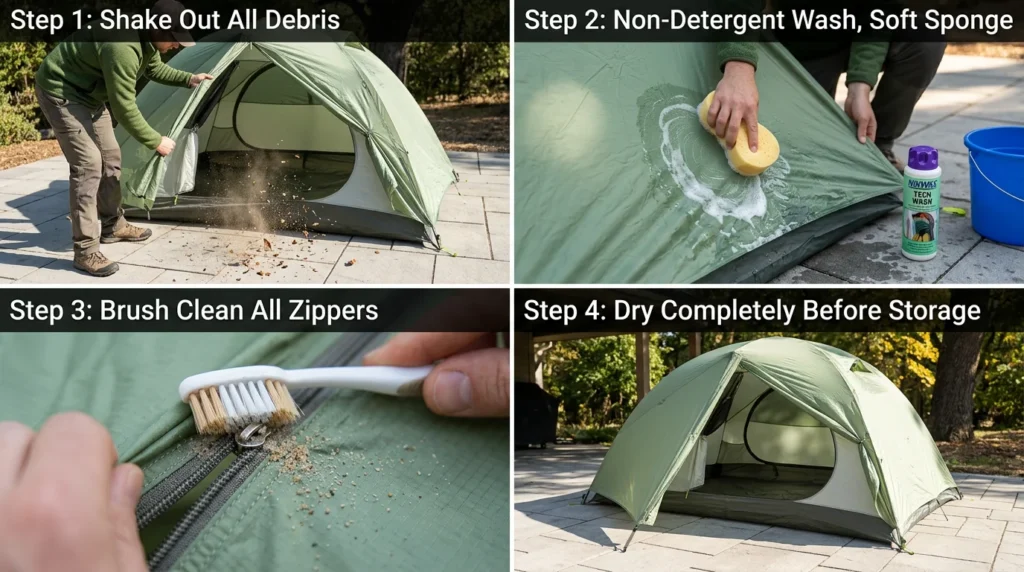
The most impactful single habit for extending the lifespan of camping tents is the post-trip cleaning protocol that most campers perform partially and many skip entirely.
Dirt, grit, and organic debris accumulating on tent fabric is not cosmetic. Fine mineral particles work into the fabric weave and act as abrasives during packing, storage compression, and subsequent deployment, accelerating the mechanical wear on both the fabric surface and the waterproof coating from below. Organic material including leaf debris, pollen, and bird droppings contains acids and enzymes that chemically attack both fabric coatings and zipper hardware. Pine sap and tree resin harden onto tent fabric and, if not removed promptly, require solvents that themselves stress the waterproof coating.
The correct post-trip cleaning sequence for all tent types:
Shake out the tent thoroughly after removing all gear and before any wet cleaning. The majority of loose debris is removed in this step and should not be scrubbed into the fabric with wet cleaning.
Wipe all tent surfaces with a soft sponge and cool water with a small amount of Nikwax Tech Wash or Gear Aid Revivex Wash-In treatment. Both are non-detergent cleaners specifically formulated for coated outdoor fabrics that clean effectively without stripping DWR or attacking PU coatings. Never use standard household laundry detergent, dish soap, or any cleaner containing bleach or optical brighteners on tent fabric.
Pay specific attention to the tent floor during post-trip cleaning. The floor accumulates the highest concentration of abrasive grit through contact with the ground surface and through shoes and boots tracking material into the interior. A floor cleaned after every trip maintains its coating integrity. A floor cleaned seasonally at best develops the ground-in grit accumulation that creates the coating micropunctures where hydrostatic failure begins.
Clean zippers separately with a soft toothbrush to remove the grit that accumulates in the coil interstices during outdoor use. Grit in tent zippers is the primary cause of the missed-teeth slider failures that produce the frustrating “zipper is broken” experience, when the zipper itself is fine and the problem is entirely maintenance-addressable.
Allow the tent to dry completely before packing. This single step is the most important in the entire post-trip routine for the lifespan of camping tents. A tent packed wet into its stuff sack in ambient temperatures above 60°F develops mildew growth within 48 to 72 hours that permanently degrades waterproof coatings and creates the musty odor that cannot be fully eliminated.
The cleaning protocols that apply to tent fabric connect directly to the complete gear cleaning and preparation framework covered in the camper maintenance checklist guide, where tent condition assessment is one of the pre-season items in the systematic gear review.
UV Damage : The Silent Killer of Camping Tents
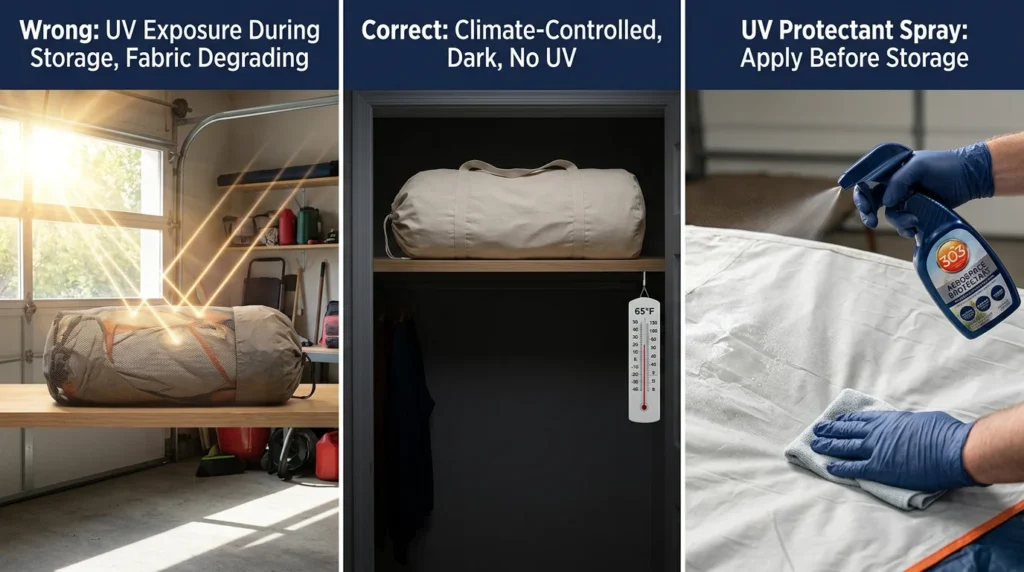
Ask most campers how they protect their tent from UV and you will typically get a blank expression, because UV protection for camping equipment is the least discussed and most impactful variable in the lifespan of camping tents.
The mechanism is straightforward. Ultraviolet radiation at wavelengths below 400nm breaks the molecular bonds in the polyamide (nylon) and polyester polymer chains that constitute tent fabric. Each exposure event produces a small amount of chain scission, reducing the molecular weight of the polymer and with it the fabric’s tensile strength and tear resistance. The degradation is cumulative and irreversible. There is no repair or treatment that restores UV-degraded fabric to its original tensile strength.
The primary UV exposure risk for camping tents is not field use. It is storage. A tent stored in a car, a garage with windows or skylights, an outdoor shed, or any space with UV-transmitting surfaces may receive more cumulative UV exposure during a 10-month storage period than during the actual camping trips it was used on. A tent stored in a sealed opaque bag in a cool, dark interior space receives essentially zero UV exposure during storage, extending its fabric life to the theoretical ceiling that the material quality allows.
For field UV exposure, the practical mitigation is pitching the tent in shade where available and using a footprint and rainfly to reduce the UV load on the floor and main body fabric. The rainfly takes the majority of UV exposure during field use, and flies are typically the first component to show UV degradation visible as chalking, fading, and reduced flexibility in the coated fabric.
For storage UV protection, use an opaque storage bag rather than the semi-transparent mesh bags that some tents are shipped in. Store in a cool, dark interior space. A climate-controlled closet or an indoor storage room is significantly better than a garage, basement with natural light, or outdoor shed for long-term tent storage.
UV protectant sprays including 303 Aerospace Protectant and Nikwax UV Proof applied to tent fabric surfaces before storage provide a surface barrier that absorbs UV energy before it reaches the fabric polymer. Apply to the fly exterior and tent body after cleaning and before storage for maximum effectiveness. The 303 Aerospace Protectant is particularly widely recommended because it also restores surface flexibility to coatings that have begun to stiffen from UV exposure during field use.
How to Re-Waterproof Your Tent When It Stops Beading Water
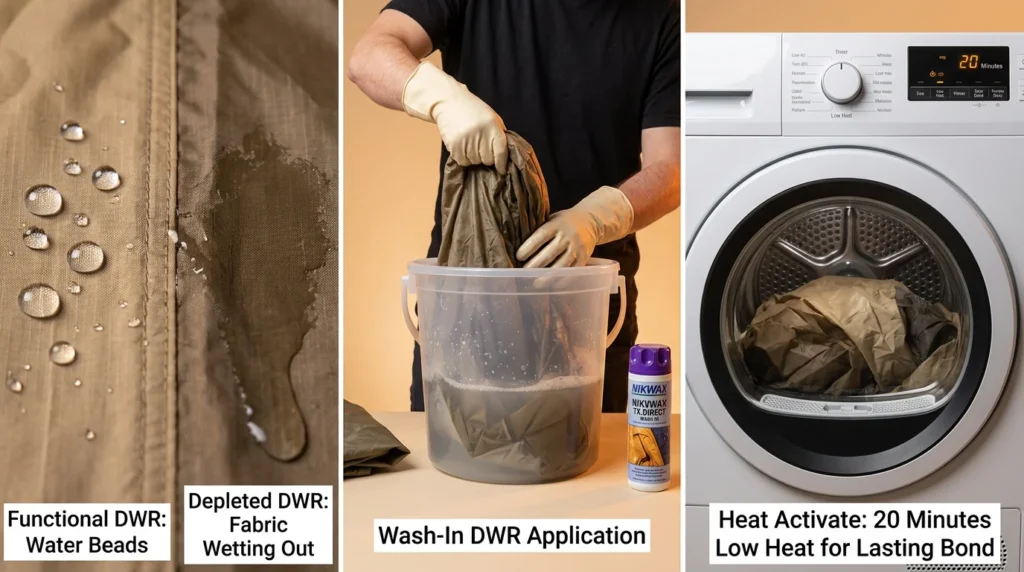
The DWR coating on a tent fly is the first waterproofing layer to require renewal in the lifespan of camping tents, and renewing it is a straightforward process that most campers do not realize they should be performing.
Test your fly’s DWR condition by sprinkling water on the surface. Water that beads into discrete droplets and rolls off indicates functional DWR. Water that spreads into a flat wet patch on the fabric surface indicates depleted DWR that is allowing the fly fabric to wet out. A wet-out fly does not immediately leak through the underlying coating, but it performs at reduced breathability, adds weight when wet, and places higher hydrostatic pressure on the PU coating that does represent your tent’s primary waterproof barrier.
Renewing DWR requires one of two approaches depending on the remaining condition of the fabric.
For fly fabric with depleted DWR but intact factory coating, a wash-in DWR treatment (Nikwax TX.Direct Wash-In, Gear Aid Revivex Wash-In Water Repellent) applied during the hand wash cleaning cycle renews DWR across the entire fabric surface evenly. The wash-in approach is the easiest and produces the most uniform coverage.
For fly fabric with depleted DWR and a coating that is showing early signs of delamination or failure, apply a spray-on DWR treatment (Nikwax TX.Direct Spray-On, Gear Aid Revivex Spray-On Water Repellent) targeted to the fly exterior and heat-activate by briefly tumbling in a dryer at low heat for 20 minutes or using a handheld heat gun at low temperature from 6 inches distance. Heat activation bonds the DWR molecules to the fabric surface chemistry and produces significantly longer-lasting repellency than room-temperature-dried spray-on treatments.
Renew DWR when the fly wets out, not on a fixed calendar schedule. In typical use patterns (10 to 15 camping trips per year), DWR renewal every 2 to 3 seasons is the right interval. Heavy-use campers may need annual DWR renewal.
Seam Sealing and Coating: How to Fix Leaks Before They Start
Beyond DWR maintenance, extending the lifespan of camping tents requires attention to seam integrity and, in older tents, floor coating renewal as the primary coating layer begins to thin.
Seam sealing is the process of applying a waterproof sealant to the interior face of tent seams to prevent water infiltration at the needle holes created during manufacturing. Factory seam sealing on quality tents is applied as a hot-melt tape rather than a liquid sealant, and this tape delaminates with UV exposure, chemical exposure, and repeated flexion at fold lines over time.
Inspect seam tape annually by running your fingers along interior seam tape and feeling for sections that lift or peel. Any lifted seam tape section is a potential infiltration pathway. Remove the lifted section completely (do not tape over tape), clean the seam with isopropyl alcohol, and apply Gear Aid Seam Grip WP in a thin bead along the seam, worked into the needle holes with a brush applicator. Allow 2 hours minimum cure time before exposing to moisture.
Floor coating renewal for tents with PU-coated floors that are beginning to show tackiness, peeling, or visible coating breakdown is possible with products like Gear Aid Seam Grip TF Clear Sealant or Kiwi Camp Dry applied to the interior floor surface. This is a multi-hour project that requires complete drying between coats, but it extends a tent’s waterproof floor life by 2 to 4 additional seasons at a material cost of under $30, making it highly cost-effective relative to tent replacement.
Pole maintenance is the hardware dimension of extending the lifespan of camping tents. Clean aluminum pole sections after any trip involving sand or grit exposure using a cloth dampened with fresh water. Apply a thin coat of Gear Aid Zipper Lubricant or a dry wax to pole ferrule connections every 5 to 10 trips to reduce the galling wear that makes ferrule connection and disconnection increasingly difficult over time.
The connection between seam and coating maintenance on tent fabric and the equivalent seam sealing principles on larger shelter systems is covered in detail in the annual RV roof maintenance guide, where the same phosphoric acid and sealant chemistry principles apply at a larger scale.
How to Store Your Tent to Make It Last Twice as Long
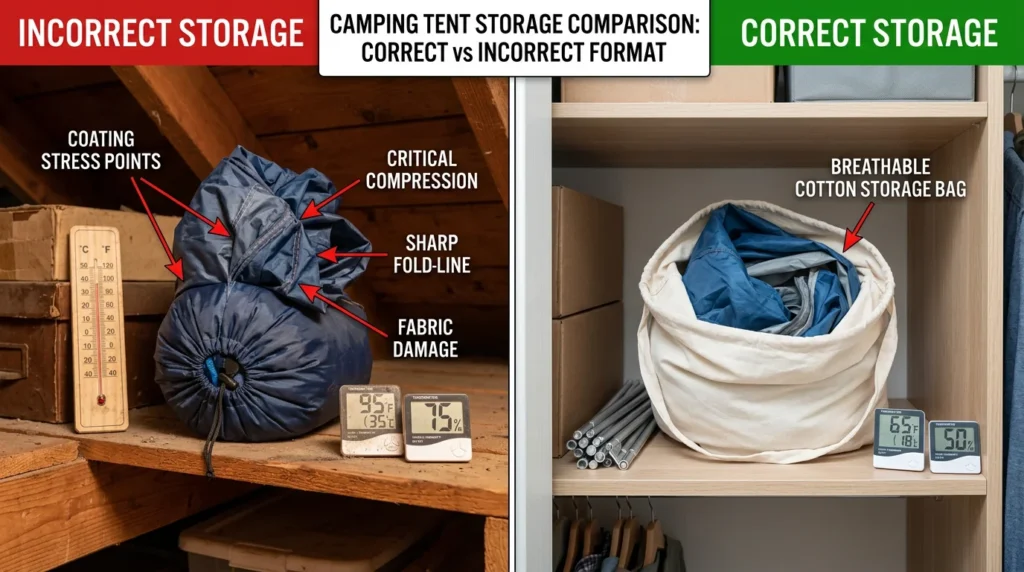
If one change in care behavior could be attributed to the greatest improvement in the lifespan of camping tents, it is moving from ambient uncontrolled storage to climate-controlled interior storage.
The two environmental factors that degrade stored tents fastest are heat and moisture. Heat above 80°F accelerates hydrolysis of PU coatings, softens and deforms plastic hardware, degrades elastic shock cord in pole assemblies, and reduces the adhesive bond strength of factory-applied seam tape. A tent stored in a hot attic or a black plastic bin in a sunny garage experiences equivalent degradation from heat exposure alone that would take 3 to 4 times longer in a climate-controlled space.
Moisture is the second variable. A tent stored at relative humidity above 70%, the typical humidity of an unventilated basement or storage shed in humid climates, provides the conditions for ongoing mildew growth on any organic residue remaining in the fabric weave from field use. This mildew produces the musty odor most campers attribute to age and accepts as inevitable, when it is entirely preventable with dry storage conditions.
The correct storage environment for maximizing the lifespan of camping tents is a climate-controlled interior space at 50 to 70°F with relative humidity below 60%. A bedroom closet, an interior storage room, or a climate-controlled portion of a basement all qualify. A garage, attic, outdoor shed, or vehicle do not, in most climate zones.
The correct storage format is equally important. Store tents loosely in a breathable storage sack rather than tightly compressed in the stuff sack used for field packing. Tight compression in the stuff sack for months at a time creates permanent fold-line stress in coated fabrics that accelerates coating delamination at those specific crease points. A large cotton or mesh breathable sack that allows the tent fabric to rest without compression significantly extends coating life compared to year-round stuff-sack storage.
For pole storage, allow the elastic shock cord to rest in a relaxed state by storing poles loosely in a cylinder bag rather than keeping them folded and compressed. Shock cord stored under continuous tension loses elastic recovery over time, producing the floppy, imprecise pole assembly that creates additional fabric stress at contact points and makes deployment imprecise.
The climate-controlled storage principles for outdoor gear connect to the seasonal preparation and storage protocols for all camp systems covered in the camper battery health maintenance guide, where temperature and humidity control during storage are the primary variables in preserving hardware function across the off-season.
Field Repairs : Fix Small Tent Damage Before It Becomes Irreparable
The lifespan of camping tents depends not just on preventive care but on catching and repairing small failures in the field before they propagate into unrepairable damage.
A 1-inch tear in tent body fabric left unrepaired for two more camping trips becomes a 6-inch tear when the stress concentration at the tear endpoint propagates through the adjacent fabric under wind loading. A 1-inch tear repaired immediately with Gear Aid Tenacious Tape takes 30 seconds and costs pennies. The same tear after propagation may require a full fabric panel replacement that approaches the cost of a new tent.
The minimum field repair kit for preserving the lifespan of camping tents should contain: Gear Aid Tenacious Tape (for fabric and floor repairs), a pole splint sleeve (for broken or cracked pole sections), Gear Aid Seam Grip WP in a small tube (for seam tape failures discovered in the field), and zipper lubricant (for sticking zippers that, if forced, will damage the coil or pull the slider off the track).
Inspect your tent’s fabric, seams, zipper, and poles briefly at the beginning of each trip during setup, not at the end when packing up under time pressure. A torn seam discovered during setup can be field-repaired before use. The same seam discovered while packing in the rain at departure gets deferred to “I’ll deal with it at home,” where it sits unrepaired until the next trip when the damage has extended further.
The field repair mindset that catches small problems before they become expensive ones applies across all camp gear categories. The approach connects to the complete gear inspection philosophy in the tent accessories guide, where the repair kit is covered as one of the 10 essential accessories for maximizing shelter utility and longevity.
Tent Lifespan Chart : Budget vs Mid-Range vs Premium by Care Level
| Care Level | Budget Tent ($50 to $150) | Mid-Range Tent ($150 to $350) | Premium Tent ($350 to $800) |
|---|---|---|---|
| Poor care (wet storage, no cleaning, garage UV exposure) | 1 to 2 seasons | 2 to 4 seasons | 3 to 5 seasons |
| Average care (occasional cleaning, ambient storage) | 2 to 4 seasons | 4 to 7 seasons | 6 to 10 seasons |
| Excellent care (full protocol, climate storage, DWR renewal) | 4 to 6 seasons | 7 to 12 seasons | 10 to 15 seasons |
| Cost per trip at excellent care (20 trips/year) | $1.25 to $3.75 | $0.63 to $2.50 | $1.17 to $4.00 |
Camping Tent Lifespan : Frequently Asked Questions
Q: How many years do camping tents typically last?
The lifespan of camping tents ranges from 2 seasons to 15 or more seasons depending on tent quality and care behaviors. A budget tent ($50 to $150) under excellent care lasts 4 to 6 seasons. A mid-range tent ($150 to $350) under excellent care lasts 7 to 12 seasons. A premium tent ($350 and above) from brands like MSR, Hilleberg, or Big Agnes under excellent care lasts 10 to 15 seasons with component replacements (zippers, pole sections) as needed. The single most impactful variable in all categories is whether the tent is stored dry in a climate-controlled space or stored wet or in temperature-extreme conditions.
Q: What ruins camping tents the fastest?
Packing and storing a tent while wet is the fastest path to premature failure. A tent packed wet in its stuff sack at temperatures above 60°F develops mildew growth within 72 hours that permanently degrades PU coatings. The second-fastest degradation cause is UV exposure during storage, particularly in vehicles, garages with natural light, and outdoor sheds. The third is using harsh cleaning agents like bleach, standard detergents, or dish soap that strip DWR and attack PU coatings while appearing to clean the fabric.
Q: How do I know when my camping tent needs re-waterproofing?
Two tests identify when re-waterproofing is needed in the lifespan of camping tents. The bead test: sprinkle water on the fly exterior. If water beads and rolls off, DWR is functional. If water spreads flat on the fabric surface, DWR is depleted and needs renewal. The leak test: pitch the tent and spray with a hose under moderate pressure for 5 minutes. Seam drips indicate failed seam tape. Fabric sweating (diffuse moisture through the fly fabric under sustained pressure) indicates coating degradation requiring reapplication.